



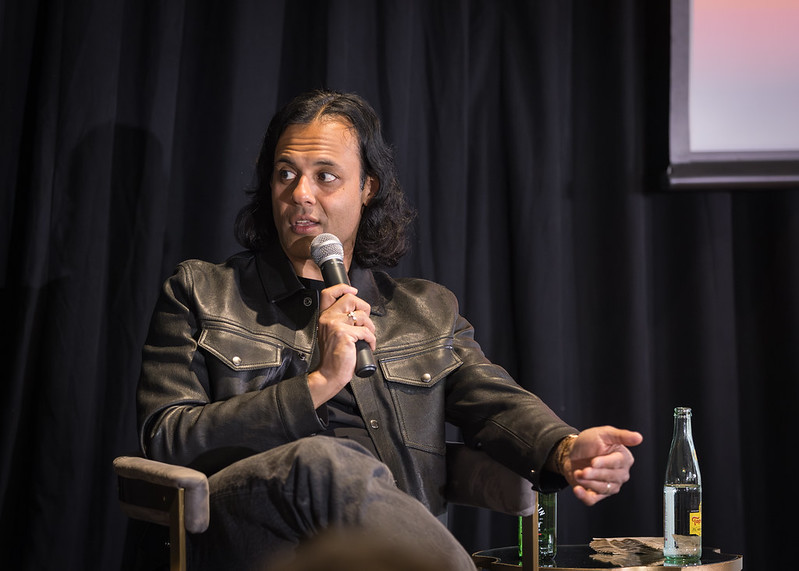
When Baiju Bhatt stepped away from his role as Chief Creative Officer at Robinhood last year, only those close to him could have predicted his next move: launching a space company built around tech that the aerospace industry has largely dismissed, and which might be more groundbreaking than anyone realizes.
If people aren’t paying much attention, that’s just fine with Bhatt, who co-founded the trading app in 2013, five years after earning his master’s degree in mathematics at Stanford. It means less competition for his new company, Aetherflux, which has so far raised $60 million on its quest to prove that beaming solar power from space isn’t science fiction but a new chapter for both renewable energy and national defense.
“Until you do stuff in space, if you happen to be an aerospace company, you’re actually an aspiring space company,” Bhatt said on Wednesday night at a TechCrunch StrictlyVC event held in a glass-lined structure on Sand Hill Road in Menlo Park. “I would like to transition from ‘aspiring space company’ to ‘space company’ sooner.”
Bhatt’s space ambitions date back to his childhood. He says that his dad, who worked as an optometrist in India, spent a decade applying to graduate physics programs in the United States, eventually taking a hard left turn and landing at NASA as a research scientist.
He then proceeded to use the powers of reverse psychology on his son, says Bhatt. “My dad worked at NASA through my whole childhood” and “he was very adamant: ‘When you grow up, I’m not going to tell you you should study physics.’ Which is a very effective way of convincing somebody to do exactly that.”

Now, at roughly the same age his father was when he joined NASA, Bhatt is making his own move into space, seemingly with an eye toward creating even more impact than at Robinhood.
He’s certainly taking a big swing with the effort.
Traditional space solar power concepts have focused on massive geostationary satellites, using microwave transmission to beam energy to Earth. The scale and complexity made these projects perpetually “20 years away,” Bhatt said Wednesday night. “Everything was too big . . .The size of the array, the size of the spacecraft was the size of a small city. That’s real science fiction stuff.”
His solution is both far smaller and more nimble, he suggested. Most notably, instead of massive microwave antennas that require precise phase coordination, Aetherflux’s satellites will use fiber lasers, essentially converting solar power back into focused light that can be precisely targeted at receivers on the ground.
“We take the solar power that we collect from the sun with solar panels, and we take that energy and put it into a set of diodes that turn it back into light,” Bhatt said. “That light goes into a fiber where there’s a laser, which then lets us point that down to the ground.”
The idea is to launch a demonstration satellite in June of next year.
National security, first
While Bhatt envisions eventually building “a true industrial-scale energy company,” he’s starting with national defense. In fact, the Department of Defense has approved funding for Aetherflux’s program, recognizing the military value of beaming power to forward bases without the logistical nightmare of transporting fuel. “It allows the U.S. to have energy out in the battlefield,” Bhatt explained.
The precision Bhatt is promising is remarkable. Aetherflux’s initial target is a laser spot “bigger than 10 meters diameter” on the ground, but Bhatt believes they can shrink it to “five to 10 meters, potentially even smaller than that.” These compact, lightweight receivers would be “of little to no strategic value if captured by an adversary” and “small enough and portable enough that you can literally bring them out into the battlefield.”
While much remains to be seen — pretty much the whole shebang, really — success for Aetherflux could potentially change the game for American military operations worldwide.

So why hasn’t someone already done what Aetherflux is attempting? As noted last year in Space News, a 2007 study found promise in the approach and recommended more research, but no one acted on the report (Bhatt said he wasn’t aware of it). Either way, to Bhatt, it’s the kind of overlooked opportunity that an outsider is well-positioned to seize. Indeed, in addition to his own father, Bhatt said that he draws inspiration from someone else who has proved that if you’re curious and willing to work hard, you can master multiple industries: Elon Musk. That outsider perspective “is actually an advantage,” Bhatt told the crowd.
Of course, unlike the iterate-fast mentality of companies like Robinhood that can roll out, and also sometimes roll back, software features, space hardware involves much higher stakes. You only get one shot when your satellite launches.
“We build one spacecraft, we bolt it to the fairing inside of the SpaceX rocket, we put it in space, and it detaches, and then the thing better work,” Bhatt said. “You can’t go up there and tighten the bolt.”
Asked during the sit-down how he pressure-tests that spacecraft, Bhatt said that Aetherflux is pursuing a “hardware-rich” approach, which means building and testing components while refining designs. “The right balance is not waiting five years, 10 years, 15 years, 20 years, as is the case with many important space programs,” he said. “People’s careers are oftentimes shorter than that.”
He also noted that if Aetherflux succeeds, the implications extend far beyond military applications. Space-based solar power could provide baseload renewable energy, or solar power that works day and night, anywhere on Earth. That might mean turning upside down the ways we currently think about energy distribution, offering power to remote locations without massive infrastructure investments and providing emergency power during disasters.
Aetherflux has already hired a mix of physicists, mathematicians, and engineers from Lawrence Livermore Labs, Rivian, Cruise, and SpaceX, among other places, and Bhatt said the 25-person organization is still hiring. “If you are the kind of person that wants to work on stuff that’s super, super difficult, please come and contact us,” he told attendees.
Bhatt has more than his reputation riding on what happens from here. He self-funded Aetherflux’s first $10 million, and he says he also contributed to a more recent $50 million round that was led by Index Ventures and Interlagos, and included Bill Gates’s Breakthrough Energy Ventures, Andreessen Horowitz, and NEA, among others.
Aetherflux’s timeline is aggressive, too. That plan to launch a demonstration satellite precisely one year from now means that it’s basically around the corner.
Still, there’s a prototype for Bhatt’s approach. GPS started as a DARPA project before becoming ubiquitous civilian infrastructure. Similarly, Aetherflux is working closely with DARPA’s beaming expert, Dr. Paul Jaffe, who Bhatt called “a pretty good friend to our company.” Jaffe also works with other companies developing similar technology, positioning DARPA as a bridge between military applications and commercial potential.
“There’s this precedent of doing stuff in space where there’s a really important part of working with the government,” Bhatt said. “But we actually think, over time, as the technology matures and things like [SpaceX’s reusable super heavy-lift launch vehicle] Starship really open up commercial access to space, this is not going to be just a Department of Defense thing.”
