



Donald Trump, as both a citizen and president, has railed against modern dishwashers, washing machines, light bulbs, showerheads and toilets, claiming that onerous government regulations render them less effective and more expensive.
Since returning to the White House in January, he’s turned his ire into an edict.
On April 9, Trump issued an executive order directing certain federal agencies “to incorporate a sunset provision” into a laundry list of energy production regulations, including those covering appliances. A month later, he issued a memorandum, entitled “Rescission of Useless Water Pressure Standards.”
Following that, on May 12, the Department of Energy announced that it was preparing to eliminate or modify 47 federal regulations “that are driving up costs and lowering quality of life for the American people.”
Many of the rules are covered in the Energy Policy and Conservation Act (EPCA), a decades-old law that mandates energy-efficiency and water-conservation standards for home appliances and plumbing fixtures.
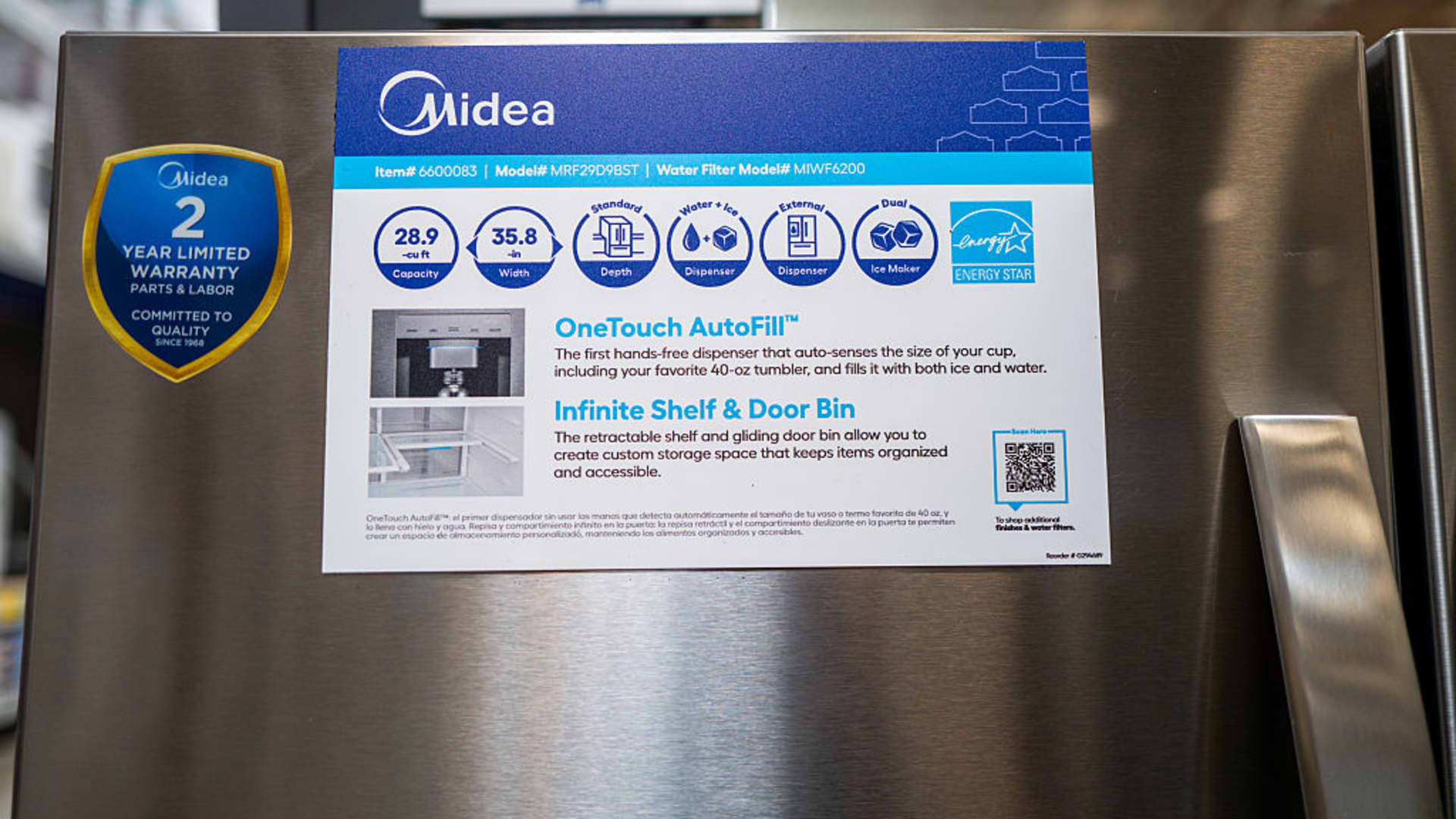
Meanwhile, the Environmental Protection Agency said it is planning to eliminate the Energy Star program, a popular voluntary initiative that manufacturers employ to rank their appliances based on energy conservation and cost savings, displayed on familiar blue labeling at retail as comparison-shopping guides.
Trump’s actions have been met with a mix of resistance from consumer protection groups and appliance manufacturers, as well as support from deregulation hawks and decriers of the nanny state. And while the administration continues to review the current standards and solicit comments before considering any official changes, legal challenges to the efforts are being weighed.
A new era of ‘buyer beware’ in electric bills
Originally passed in 1975, EPCA ensures that the entire array of products covered by the law all meet a basic level of energy- and water-efficiency performance, reflected in different price points. A prime example are the ubiquitous yellow Energy Guide stickers affixed to appliances that indicate their annual energy usage and cost.
“Consumers who are shopping primarily, if not exclusively, on price also get reasonable efficiency performance [information],” said Andrew deLaski, executive director of the Appliance Standards Awareness Project, a coalition of environmental and consumer groups, utilities and state governments, based at the American Council for an Energy-Efficient Economy, a nonprofit research organization.
Without that level of regulated consumer protection, deLaski said, “It’s buyer beware.”
Consumers would face the risk of less-efficient appliances entering an unregulated marketplace, he said, “and you’re not going to know it until you get the [higher] electric bill.”
Separate from EPCA, the Energy Star labeling program was established by the EPA in 1992 as a public-private partnership. Managed and jointly funded by the DOE, it sets energy-efficiency standards that manufacturers can choose to display on appliances, building products, electronics, lighting fixtures, HVAC equipment and other products as a way for consumers and businesses to make informed purchase decisions.
The EPA estimates that 90% of households recognize the Energy Star label and that over its 33 years, the program has saved five trillion kilowatt-hours of electricity, reduced greenhouse gas emissions by four billion metric tons and saved $500 billion in utility costs. The program’s 2024 operating budget was $35.7 million. To date, every dollar spent has resulted in nearly $350 in energy cost savings.
Americans support energy-efficient appliance efforts
Consumer Reports conducted a national survey in March which found that 87% of respondents support energy-efficient home appliance standards. Nearly a third said that saving money on energy bills would motivate them to buy a more efficient large home appliance.
Last month, in response to plans to shutter Energy Star, the organization issued a statement urging the EPA to preserve the program. “The loss would hit especially hard at a time when people are dealing with unpredictable energy bills and trying to cut expenses,” said Shanika Whitehurst, associate director for Consumer Reports’ product sustainability, research and testing team.
The nonprofit Alliance to Save Energy, a bipartisan coalition of consumer, environment, business and government groups, suggests that EPCA and Energy Star actually promote the White House’s goals of lowering families’ energy bills and making the nation energy dominant. “If you start to dismantle the energy-efficiency programs, American households are going to pay for that,” said Jason Reott, ASE’s senior manager of policy. “Energy dominance begins at home, by eliminating energy waste.”
The Association of Home Appliance Manufacturers, which represents more than 150 manufacturers, has historically supported efficiency regulations, but pushed back against the Biden administration’s updates of EPCA standards for gas stoves, refrigerators, dishwashers and other appliances. The law requires the DOE to review standards at least once every six years, a process that has often led to rule changes.
“We have always been able to produce products at higher efficiency levels,” said Jill Notini, vice president of communications and marketing for AHAM, “but there’s a tipping point where you have to stop and say, you have to have the technology that allows those standard levels.”
“We very much appreciate the intent behind [President Trump’s] goals of deregulatory actions,” Notini said. “Our industry needs it after looking at our products and how far they have come in terms of energy efficiency and water use,” alluding to the eight rounds of EPCA reviews, updates and revisions over the years.
Already at or near peak efficiency, industry says
Today’s appliances are at or near their peak efficiency, a result of federal standards and manufacturers’ investment in technology and innovation, Notini said. “So there needs to be a recognition that we can’t stay on this path and continue to ratchet up standards and expect high-performing products,” she added.
AHAM favors revising EPCA standards, she said, based on technological advances rather than the every-six-year requirement. What the association does not endorse, however, is Trump’s request for the DOE to waive federal preemption of states’ regulations regarding the water efficiency of showerheads, faucets and toilets.
“It’s concerning to us that we may not have federal preemption, which creates that certainty that the industry is looking for,” Notini said, noting that several states have established their own efficiency standards on some EPCA-covered products. Federal preemption “truly is what has made energy efficiency such a success.”
AHAM member LG Electronics USA has mixed views on efforts to roll back EPCA, according to senior vice president John I. Taylor. “Generally, deregulation is good for business, but there are some specific things in EPCA that are beneficial to American consumers and the American economy,” he said. “Our company has been a leader in driving energy efficiency, so regardless of how the regulations end up, we’ll continue to keep our foot on that accelerator.”
In March, nearly three dozen industry groups and appliance companies, including the Chamber of Commerce, Bosch, Carrier and the Air-Conditioning, Heating, & Refrigeration Institute (AHRI) sent a letter to EPA administrator Lee Zeldin, urging him not to end Energy Star. In April, the U.S. Green Building Council, along with more than 1,000 signatories — among them LG, Miele and Samsung Electronics America — wrote to Zeldin to express concerns about proposed cuts at the EPA, including Energy Star.
Energy Star very popular with consumers, according to retail sector
While major appliance retailers, such as Lowe’s, Home Depot and Best Buy, have not publicly commented on any of these pending regulatory changes, the National Retail Federation, one of several consumer products, manufacturing, real estate and retail organizations that sent a letter on June 6 to a bipartisan group of Congressional leaders, asking them to “strongly support continuation of the non-regulatory and non-partisan Energy Star program within the federal government.”
“Consumers have said overwhelmingly that they support voluntary environmental standard-setting programs like Energy Star,” said Scot Case, vice president of corporate social responsibility and sustainability and executive director for the NRF’s Center for Retail Sustainability. And that’s why retailers the trade group represents “want to make sure they’re able to share the benefits of those programs with the consumer,” he said.
Trump’s tribulations with energy-efficiency and water-conservation standards echo those of libertarians and free-marketers who maintain that regulations often represent government overreach and restrict personal choice. For instance, the libertarian Cato Institute has called Energy Star “a very coarse piece of energy information that may crowd out efforts” to develop more accurate ways to measure energy-operating costs.
“I’m a big proponent of energy efficiency, but I don’t think we need the federal government overriding the choices and preferences that consumers may have when purchasing an appliance,” said Nick Loris, vice president of public policy for C3 Solutions, a conservative energy think tank. He said rolling back EPCA standards is “a step forward in reducing government intervention into decisions that should be best left for producers and consumers.”
Where legal challenges are headed
As with a mounting number of actions taken by the Trump administration this year — from tariffs to immigration — tinkering with EPCA is expected to be challenged in federal courts. The law includes a so-called anti-backsliding provision, which prevents rolling back standards that have already been finalized. A 2004 case deLaski referred to, NRDC v. Abraham, upheld the provision. “Once a DOE standard has been updated and published in the Federal Register, you can’t go backward,” he said of the precedent.
The administration may seek legal authority to enact these deregulation orders by citing the “good cause” exception in the Administrative Procedures Act as a way to avoid the APA’s public notice-and-comment processes. Yet legal experts, environmental groups and state attorneys general have warned that skipping APA procedures — especially for weakening energy- and water-use standards covered by EPCA — would likely be deemed “arbitrary and capricious” and illegal.
Ultimately, considering the success and popularity of EPCA and Energy Star — with consumers, manufacturers and retailers — as well as the legal underpinnings, it’s entirely possible that both will remain intact, if perhaps with a few tweaks. “In one form or another,” Taylor said, “we expect both will.”
“We know consumers want the information, and the interesting thing about consumers is, they are also voters,” Case said.
