



Apolink, a Y Combinator-backed space-tech startup founded by a 19-year-old Indian-origin entrepreneur, has raised $4.3 million in an “oversubscribed” seed round at a $45 million post-money valuation to build a real-time connectivity network for satellites in low Earth orbit (LEO).
The startup is tackling a persistent problem in space communications. Satellites frequently go offline during parts of their orbit due to dead zones — periods when they are not in the line of sight of a ground station. While relay satellites and global ground station networks help reduce this downtime, they only provide partial solutions.
That gap has become critical as the space industry evolves. For years, NASA relied on its Tracking and Data Relay Satellite (TDRS) system to maintain near-continuous contact with satellites in geostationary orbit. But in 2022, the agency announced it would gradually phase out TDRS and transition to commercial providers for satellite communications. Most of these commercial systems still focus on geostationary or medium Earth orbits. Apolink, formerly known as Bifrost Orbital, aims to change that by providing 24/7 connectivity to LEO satellites — with each orbital ring designed to handle 256 users at 9.6kbps.
“LEO has its own advantages,” said Apolink founder Onkar Singh Batra in an exclusive interview. “It’s much closer than geostationary orbit, which means closing the link between the customer satellite and our constellation is way easier… that’s where you make the power requirements limited, and that’s where the compatibility comes in as well.”
Apolink’s approach stems from Batra’s early recognition of this connectivity challenge. At the age of 14 in 2020, he developed an interest in space. In 2022, when he was in 12th grade at a defense school in the northern Indian city of Jammu, he created a satellite system named InQube, which emerged as India’s first open source satellite. He also taught space ecosystems to engineering students as a guest professor at IIT Jammu between 2022-23.

While working on his first satellite system, Batra recognized the satellite connectivity problem and noticed that existing solutions did not provide backward compatibility, requiring specific hardware to enable network access in orbit.
According to Batra, the issue remains because all other inter-satellite links (ISLs) lack interoperability and are not compliant with the Space Development Agency’s requirements.
“We solve this [through] our hybrid-RF optical architecture and no user terminal, hardware-independent approach,” he stated.
Some startups have tried to address dark zones by building new ground stations. However, Batra noted that ground stations are “very cumbersome to work with and can’t guarantee a 24/7 link.”
“The maximum you can afford is a reliable continuous link to the ground during the window,” he said.
Founded in 2024, the Palo Alto-based startup plans to solve the problem with a constellation of 32 satellites that include lasers and radios to enable connectivity even for satellites that lack specific hardware.
Apolink, which literally means Apogee-plus-link, aims to offer almost 99% uptime and 10-15 seconds of latency. The latency will be further reduced to 2-3 seconds once the network is established.
Companies, including Amazon’s Kuiper and SpaceX’s Starlink, are also building inter-satellite links to address connectivity issues for satellite customers. However, Batra said that most players with multipurpose constellations do not dedicate them to virtual relays, resulting in limited bandwidth available for customers. They also require customers to have an optical terminal installed on their site for connectivity.
“Other ISL players focus on Ku/Ka-band and use optical terminals for EO image downlink, and we don’t,” he told TechCrunch.
The startup has its own FCC license, eliminating the need for customers to fulfill additional licensing requirements. Furthermore, it produces satellite components, including lasers and radios, in-house to ensure they are compatible with its algorithms.
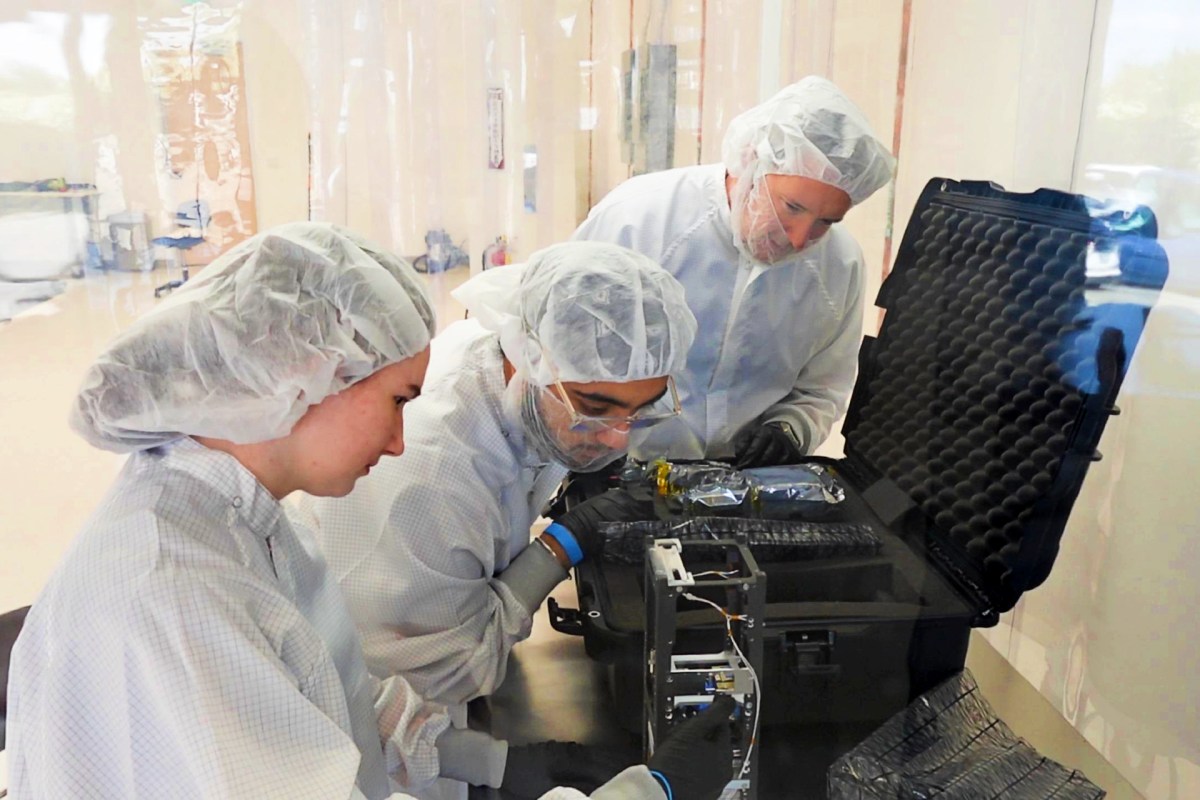
In Q2 2026, Apolink aims to launch its initial demo mission via a SpaceX rideshare. The mission will feature a 3U technology demonstration satellite, LinkONE/IPoS, designed to confirm the backward-compatible radio-frequency relay in low Earth orbit, Batra said.
A second demo is expected in June 2027, featuring two satellites. In 2028, the startup will roll out its commercial constellation, with the entire constellation of 32 satellites expected to be launched in 2029.
Despite being in the early stages, the startup has already secured more than $140 million in letters of intent from companies in the Earth observation, communication, and spatial data sectors, including Astro Digital, Hubble Network, and Star Catcher Industries.
Its new seed round was backed by Y Combinator, 468 Capital, Unshackled Ventures, Rebel Fund, Maiora Ventures, and several angel investors, including Laura Crabtree (CEO of Epsilon3), Benjamin Bryant (co-founder of Pebble Tech), and Kanav Kariya (president of Jump Crypto).
Apolink operates with a core team of four (each with more than five years of industry experience and from companies including Maxar, Audacy, and Astra), located within a 4,000-square-foot R&D facility. The company currently focuses on spacecraft integration and testing and is working with early partners to validate its system in orbit.
