



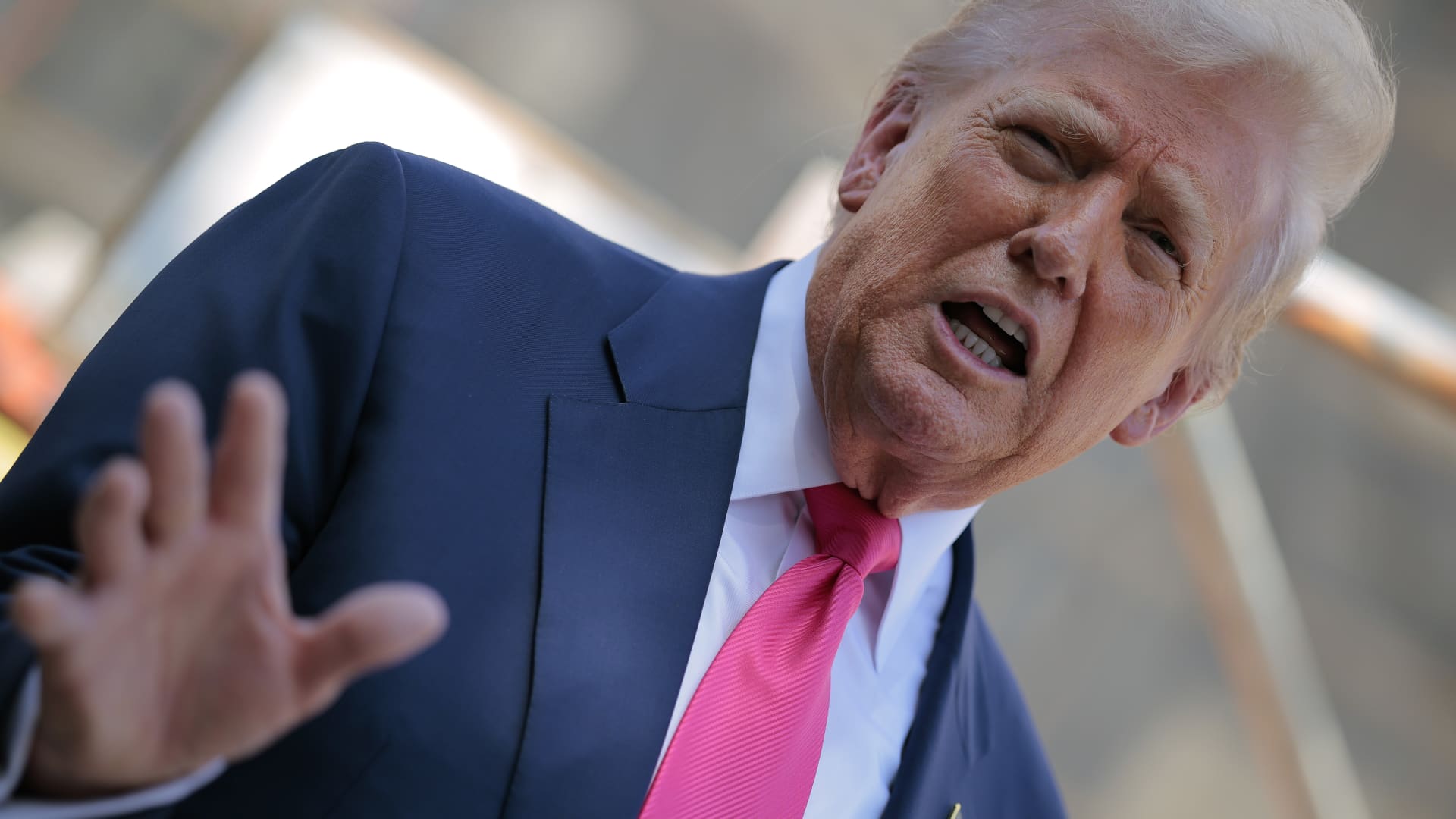

The Trump administration has taken direct stakes in companies on a scale rarely seen in the U.S. outside wartime or economic crisis, pushing a Republican Party that traditionally championed free-market capitalism to embrace state intervention in industries viewed as important for national security.
Japan’s Nippon Steel agreed to give President Donald Trump a “golden share” in U.S. Steel as a condition for the two companies’ controversial merger. Trump now personally wields sweeping veto power over major business decisions made by the nation’s third-largest steel producer.
“You know who has the golden share? I do,” Trump said at a summit on artificial intelligence and energy in Pittsburgh on July 15.
The president’s golden share in U.S. Steel is similar to nationalizing a company but without any of the benefits that a company normally receives, such as direct investment by the government, said Sarah Bauerle Danzman, an expert on foreign investment and national security at the Atlantic Council, a think tank focused on international affairs.
But the Trump administration demonstrated earlier this month that it is also willing to buy directly into publicly traded corporations. The Department of Defense agreed to purchase a $400 million equity stake in rare-earth miner MP Materials, making the Pentagon the company’s largest shareholder.
This level of support by the federal government for a mining company is unprecedented, said Gracelin Baskaran, an expert on critical minerals at the Center for Strategic and International Studies.
“This is the biggest public-private cooperation that the mining industry has ever had here in the United States,” Baskaran said. “Historically, DOD has never done equity in a mining company or a mining project.”
Trump’s unique hold over the Republican Party gives him the ability to intervene in companies on a scale that would be difficult politically for a Democratic president, Danzman said.
“The Democrat would have been accused of being a communist and a lot of other Republicans probably would not have felt comfortable moving in this particular direction because of their greater commitment to market principles,” Danzman said. Trump is expanding the range of what is possible in the U.S. in terms of state intervention in markets, she said.
The White House did not immediately respond to a request for comment.
More state investments likely
More interventions could be on the horizon as the Trump administration develops a policy to support U.S. companies in strategic industries against state-backed competition from China.
Interior Secretary Doug Burgum said in April that the U.S. government might need to make an “equity investment in each of these companies that’s taking on China in critical minerals.” The Pentagon’s investment in MP Materials is a model for future public-private partnerships, CEO James Litinsky said.

“It’s a new way forward to accelerate free markets, to get the supply chain on shore that we want,” Litinsky told CNBC. The U.S. government is helping the mining industry fight “Chinese mercantilism,” the CEO said.
Meanwhile, the golden share in U.S. Steel is a potential model for foreign direct investment “transactions that really affect our national security but where it’s going to be great for our economic growth,” Sen. Dave McCormick, R-Pa., said in a May interview with CNBC.
“Having taken a stake in US Steel and MP, we’re now left to wonder where this administration will find its next investment,” Don Bilson, an analyst at Gordon Haskett, wrote in a note to clients earlier this month.
Trump proposed in January that the U.S. should take a 50% stake in social media app TikTok as part of a joint venture. China’s ByteDance is required under a recently passed law to divest TikTok or the platform will be banned in the U.S. Trump extended ByteDance’s compliance deadline until Sept. 17.
Past precedent
The U.S. has a long history of intervening in industries, particularly where national defense is concerned, said Mark Wilson, a historian at the University of North Carolina, Charlotte, who studies the military-industrial complex.
But past interventions were often temporary and typically happened during war, economic crisis or took the form of bailouts to prevent a major player in a critical industry from going bankrupt.
The U.S. government bought a majority stake in General Motors to prevent the automaker from collapsing in the wake of the 2008 financial crisis, ultimately selling off its shares at a loss to the taxpayer. In the 1970s, defense giant Lockheed and automaker Chrysler received government bailouts.
During World War I, President Woodrow Wilson nationalized the railroads, but he returned them to private ownership after the conflict. The Roosevelt administration made sweeping interventions during the Great Depression and World War II, from establishing the Tennessee Valley Authority to making big investments in the nation’s manufacturing capacity.
China looms large
The U.S. is not fighting an economic crisis or war today, but the return of great power competition with Russia and China and the supply chain disruptions of the Covid-19 pandemic have led to more nationalistic economic policies, said UNC’s Wilson.
The U.S. has increasingly recognized that China’s economic model is based on manufacturing overcapacity that dumps products “onto global markets in ways that make it hard for other markets to compete,” Danzman said.
The threat posed by China’s dominance of the rare-earth supply chain became apparent in April when Beijing imposed export restrictions against the U.S., Baskaran said. Within weeks, automakers warned they would have to halt production due to a rare-earth shortage, forcing the U.S. back to the negotiating table with Beijing, she said.
“The historical moment we’re in does seem to be one where there is this reassessment of assumptions of the previous generation about the efficacy of markets and free trade to solve all our problems in national security,” Wilson said.
The question is whether state intervention can solve the failure of the free market to address national security concerns in industries like rare earths, Danzman said.
“When you step in to try to address one of these market failures with this kind of government intervention, you can have a cascade of new market failures,” she said. “You’re distorting the market more.”
