



HARRISBURG, Pa. (AP) — Amid rising electric bills, states are under pressure to insulate regular household and business ratepayers from the costs of feeding Big Tech’s energy-hungry data centers.
It’s not clear that any state has a solution and the actual effect of data centers on electricity bills is difficult to pin down. Some critics question whether states have the spine to take a hard line against tech behemoths like Microsoft, Google, Amazon and Meta.
But more than a dozen states have begun taking steps as data centers drive a rapid build-out of power plants and transmission lines.
That has meant pressuring the nation’s biggest power grid operator to clamp down on price increases, studying the effect of data centers on electricity bills or pushing data center owners to pay a larger share of local transmission costs.
Rising power bills are “something legislators have been hearing a lot about. It’s something we’ve been hearing a lot about. More people are speaking out at the public utility commission in the past year than I’ve ever seen before,” said Charlotte Shuff of the Oregon Citizens’ Utility Board, a consumer advocacy group. “There’s a massive outcry.”
Not the typical electric customer
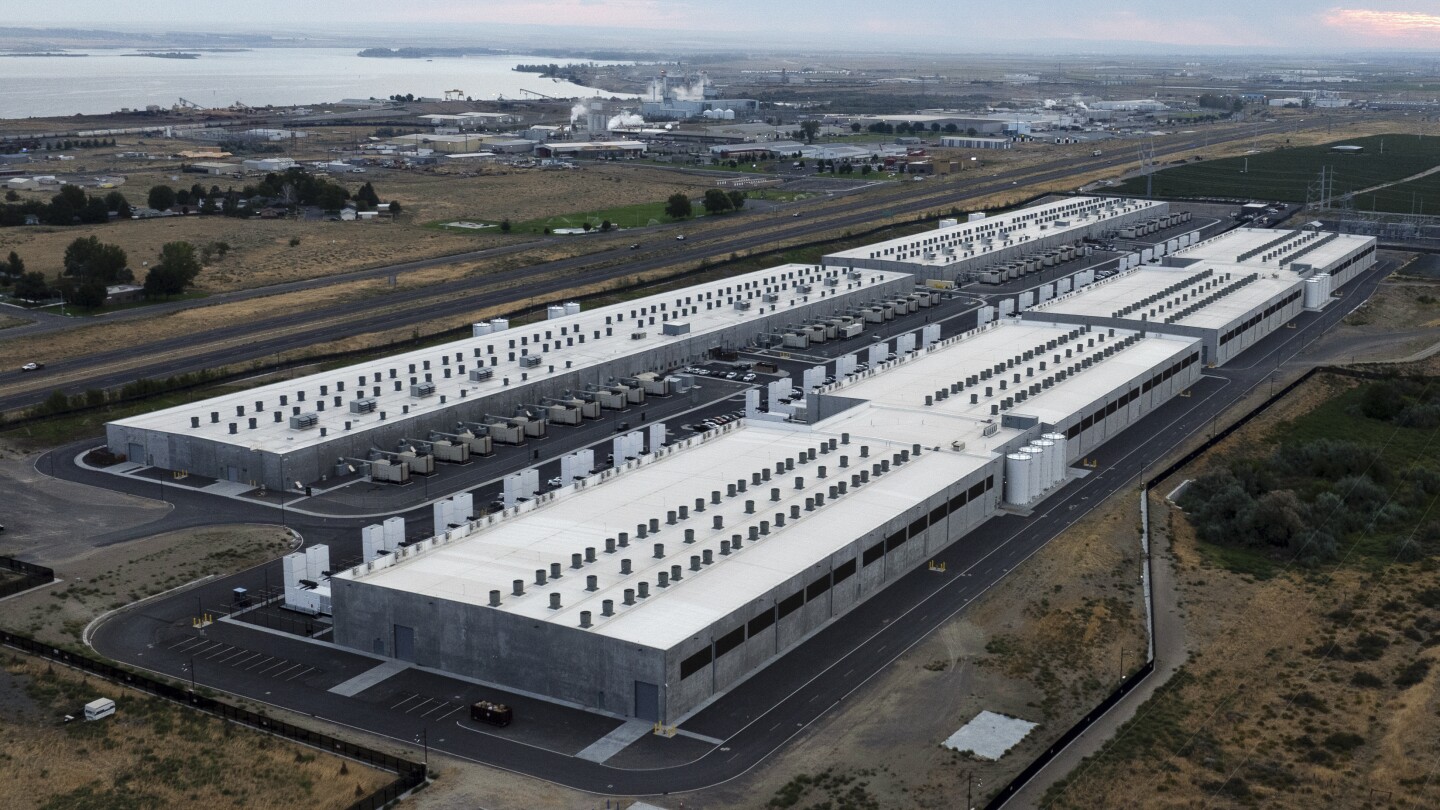
Some data centers could require more electricity than cities the size of Pittsburgh, Cleveland or New Orleans, and make huge factories look tiny by comparison. That’s pushing policymakers to rethink a system that, historically, has spread transmission costs among classes of consumers that are proportional to electricity use.
“A lot of this infrastructure, billions of dollars of it, is being built just for a few customers and a few facilities and these happen to be the wealthiest companies in the world,” said Ari Peskoe, who directs the Electricity Law Initiative at Harvard University. “I think some of the fundamental assumptions behind all this just kind of breaks down.”
A fix, Peskoe said, is a “can of worms” that pits ratepayer classes against one another.
Some officials downplay the role of data centers in pushing up electric bills.
Tricia Pridemore, who sits on Georgia’s Public Service Commission and is president of the National Association of Regulatory Utility Commissioners, pointed to an already tightened electricity supply and increasing costs for power lines, utility poles, transformers and generators as utilities replace aging equipment or harden it against extreme weather.
The data centers needed to accommodate the artificial intelligence boom are still in the regulatory planning stages, Pridemore said, and the Data Center Coalition, which represents Big Tech firms and data center developers, has said its members are committed to paying their fair share.
But growing evidence suggests that the electricity bills of some Americans are rising to subsidize the massive energy needs of Big Tech as the U.S. competes in a race against China for artificial intelligence superiority.
Data and analytics firm Wood Mackenzie published a report in recent weeks that suggested 20 proposed or effective specialized rates for data centers in 16 states it studied aren’t nearly enough to cover the cost of a new natural gas power plant.
In other words, unless utilities negotiate higher specialized rates, other ratepayer classes — residential, commercial and industrial — are likely paying for data center power needs.
Meanwhile, Monitoring Analytics, the independent market watchdog for the mid-Atlantic grid, produced research in June showing that 70% — or $9.3 billion — of last year’s increased electricity cost was the result of data center demand.
States are responding
Last year, five governors led by Pennsylvania’s Josh Shapiro began pushing back against power prices set by the mid-Atlantic grid operator, PJM Interconnection, after that amount spiked nearly sevenfold. They warned of customers “paying billions more than is necessary.”
PJM has yet to propose ways to guarantee that data centers pay their freight, but Monitoring Analytics is floating the idea that data centers should be required to procure their own power.
In a filing last month, it said that would avoid a “massive wealth transfer” from average people to tech companies.
At least a dozen states are eyeing ways to make data centers pay higher local transmission costs.
In Oregon, a data center hot spot, lawmakers passed legislation in June ordering state utility regulators to develop new — presumably higher — power rates for data centers.
The Oregon Citizens’ Utility Board says there is clear evidence that costs to serve data centers are being spread across all customers — at a time when some electric bills there are up 50% over the past four years and utilities are disconnecting more people than ever.
New Jersey’s governor signed legislation last month commissioning state utility regulators to study whether ratepayers are being hit with “unreasonable rate increases” to connect data centers and to develop a specialized rate to charge data centers.
In some other states, like Texas and Utah, governors and lawmakers are trying to avoid a supply-and-demand crisis that leaves ratepayers on the hook — or in the dark.
Doubts about states protecting ratepayers
In Indiana, state utility regulators approved a settlement between Indiana Michigan Power Co., Amazon, Google, Microsoft and consumer advocates that set parameters for data center payments for service.
Kerwin Olsen, of the Citizens Action Council of Indiana, a consumer advocacy group, signed the settlement and called it a “pretty good deal” that contained more consumer protections than what state lawmakers passed.
But, he said, state law doesn’t force large power users like data centers to publicly reveal their electric usage, so pinning down whether they’re paying their fair share of transmission costs “will be a challenge.”
In a March report, the Environmental and Energy Law Program at Harvard University questioned the motivation of utilities and regulators to shield ratepayers from footing the cost of electricity for data centers.
Both utilities and states have incentives to attract big customers like data centers, it said.
To do it, utilities — which must get their rates approved by regulators — can offer “special deals to favored customers” like a data center and effectively shift the costs of those discounts to regular ratepayers, the authors wrote. Many state laws can shield disclosure of those rates, they said.
In Pennsylvania, an emerging data center hot spot, the state utility commission is drafting a model rate structure for utilities to consider adopting. An overarching goal is to get data center developers to put their money where their mouth is.
“We’re talking about real transmission upgrades, potentially hundreds of millions of dollars,” commission chairman Stephen DeFrank said. “And that’s what you don’t want the ratepayer to get stuck paying for.”
___
Follow Marc Levy on X at https://x.com/timelywriter.
