



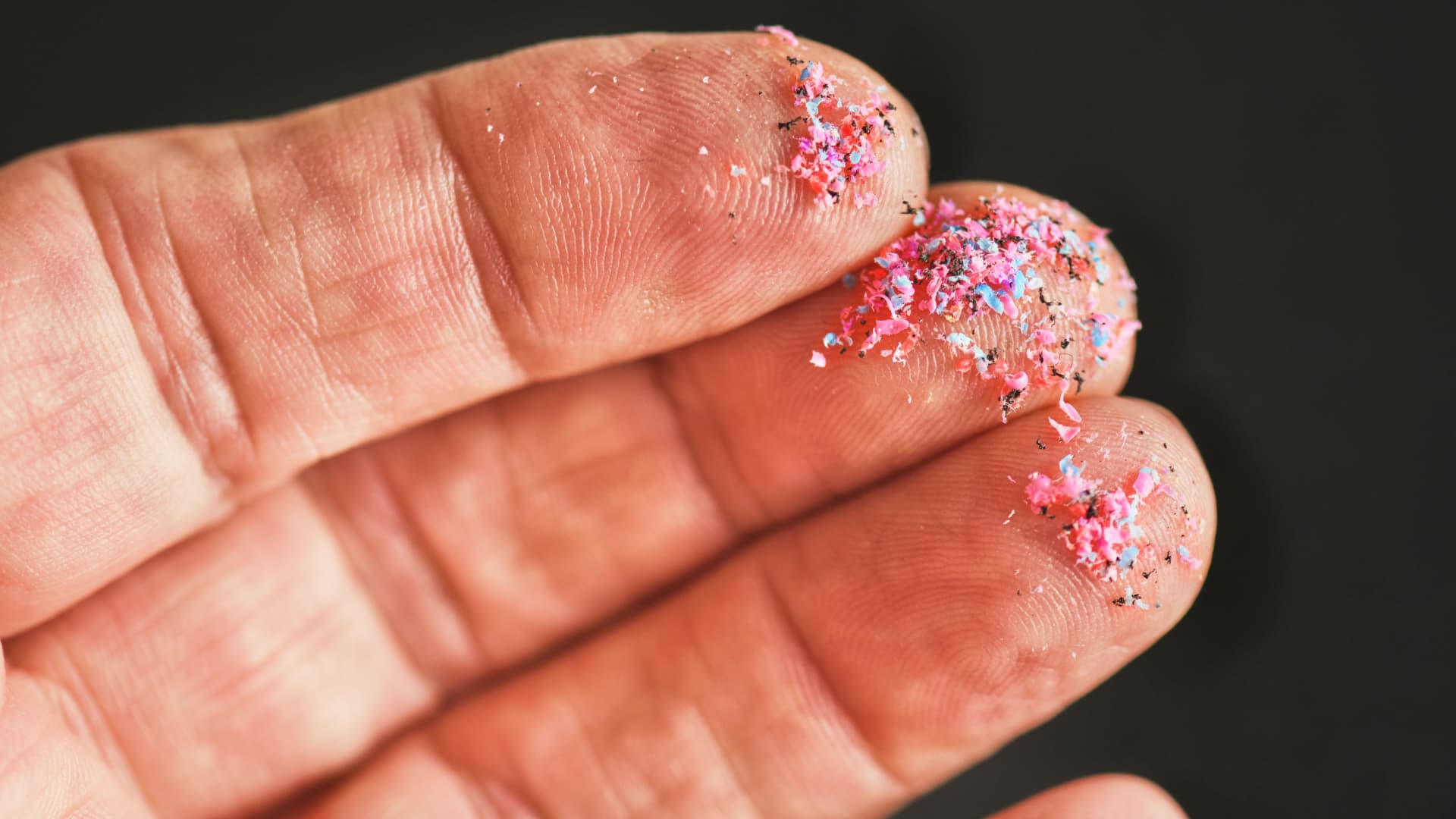
Microplastics are increasingly being found in our bodies and food supply.
They are defined as pieces of plastic smaller than 5 millimeters — about the size of a pencil eraser. But they can also be much smaller, like the size of a virus particle or a strand of DNA.
Petrochemicals, the building blocks of plastic, are produced from oil and gas. The business is a small but profitable area of the fossil fuel industry, and any push back on the use of plastics is seen as a threat to the oil and gas industry.
“Where the industry is most vulnerable is on the human exposure to microplastics,” said Richard Wiles, president of the Center for Climate Integrity. “They’re going to have to try to tell us that exposure to microplastics every day, from birth to death is just fine. It’s just great. You should just eat more of it. It’s no problem. And I just don’t think they can win that argument.”
Scientific research on microplastics has spiked over the past few years. The National Library of Medicine’s PubMed database reported that the level of published scientific research related to the search term “microplastics” has nearly doubled from 2021 to 2024.
One study, published in Nature Medicine in February, found that human brains from 2024 had an average of about 7 grams of plastic, which is about 50% more plastic than brains examined from 2016. Scientists involved in the study told CNBC that those samples came from the frontal cortex, which ongoing research suggests may contain the highest levels of microplastic.
“If people think there are watchdogs measuring and understanding these types of nanoplastics as they are coming in, our food, our water, our air, I have not seen any evidence of that happening on any meaningful scale,” said Andrew West, a researcher at Duke University and one of the co-authors of the study.
Microplastics also have been found by scientists in the muscle tissue of fish and even in the fibers of fruits and vegetables.
“Thanks to advances in monitoring technology, we can now detect incredibly tiny amounts of substances like microplastics,” said Kimberly Wise White, vice president of regulatory and scientific affairs at the American Chemistry Council, a trade association for the plastics industry. “But finding something at extremely low levels does not mean it’s harmful. Plastics deliver proven benefits in health care, food safety, transportation and technology — benefits we can’t afford to lose.”
Industry giants are investing heavily into chemical production as oil demand is declining from electrification, U.S. tariffs and slowing economic growth in China and India. The International Energy Agency said electric vehicle adoption, for example, has displaced more than 1 million barrels of oil consumption per day in 2024 and that is expected to increase to 5 million barrels by 2030.
In its 2024 outlook, BP said the declining use of oil in transportation was being offset by oil use for petrochemical production. While chemical uses include a variety of products like detergent and paints, polyethylene plastics are a major part of the chemicals business.
“Major oil and gas companies are playing a key role in the supply chain for plastics. And then there are a whole set of many other companies [on] the downstream side that are involved in creating the plastics,” said Yale University energy and environmental economics professor Kenneth Gillingham. “The surplus of natural gas is coming about because of fracking, and it’s led to low prices of natural gas.”
In the U.S., about 1.5% of natural gas is converted into chemicals that are used to make plastics and other consumer products, according to the University of Wisconsin-Madison.
Saudi Aramco, the biggest oil company in the world, has also increased its activity in the space. In 2020, it bought a 70% stake in petrochemicals company SABIC. While fourth-quarter 2024 results were lower than expected, SABIC made nearly $35 billion from petrochemicals last year.
“We’re unquestionably, as a society, better off having plastics than no plastics, but we’re facing the consequences of having those plastics,” Gillingham said.
Watch the video to learn more about how microplastics have become a major issue for big oil.
