



MULANJE, Malawi (AP) — Alex Maere survived the destruction of Cyclone Freddy when it tore through southern Malawi in 2023. His farm didn’t.
The 59-year-old saw decades of work disappear with the precious soil that the floods stripped from his small-scale farm in the foothills of Mount Mulanje.
He was used to producing a healthy 850 kilograms (1,870 pounds) of corn each season to support his three daughters and two sons. He salvaged just 8 kilograms (17 pounds) from the wreckage of Freddy.
“This is not a joke,” he said, remembering how his farm in the village of Sazola became a wasteland of sand and rocks.
Freddy jolted Maere into action. He decided he needed to change his age-old tactics if he was to survive.
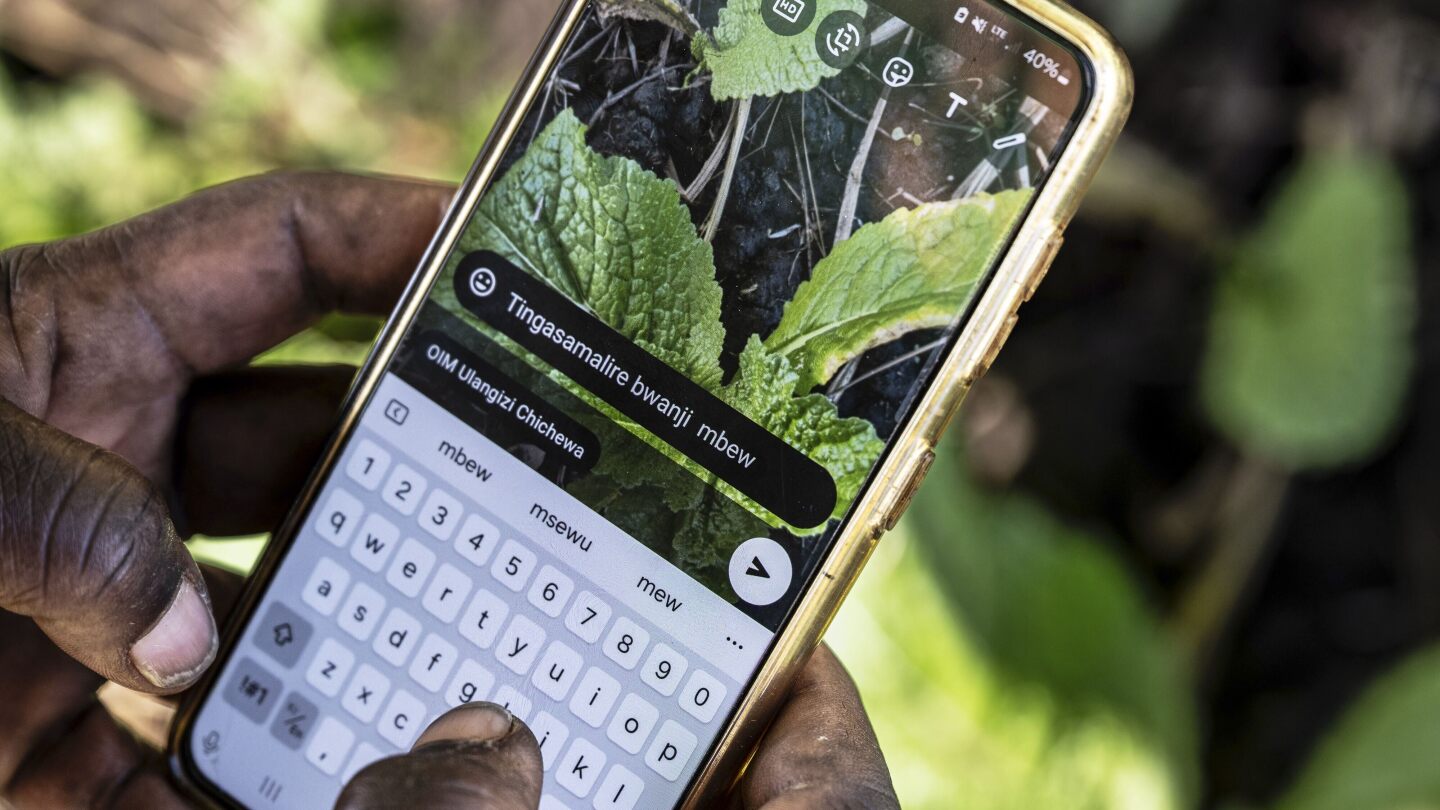
He is now one of thousands of small-scale farmers in the southern African country using a generative AI chatbot designed by the non-profit Opportunity International for farming advice.
AI suggests potatoes
The Malawi government is backing the project, having seen the agriculture-dependent nation hit recently by a series of cyclones and an El Niño-induced drought. Malawi’s food crisis, which is largely down to the struggles of small-scale farmers, is a central issue for its national elections next week.
More than 80% of Malawi’s population of 21 million rely on agriculture for their livelihoods and the country has one of the highest poverty rates in the world, according to the World Bank.
The AI chatbot suggested Maere grow potatoes last year alongside his staple corn and cassava to adjust to his changed soil. He followed the instructions to the letter, he said, and cultivated half a soccer field’s worth of potatoes and made more than $800 in sales, turning around his and his children’s fortunes.
“I managed to pay for their school fees without worries,” he beamed.
AI, agriculture and Africa
Artificial intelligence has the potential to uplift agriculture in sub-Saharan Africa, where an estimated 33-50 million smallholder farms like Maere’s produce up to 70-80% of the food supply, according to the U.N.’s International Fund for Agricultural Development. Yet productivity in Africa — with the world’s fast-growing population to feed — is lagging behind despite vast tracts of arable land.
As AI’s use surges across the globe, so it is helping African farmers access new information to identify crop diseases, forecast drought, design fertilizers to boost yields, and even locate an affordable tractor. Private investment in agriculture-related tech in sub-Saharan Africa went from $10 million in 2014 to $600 million in 2022, according to the World Bank.
But not without challenges.
Africa has hundreds of languages for AI tools to learn. Even then, few farmers have smartphones and many can’t read. Electricity and internet service are patchy at best in rural areas, and often non-existent.
“One of the biggest challenges to sustainable AI use in African agriculture is accessibility,” said Daniel Mvalo, a Malawian technology specialist. “Many tools fail to account for language diversity, low literacy and poor digital infrastructure.”
The man with the smartphone
The AI tool in Malawi tries to do that. The app is called Ulangizi, which means advisor in the country’s Chichewa language. It is WhatsApp-based and works in Chichewa and English. You can type or speak your question, and it replies with an audio or text response, said Richard Chongo, Opportunity International’s country director for Malawi.
“If you can’t read or write, you can take a picture of your crop disease and ask, ‘What is this?’ And the app will respond,” he said.
But to work in Malawi, AI still needs a human touch. For Maere’s area, that is the job of 33-year-old Patrick Napanja, a farmer support agent who brings a smartphone with the app for those who have no devices. Chongo calls him the “human in the loop.”
“I used to struggle to provide answers to some farming challenges, now I use the app,” said Napanja.
Farmer support agents like Napanja generally have around 150-200 farmers to help and try to visit them in village groups once a week. But sometimes, most of an hour-long meeting is taken up waiting for responses to load because of the area’s poor connectivity, he said. Other times, they have to trudge up nearby hills to get a signal.
They are the simple but stubborn obstacles millions face taking advantage of technology that others have at their fingertips.
Trust is critical, scaling up is difficult
For African farmers living on the edge of poverty, the impact of bad advice or AI “hallucinations” can be far more devastating than for those using it to organize their emails or put together a work presentation.
Mvalo, the tech specialist, warned that inaccurate AI advice like a chatbot misidentifying crop diseases could lead to action that ruins the crop as well as a struggling farmer’s livelihood.
“Trust in AI is fragile,” he said. “If it fails even once, many farmers may never try it again.”
The Malawian government has invested in Ulangizi and it is programmed to align with the agriculture ministry’s own official farming advice, making it more relevant for Malawians, said Webster Jassi, the agriculture extension methodologies officer at the ministry.
But he said Malawi faces challenges in getting the tool to enough communities to make an extensive difference. Those communities don’t just need smartphones, but also to be able to afford internet access.
For Malawi, the potential may be in combining AI with traditional collaboration among communities.
“Farmers who have access to the app are helping fellow farmers,” Jassi said, and that is improving productivity.
___
For more on Africa and development: https://apnews.com/hub/africa-pulse
The Associated Press receives financial support for global health and development coverage in Africa from the Gates Foundation. The AP is solely responsible for all content. Find AP’s standards for working with philanthropies, a list of supporters and funded coverage areas at AP.org.
