



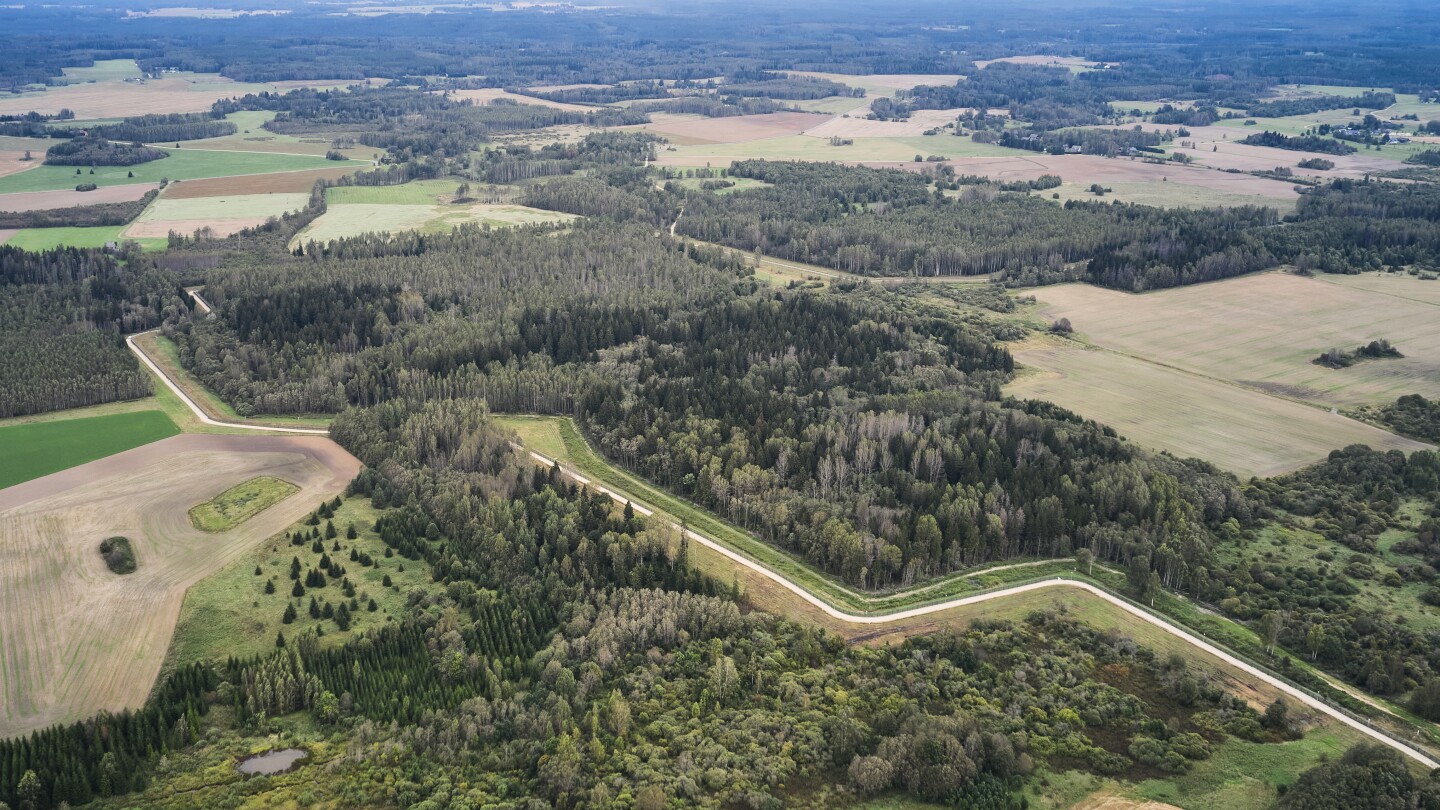
VINSKI, Estonia (AP) — Estonia is extending a fence along its border with Russia and building anti-tank ditches and bunkers in preparation for a potential conflict with Moscow. But those defenses won’t guard against the threat it and its NATO allies face from Russian drones and electronic warfare.
From the Baltic to the Black Sea, countries bordering Russia, Belarus and Ukraine are facing the spillover from Moscow’s war in Ukraine.
The incursion of about 20 Russian drones into Poland this month shone a spotlight on holes in NATO’s air defenses, as multimillion-dollar jets had to be scrambled to respond to drones that cost thousands and that ended up crashing into the Polish countryside. Russia denied that it targeted Poland, but Polish officials suggested it was intentional.
Faced with a growing problem, some EU defense ministers will meet Friday to discuss creating a “drone wall.”
NATO warned Russia on Tuesday that it would defend against any further breaches of its airspace after Estonia said Russian fighter jets violated it last week. But although the alliance knows how to identify threats from jets and missiles, dealing with drones is a greater challenge, officials said.
In Poland, “most of the drones were not detected,” said Hanno Pevkur, Estonia’s defense minister. “This is a real gap we have to solve.”
Military and defense officials from the Baltic countries of Estonia, Latvia and Lithuania — NATO and EU members that border Russia — told The Associated Press that defending against drones requires solving a complex set of technological, financial and bureaucratic problems.
Europe needs cheaper technology to buy and to speed up slow production and procurement cycles, they said. But even then, drone technology is advancing so quickly that anything bought now could be outdated in months.
“What I need,” said Lt. General Andrus Merilo who commands Estonia’s military, is technology that is “good enough, it’s affordable and can be produced in mass.”
“I don’t need high-end capabilities of which I can fire only one, against targets which will be attacking in hundreds,” he said.
Europe’s drone challenge
Russia is using drones every night in Ukraine because each drone is a “lottery ticket that always wins,” said Kusti Salm a former top official at Estonia’s Defense Ministry.
That’s because a drone either hits something or, if Ukraine shoots it down with a missile, it drains Kyiv’s air defenses and finances, since missiles are more expensive than drones, said Salm who now runs Frankenburg Technologies, a company developing low-cost anti-drone missiles.
Although NATO countries have a “very good understanding” of how to defend against conventional threats such as missiles and planes, they need to rapidly improve at dealing drone threats, said Tomas Godliauskas, Lithuania’s vice-minister of national defense.
When the Russian drones flew into Poland, NATO nations deployed fighter jets and attack helicopters and put missile defense systems on alert. But none of those options was specifically designed for drone warfare.
Although Russia and Ukraine have been firing more and more drones at each other, there has been less investment in counter-drone systems, said Salm. He suggested that’s partly because it’s easier to get a drone to fly than it is to develop something to detect or intercept it.
Slow, low-flying drones made from wood, fiberglass, plastic or polystyrene might not be detected by radar systems searching for a fast-moving missile made of metal, or they might look like birds or a plane. Enemy operatives can also bypass defenses by launching drones from inside a country, as Ukraine did to devastating effect when it attacked Russian airfields this year.
There are also other technological hurdles, including trying to jam the enemy’s drones and communications without cutting your own, Merilo said.
Multiple drone incidents
In August, a Ukrainian drone — possibly sent off course by Russian electronic jamming — landed in a field in southeastern Estonia. It crashed because the military wasn’t capable of detecting it, Merilo said.
The Estonian military and border force have also lost drones — used for surveillance and to stop illegal border crossings — to Russian jamming, which has also been blamed for disrupting flights.
Other drones have crashed in Romania, Moldova, Lithuania and Latvia, and there have been multiple unidentified drone sightings over military facilities and airports in Europe, including in Germany, the U.K., Norway and Denmark, where air traffic was halted for several hours Monday at Copenhagen Airport.
The number of incidents shows Europe needs to solve its drone problem “right now,” said Colonel Māris Tūtins, Head of Information Analysis and Operations at Latvia’s Joint Forces Headquarters.
A drone wall
There is growing support among European leaders for establishing some sort of drone wall along the EU’s eastern border, though the bloc in March denied funding to a joint Estonia-Lithuania proposal to establish one.
The EU needs to prioritize funding for the project, said Pevkur. But although support for the idea is growing, actually creating a drone defense system won’t be easy.
“Drones are not mosquitoes,” the Estonian minister said, suggesting they would be unlikely to be zapped by an “electronic wall” along NATO’s borders.
There are many types of drones, including those used for intelligence and reconnaissance, that fly at high-altitude, that are used in attacks, or that even remain attached to a thin fiber-optic cable while flying, making them impossible to jam. Russia also uses decoy drones in Ukraine that carry no payload and are designed to exhaust air defenses.
Any plan to defend against drones needs a multilayered approach including sensors, “electronic warfare … also low-cost small missiles or attack drones,” said Merilo.
A need for cheaper and more plentiful technology
Although the need for better drone defenses isn’t new, it’s still largely only possible to buy systems that are “really expensive,” take a long time to develop and cannot be mass-produced, Merilo said.
He suggested that’s partly because big defense companies that have spent decades developing billion-dollar air defense systems might not want something new — and cheaper — on the market.
“We have to understand this game,” Merilo said, adding that some technology does exist, but “the question is who — and how fast they can start producing.”
Facing nightly onslaughts, Ukraine is rapidly developing its technology, including long-range attack drones and smaller ones for use on the frontlines.
Latvia and some other NATO countries have turned to Salm’s company, Frankenburg, to acquire its small anti-drone missiles once they’re in production.
But a piecemeal approach isn’t ideal, Salm said. Instead, the EU needs to invest more in European startups which can turbocharge drone defense production that can be used by allies across different weapons systems, he said.
Europe needs to switch to “semi-wartime thinking” and foster greater collaboration between the military, government and defense industries to be able to fill its technology gap, said Godliauskas.
In Ukraine, it’s sometimes only a matter of weeks between drone technology being developed and used on the battlefield. Europe “doesn’t have time” to spend years waiting to acquire equipment, the Lithuanian said.
Another lesson from Ukraine is that what works today, might not work tomorrow, Godliauskas noted.
While drone defense is critical now, it would be wrong to forget about everything else, said Tūtins. That’s because Moscow is using “all means possible” to destabilize Europe, including hybrid warfare and cyberattacks, he said.
