



Walking into Huawei’s Shanghai Acoustics R&D Centre, I expected a standard facility tour. What I encountered instead was a comprehensive automotive sound engineering operation that challenges the established order of in-car audio systems.
The facility, which Huawei has developed since beginning serious audio research investments in 2012, houses three distinct testing environments: a fully anechoic chamber measuring 4.8x4x4 metres, a larger semi-anechoic room spanning 14x12x5 metres with a reflective floor, and a dedicated listening room configured in a 9.1.6 layout. Photography wasn’t permitted due to proprietary technology concerns, but the technical specifications tell their own story.
The challenge of in-car audio
Goller, whose background includes positions at Gamut Audio, Bang & Olufsen, and Harman International, oversees what Huawei calls “master-tuning methodology” – a process that begins with objective acoustic measurements but relies heavily on psychoacoustic principles for final voicing.
Speaking in the listening room during the first agenda of the tour, Goller outlined Huawei’s development philosophy: the aim is to faithfully reproduce recordings as artists intended them to be heard, creating what he described as a “phantom effect” that transports listeners to the original recording environment. This requires combining scientific acoustic measurement with artistic tuning expertise and purpose-built hardware.
The technical process, he explained, starts with objective measurements – frequency response curves, phase relationships, timing behaviour, and distortion characteristics. These establish the performance boundaries. From there, extensive subjective listening sessions refine the voicing using psychoacoustic principles to compensate for the cabin’s inherent acoustic challenges: asymmetry, close-range reflections, and bass loading.
The goal is to work within these constraints while remaining faithful to the source material.
The HUAWEI SOUND ULTIMATE Series

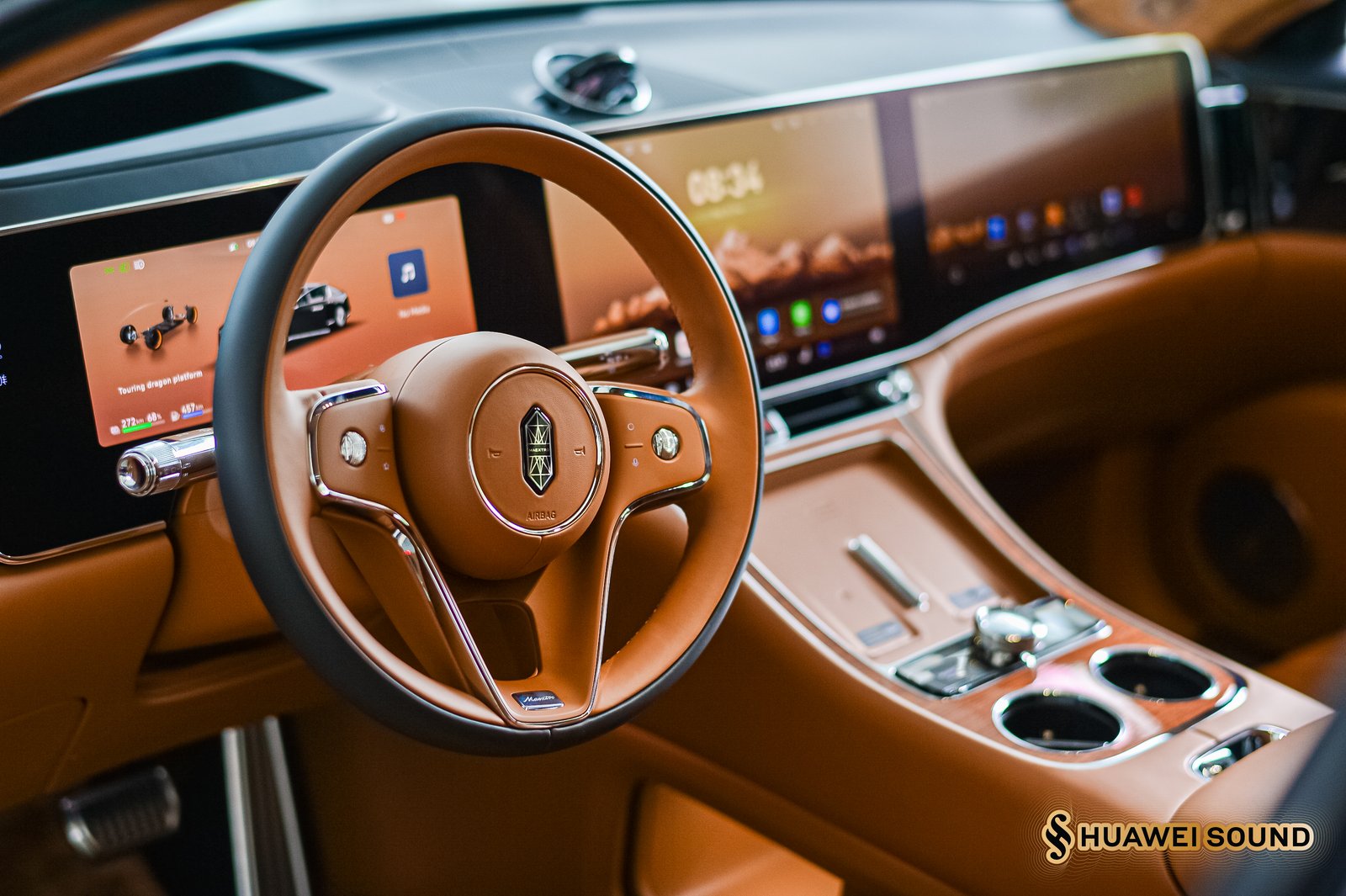
The tangible result of this research is the HUAWEI SOUND ULTIMATE Series, the tech giant’s most luxurious audio system to date, currently deployed in the Maextro S800 luxury electric sedan. The system comprises 43 speakers driven by dual amplifiers delivering 2,920 watts total power.
What Huawei terms an “industry-first seat-specific 4D immersive surround sound experience” includes rear 4D exciters that synchronise with music and video content, adding tactile feedback to the auditory experience.
The hardware innovations are specific rather than generic. The Tangential Force Woofer rotates conventional door-woofer geometry by 90 degrees, reducing panel resonance while extending bass response. A patented dual-diaphragm subwoofer leverages the cabin volume itself rather than being constrained by traditional enclosure design.

The Crystal Star-Ring Diffuser rises automatically when occupants enter, integrating with rhythm-synchronised ambient lighting while improving central image precision – Huawei claims 30% greater sound uniformity compared to the previous generation.
The spatial audio implementation uses 10 overhead channels, adaptive sound-field control, and what Huawei describes asa proprietary spatial audio track model for positioning and clarity. Interestingly, the system integrates with HarmonyOS, extending beyond pure audio into what Huawei calls “sound-to-light” technology – AI-powered ambient lighting that responds to musical content in real-time.
Independent sound zones
The most technically ambitious feature is the independent sound-zone technology. Each of the four headrests integratesfour drivers – two tweeters and two midrange units. Combined with Huawei’s sound-field control algorithms, the main speaker array can function as an active silencer, targeting audio spillage between front and rear rows.
Huawei claims up to 30dB isolation between rows and 99% energy separation. During the demonstration, front passengers listened to classical music while rear passengers watched an action film, with minimal audible crosstalk.Whether these figures hold across different program material and at higher volumes remains to be tested in real-world conditions.
The system also incorporates road-noise cancellation using what Huawei describes as an “omnidimensional model” – multi-channel amplification with low latency applying ear-adaptive cancellation. Multi-layer acoustic glass and absorptive materials provide passive isolation, targeting what the company calls a “library-level” baseline noise floor.

The investment question
Huawei disclosed substantial R&D spending: CNY 179.7 billion (approximately £20 billion / €23.4 billion) in 2024, representing 20.8% of total revenue, with over 113,000 employees in R&D roles. The company states that approximately CNY 60 billion (roughly £6.6 billion / €7.8 billion) goes specifically to fundamental science research.
These numbers contextualise Huawei’s automotive sound engineering ambitions. The company currently supplies solutions to over twenty automakers, spanning driver assistance, cockpit systems, acoustics, and control. However, Huawei positions itself as a component supplier – individual automakers determine market availability and regional launches.
Market implications
The automotive sound engineering landscape has traditionally been dominated by established European brands. Huawei’s systematic approach – purpose-built testing facilities, recruited expertise from legacy audio companies, and significant capital investment – represents a challenge to that established order.
The question isn’t whether Huawei can build impressive technology demonstrations. The Maextro S800 system clearly works. The question is whether this level of sophistication translates to broader production volumes, across multiple vehicle platforms, at commercially viable price points.
Goller’s stated goal is “optimum reproduction of the recording – to bring us closer to the experience the artist intended.” It’s a standard audiophile objective, but one that automotive sound engineering has historically struggled to achieve given the constraints of the environment.
Assessment
After experiencing both the laboratory facilities and the in-car system, Huawei’s program appears methodologically sound. The combination of measurement-driven development and subjective tuning refinement represents standard practice in high-end audio, adapted for automotive contexts.
Whether this translates to market success depends on factors beyond acoustic performance: production scalability, supply chain integration with diverse automakers, and ultimately, whether consumers value independent sound zones and advanced tuning enough to pay premium prices.
Huawei has built the technical foundation. The commercial proof will emerge as these systems move from flagship demonstrations into broader automotive lineups.
See also: Huawei details open-source AI development roadmap at Huawei Connect 2025

Want to learn more about AI and big data from industry leaders? Check out AI & Big Data Expo taking place in Amsterdam, California, and London. The comprehensive event is part of TechEx and co-located with other leading technology events. Click here for more information.
AI News is powered by TechForge Media. Explore other upcoming enterprise technology events and webinars here.
