



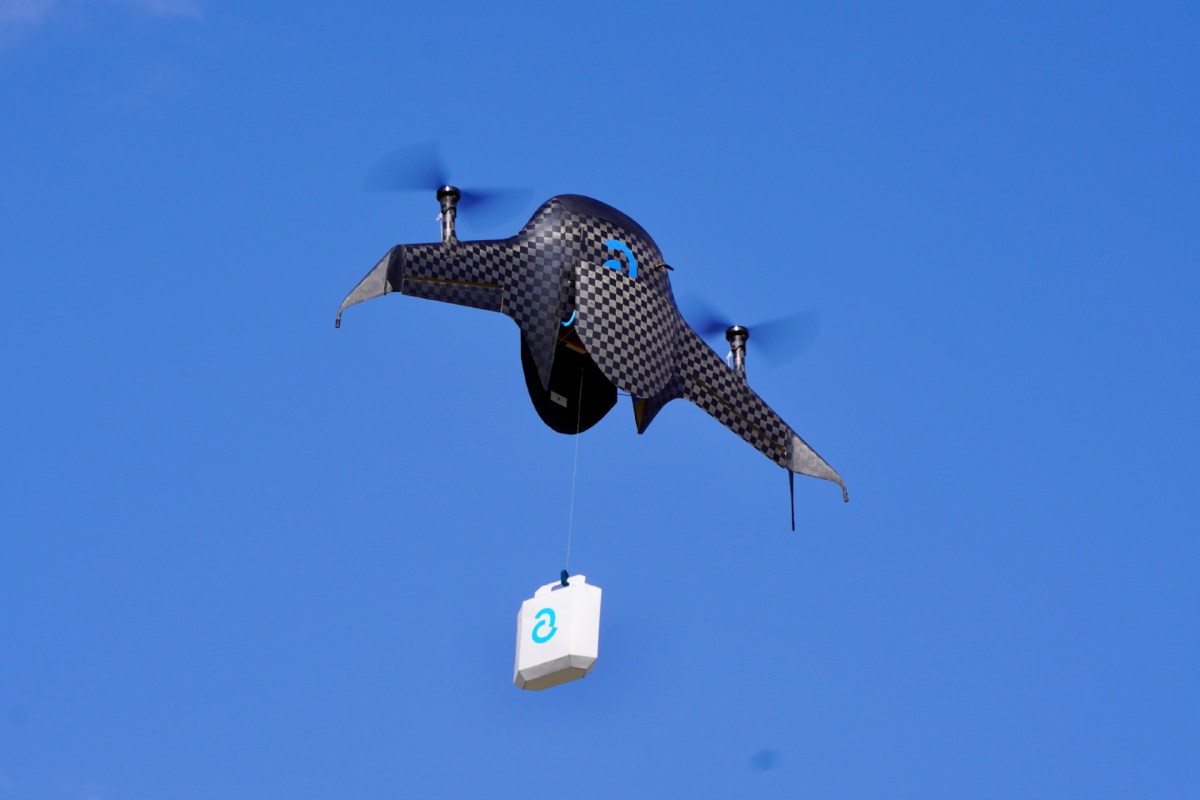
Airbound, an Indian drone startup, has raised $8.65 million in seed funding led by Physical Intelligence co-founder Lachy Groom, as it begins a drone-delivery pilot with a private hospital and works toward one-cent delivery using its ultra-light, blended-wing-body aircraft.
The seed round includes participation from Humba Ventures and Airbound’s existing investor Lightspeed Venture Partners, as well as senior leaders at Tesla, SpaceX, and Anduril.
Founded in 2020 by Naman Pushp — who was 15 at the time and is now 20 — Airbound has developed an aircraft using a tail-sitter design (where the drone sits vertically and launches upright like a rocket) and carbon fiber frame, aiming to deliver parcels at up to 20 times lower cost than conventional methods and significantly cheaper than existing drone delivery systems. The aircraft uses a blended-wing-body shape with two propellers, rather than the more common quadcopter configuration. This enables the aircraft to take off like a rocket and fly like a plane.
Airbound is targeting one-cent deliveries by rethinking how energy is used to move goods, founder and CEO Pushp said in an interview.
Typically, electric two-wheelers are used in India to deliver payloads weighing under 3 kilograms, Pushp told TechCrunch, even though the vehicles themselves weigh around 150 kilograms (331 pounds) and cost about ₹2 (about $0.02) per kilometer in energy. Airbound aims to cut that cost down to as low as 10 paise (around $0.001) by using its drone, called the TRT, which is built specifically for small payloads and removes the need for a human driver — reducing total transport weight by roughly 30 times. That, Pushp said, translates into a 20-fold drop in energy cost per kilometer, making one-cent drone delivery a feasible end state.
“There is actually an incredible amount of gaps between where drones are today and where they can be,” the founder said. “You need four kilograms of drone to lift one kilogram of payload, which is insane to me. Range is a broken metric. There’s no concept of aerodynamic efficiency with drones “[right now].”
The aircraft’s rocket-like, blended-wing design eliminates the need for additional propellers and heavy moving parts, improving aerodynamic efficiency over conventional quadcopters. By avoiding propellers that disrupt airflow over the wing, the drone maintains a higher lift-to-drag ratio, reducing the amount of thrust needed to stay aloft and making forward flight significantly more energy-efficient, the founder told TechCrunch.
Techcrunch event
San Francisco
|
October 27-29, 2025
The first version of Airbound’s drone weighs 3.3 pounds and carries a payload of up to 2.2 pounds, and the startup also aims for its second version to support a 6.6-pound payload while weighing just 2.6 pounds itself.
A prototype of the second version is expected to be ready and flying by mid-next year, with production targeted for the first quarter of 2027, Pushp said.
“When you get into the world of autonomy, logistics is just a physics problem. It’s a game of efficiency and weight. And so if you have a lower weight than anyone else and a higher efficiency than others, you win,” Pushp said.
He began working on Airbound during the COVID-19 lockdown in 2020, inspired by a video of Zipline, the on-demand drone delivery company. He submitted an early prototype — made from 2D slices held together with toothpicks and tape, then sanded to resemble a fiberglass body — to a hackathon, where it earned a $500 grant. That experience prompted him to apply to Y Combinator, though he was not accepted. Instead, he received a $1,000 grant from the 1517 Fund in 2021, followed by a $25,000 check from Brand Capital and a $12,000 grant from Emergent Ventures.
At 17, Pushp received a term sheet from Lightspeed, but waited until after his 18th birthday to sign it. “That was the first legally binding document that I signed,” he recalled.
The aircraft packs lithium-ion batteries — instead of a commonly used lithium-polymer battery pack. Lithium ion batteries typically have a cycle life of 500 to 800 cycles, whereas lithium polymer lasts for around 100–200 cycles, Pushp said.
“The biggest cost of operating these drones ends up being their battery replacement costs,” he said.
The drone costs Airbound $2,000 to make and ₹24 (around $0.27) per delivery. The startup aims to cut the delivery cost to below ₹5 (roughly $0.05) by the end of 2026. It also projects reaching a million deliveries per day by the middle of 2027, and to achieve that, it plans to increase its manufacturing capacity to over 100 drones a day. This is up from the startup’s current one-drone-per-day production rate at its Bengaluru facility.
Airbound has started its first pilot program with Bengaluru’s Narayana Health through which it will deliver medical logistics for three months, aiming to complete ten deliveries a day of medical tests, blood samples, and other critical supplies.
However, Airbound also targets other sectors including quick commerce, food deliveries, and “a few other smaller areas of last-mile” delivery, the founder told TechCrunch.
Airbound also plans to go beyond India after scaling to one million deliveries per day and enter the U.S. in three years. Meanwhile, the startup is also in talks with regulators including India’s Directorate General of Civil Aviation to start its flights soon.
To date, Airbound has raised over $10 million in total funding, and it has a team of 50 people.
The latest round will help scale its manufacturing capabilities and expand operations. The pilot program will also help improve its service and reduce costs to better prepare for broader market adoption in 2026, the startup said.
