



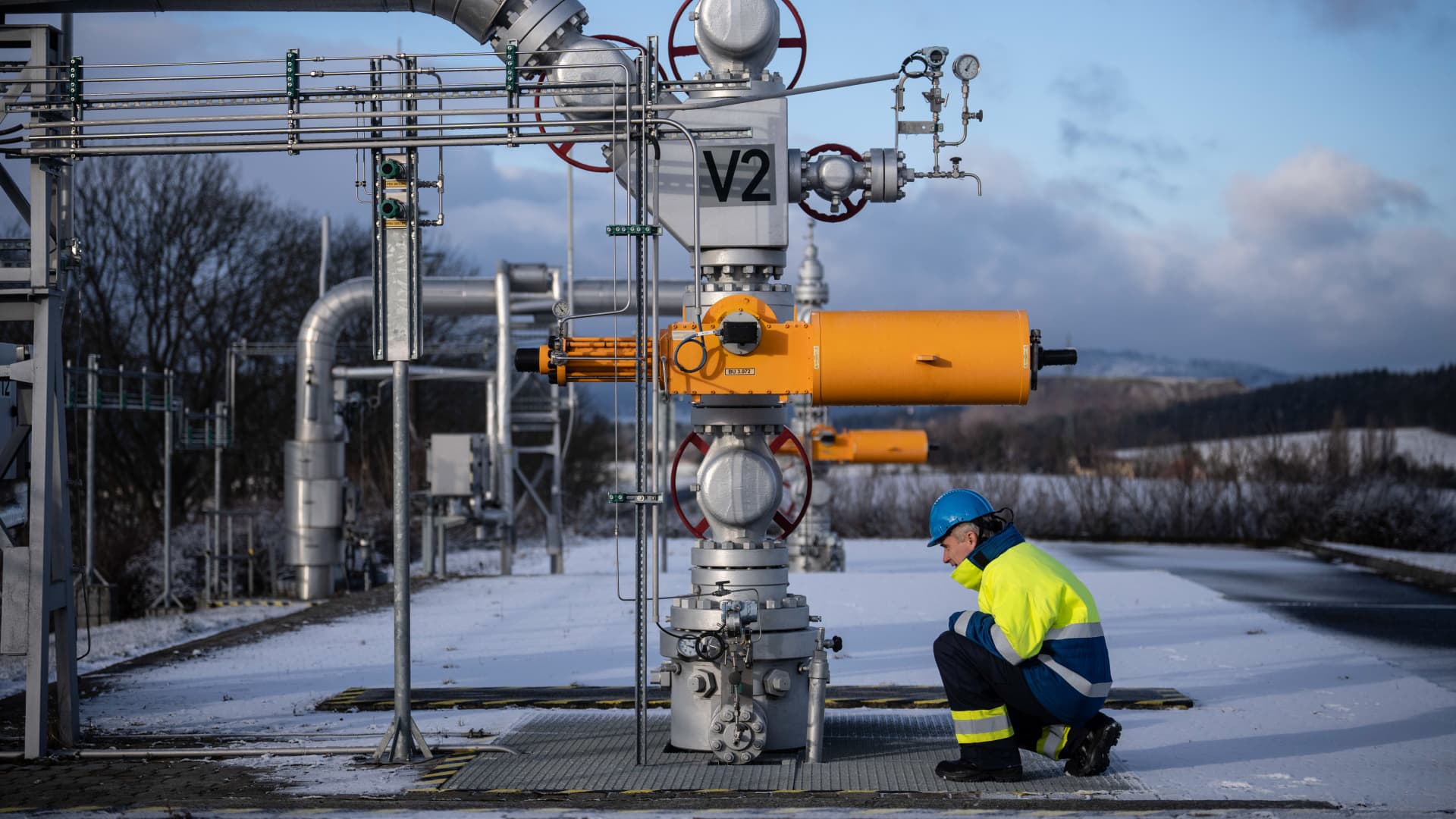
A worker inspects the outdoor gas pipes at the underground gas storage facility operated by Gas Storage CZ AS, in Haje, Czech Republic, on Friday, Jan. 3, 2025.
Bloomberg | Bloomberg | Getty Images
The International Energy Agency’s latest outlook signals that oil demand could keep growing through to the middle of the century, reflecting a sharp tonal shift from the world’s energy watchdog and raising further questions about the future of fossil fuels.
In its flagship World Energy Outlook, the Paris-based agency on Wednesday laid out a scenario in which demand for oil climbs to 113 million barrels per day by 2050, up 13% from 2024 levels.
The IEA had previously estimated a peak in global fossil fuel demand before the end of this decade and said that, in order to reach net-zero emissions by 2050, there should be no new investments in coal, oil and gas projects.
The concept of peak oil refers to the point at which global crude production reaches its highest point, before subsequently entering an irreversible decline.
The IEA’s end-of-decade peak oil forecast kick-started a long-running war of words with OPEC, an influential group of oil exporting countries, which accused the IEA of fearmongering and risking the destabilization of the global economy. U.S. Energy Secretary Chris Wright, meanwhile, labeled the IEA’s peak oil demand assumption as “nonsensical.”
The IEA’s latest forecast of increasing oil demand was outlined in its “Current Policies Scenario” — one of a number of scenarios outlined by the IEA. This one assumes no new policies or regulations beyond those already in place.
The CPS was dropped five years ago amid energy market turmoil during the coronavirus pandemic, and its reintroduction follows pressure from the Trump administration.
Earlier this month, the IEA said that now that the world has passed through the pandemic and global energy crisis, “there is merit in revisiting the CPS.”
The agency said increasing oil demand would be primarily driven by demand for petrochemical products and jet fuel, alongside a slowdown in the growth of electric vehicles.
Gregory Brew, an analyst at Eurasia Group’s Energy, Climate and Resources team, said the IEA’s retreat on peak oil demand signified “a major shift” from the group’s position over the last five years.
“The justifications offered for the shift include policy changes in the U.S., where slow EV penetration indicates robust oil [consumption], but is also tied to expected increases in petrochemical and aviation fuel in East and Southeast Asia,” Brew told CNBC by email.
“It’s unlikely the agency is adjusting based on political pressure — though there has been some of that, with the Trump administration criticizing the group’s supposed bias in favor of renewable energy — and the shift reflects a broader skepticism that oil demand is set to peak any time soon,” he added.
A misguided notion?
In an apparent thawing of tensions between two major players in the energy industry, OPEC welcomed what it described as the IEA’s “rendezvous with reality.”
In a statement published on its website, OPEC said: “We hope that the IEA’s World Energy Outlook represents a return to the fold of analysis grounded in energy realities and that we have passed the peak in the misguided notion of ‘peak oil.'”
Alongside its CPS, the IEA also laid out projections under its so-called “Stated Policies Scenario” (STEPS), which reflects the prevailing direction of travel for the global energy system.
In this assumption, the IEA said it expects oil demand to peak at 102 million barrels per day around 2030, before gradually declining. Global electric car sales are much stronger under this scenario compared to the CPS.
The IEA said its multiple scenarios explore a range of consequences from various policy choices and should not be considered forecasts.
Fatih Birol, executive director of the International Energy Agency (IEA), at the World Nuclear Exhibition (WNE) conference in Paris, France, on Tuesday, Nov. 4, 2025. The conference gathers key figures of the international nuclear sector from Nov. 4-6.
Bloomberg | Bloomberg | Getty Images
Grant Hauber, an energy analyst at the Institute for Energy Economics and Financial Analysis (IEEFA), said the IEA’s CPS appears to be the U.S. administration “capitulation” scenario, which sees some sort of flattening of current energy market trends.
“This leads to what almost appears to be a false dawn of LNG demand that could provide encouragement to those investing in the U.S. LNG export boom. CPS ‘creates’ enough global LNG demand to justify build-outs through 2035,” Hauber said.
“However, one only need look at the STEPS scenario to see how fragile that outlook is. Demand-Supply matching evaporates quickly over that same timeframe leading to LNG surplus. This occurs even with STEPS’ more moderated additions of renewables, efficiency and electrification measures,” he added.
Climate crisis
In all of the IEA’s scenarios, the energy watchdog predicted that global temperatures will rise by more than 1.5 degrees Celsius.
Scientists have repeatedly warned that global average temperatures must not increase by more than 1.5 degrees Celsius to avoid the worst of the climate crisis.
This threshold is recognized as a crucial long-term target because tipping points become more likely beyond this level. Tipping points can lead to dramatic shifts or potentially irreversible changes to some of Earth’s largest systems.
Extreme temperatures are fueled by the climate crisis, the chief driver of which is the burning of fossil fuels.
Lars Nitter Havro, head of energy macro at Rystad Energy, said the IEA’s reintroduction of its CPS represents “a tonal shift,” but shouldn’t necessarily be seen as a “wholesale reversal” on peak oil.
