



Weather woes
Evans and David Whelihan have been trekking to OIC since 2022, advancing their vision to distribute a set of low-cost sensors across the Arctic for continuous monitoring. Hosted by the Navy’s Arctic Submarine Laboratory (ASL) every two years, OIC is a three-week event during which U.S. and allied military forces conduct operational readiness exercises. The temporary infrastructure ASL sets up for OIC — a drifting sheet of Arctic sea ice, atop which sits a runway and insulated tents for lodging and command and control — simultaneously enables researchers to test prototype equipment and conduct experiments in an environment otherwise inhospitable to humans. This opportunity is particularly valuable as Arctic monitoring systems are developed in support of U.S. Department of War priorities.
This year proved especially challenging, with back-to-back blizzards creating whiteout conditions. Temperatures persistently plunged to minus 25 degrees Fahrenheit, and winds blew at 25 to 30 miles per hour with 40 mph gusts. Although the team, which also included Ella Wawrzynek and Ryan Saenger, had intended on completing two stints on the ice — one to deploy the sensors and the other to retrieve them after a few weeks — the weather had other plans. Their initial trip to camp was delayed by a week as windblown snow halted all inbound and outbound flights.
While they waited in Prudhoe Bay, Alaska, for the weather to clear, Whelihan was readying another technology they planned to test at OIC: a modem from industry partner Havguard, a Norwegian defense technology startup, that can communicate through ice using magnetic fields (instead of radio-frequency signals, which are rapidly diminished by seawater). However, harsh conditions inside and outside in Prudhoe Bay led to some system failures, and he flew back to the laboratory to fix them. “De-risking and operationalizing critical technology for the warfighter is an important part of what we do,” Whelihan says.
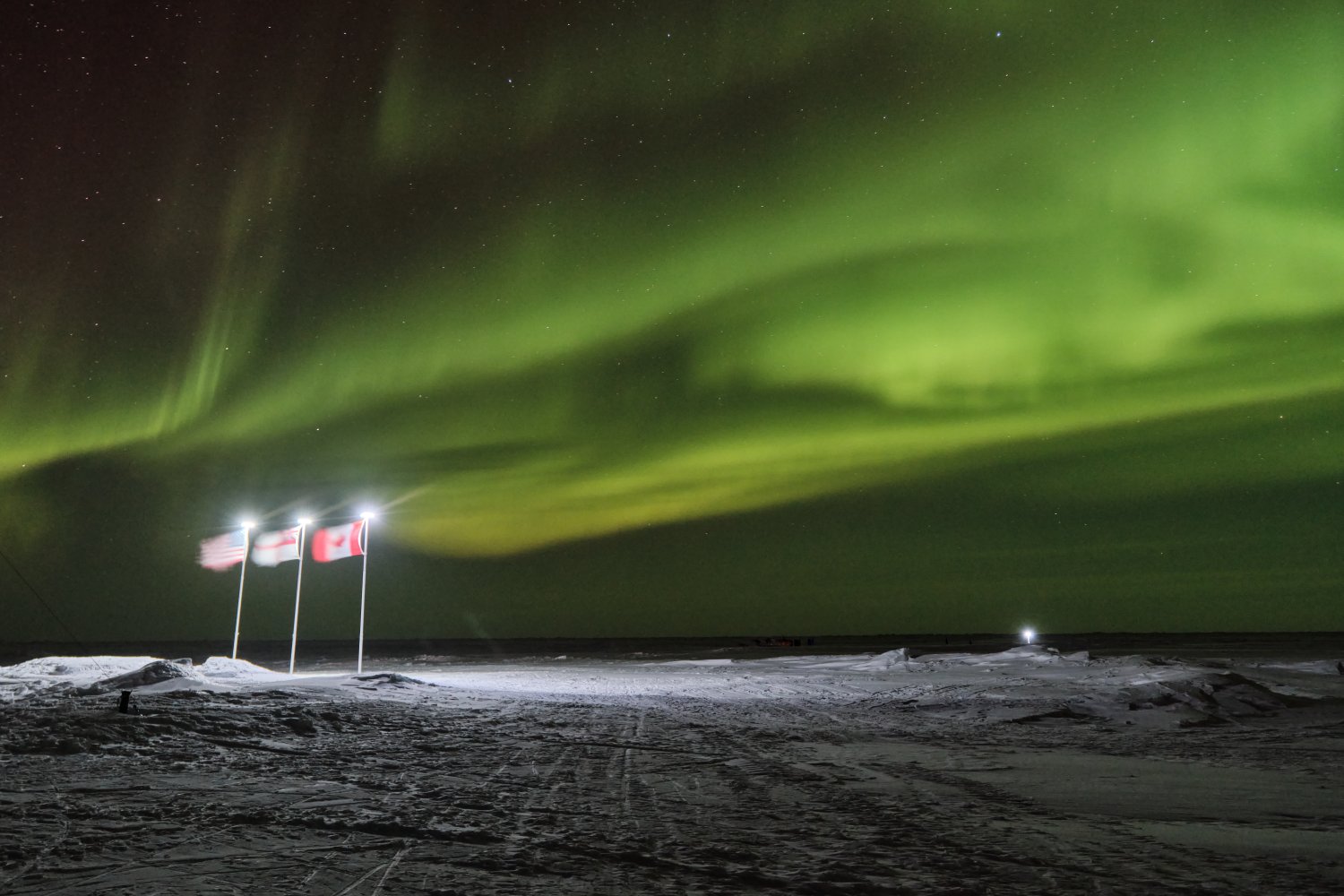
After Evans, Wawrzynek, and Saenger arrived at camp on March 7, not a single flight came or left for the next five days. During a “normal” mobilization at OIC, six to nine flights per day are typical. “At times, we couldn’t see participating countries’ flags on poles roughly 100 feet away from the command tent,” Evans says. “We had to put on hats and sometimes goggles just to go between tents, whereas at previous OIC events we walked around with long johns and pants.”
The day after their arrival, they loaded their sensors onto a sled, and a field party leader (an expert in Arctic survival) driving a 4×4 vehicle with tracks towed them outside the main camp area. After deploying a quarter of the sensors they had planned, their leader received a call from camp command instructing them to return. The windblown snow was picking up, and they soon wouldn’t be able to retrace their tracks back to camp.
A week later, the team had a clear day to retrieve their sensors and fly out of camp. “We laughed, because we could very easily see camp from where we had deployed the sensors,” Evans adds.
Magnetic communication
As Whelihan returned to Prudhoe Bay with the fixed communications modem, another blizzard hit. Because the laboratory team had already been to camp once and other research teams needed an opportunity to go onto the ice during the next clear-weather window, the laboratory contracted with UIC Science to conduct the modem experiment. A business unit of the Ukpeaġvik Iñupiat Corp., UIC Science provides logistical and technical support for Arctic research based in Utqiaġvik (Barrow), Alaska, the northernmost U.S. city. Unlike the drifting ice in the open ocean, the ice in Utqiaġvik is primarily landfast, meaning it’s fastened, or anchored, to the shoreline or seafloor.
Through UIC Science, Whelihan and Wawrzynek learned how to ride snowmobiles and then drove onto a big lagoon, where they drilled a 2×3-foot hole through 3.6 feet of ice to deploy a remotely operated vehicle (ROV) carrying the Havguard communications modem. The modem is based on a magneto-inductive transmitter (positioned below the ice) and receiver (sitting atop the ice), which are housed within polycarbonate domes to protect the sensitive electronics. The duo had met with Havguard in Norway in fall 2025 to discuss plans for testing the modem in the Arctic, and Havguard in turn built a version to testing specifications. Prior to OIC, Havguard and the laboratory team deployed the modem on a large reservoir in Vermont. While not representative of Arctic sea ice over salt water, this environment allowed them to test their procedures and capabilities.
“Under the Arctic lagoon ice, we placed the ROV, which was also equipped with a Doppler velocity logger, a four-beam sonar system that measures the vehicle’s speed and direction,” Whelihan says. “We used those measurements as the ROV drove under the ice, plus aerial drone images, to superimpose a picture of the ROV on the site so we could track it and calculate the modem’s rate of test-data transfer. We achieved through-ice communication at about 1.2 kilobytes per second on an alpha prototype system that had traveled from Boston to Alaska three times. This result is very encouraging, and the system warrants further development.”
In future iterations of this setup, the data could then be relayed out of the Arctic through drones or satellites.
Community connections
While in Utqiaġvik for a week in mid-April, they participated over the weekend in the Piuraaġiaqta annual spring festival, watching a harpoon-throwing contest and proctoring a kids’ snowmobile race. And with eighth graders at the local middle school, they discussed their Arctic R&D and engaged them in a game teaching sonar concepts.
“When you embrace this culture of community, you meet lots of interesting people and doors open up,” Whelihan says.
“Connecting with the Arctic community is an important aspect of our work,” Evans adds. “Every time we come here, we cross paths with someone we don’t expect to, learn about their work, and think about how we may be able to collaborate.” For example, at OIC 2024, the laboratory team had met a professor from the University of Maryland at College Park with extensive experience collecting and analyzing cryoseismological data; they now hope to work with him to apply machine learning to discriminate between icequakes and marine mammal vocalizations.
In the lead-up to OIC 2028, the team plans to design, prototype, and test air-droppable versions of some of their sensors while continuing to partner with Havguard on the through-ice communications modem. Their next step is to optimize the modem’s packaging to facilitate deployability in the Arctic and integration with the laboratory’s sensor suite.
“The through-line in all this work is minimizing boots on the ice,” Whelihan says. “Especially this year, we learned that the weather is in charge of our access to the Arctic. We need ways to easily get sensors where we want them and to retrieve the data they collect, even in these extremely challenging conditions.”
This work is funded through the laboratory’s internally administered R&D portfolio in mission-critical technology (integrated systems area) and the laboratory’s Advanced Concept Committee, which funds high-risk, high-reward early-stage research addressing critical gaps in national security technology.
