



Plenty of materials — from sulfur and sodium to manganese and organic molecules — have tried to topple the ubiquitous lithium-ion battery. And, so far, they’ve all failed.
Organic batteries, which are built from some of the most abundant chemicals here on Earth, including carbon, oxygen, and nitrogen, has been perhaps the most frustrating failure. They should be cheaper than today’s batteries that use metals. Yet no one has been able to crack the organic battery.
Until now, perhaps.
A young startup called XL Batteries has a new take on the chemistry, that it says should be cheaper, safer, and more durable than previous organic batteries and, crucially, lithium-ion batteries themselves.
“The capital cost should be ultra low,” Tom Sisto, co-founder and CEO of XL Batteries, told TechCrunch.
Don’t expect to find the company’s products in a next-generation electric vehicle. The liquid that XL Batteries uses to store electricity is bulkier and heavier than today’s lithium-ion batteries. That’s why the company is targeting grid-scale storage, which cares more about scale, cost, and safety than weight or density.
And the scale of XL Batteries’ installations can be, well, extra large.
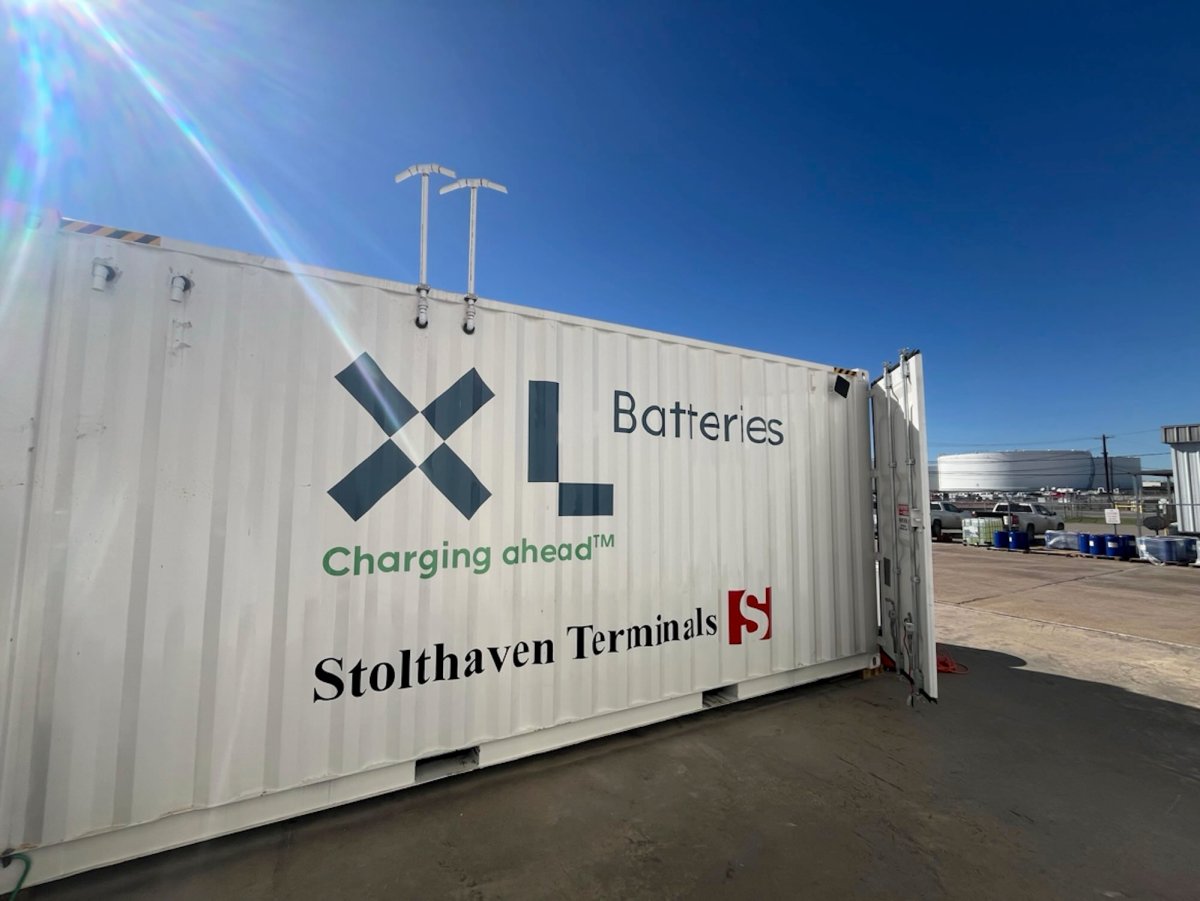
The company exclusively told TechCrunch that it has commissioned a demonstration unit for Stolthaven Terminals, a company that specializes in petrochemical storage. The first unit will be small, relatively speaking, but once it works the kinks out, the company can quickly build larger batteries, Sisto said.
Part of the reason Sisto is so optimistic is because a key component of the battery is nothing more than a storage tank.
“If we took two of [Stolthaven’s] biggest tanks, it’d be a 700 megawatt-hour battery,” Sisto said. That’s enough to power around 25,000 homes for a entire day. “I believe they have 400 tanks on their site in Houston.”
XL Batteries is building what are known as flow batteries. A basic flow battery consists of two tanks connected to pumps that flow two fluids past a membrane. Charging the battery pushes ions up a metaphorical hill, storing them in one of the fluids. When discharging, those ions flow back to the other side, releasing electrons in the process.
Flow batteries are an old technology, first invented in the late 1800s. But their bulk and relatively low energy storage held them back. Newer models have helped boost energy storage, but they’re still relatively expensive because the fluids they use are corrosive, necessitating costly materials for the pumps and other equipment.
Organic batteries have been posited for a while, but they have proven elusive because when most organic molecules are laden with extra electrons, they tend to quickly break apart. Those that have lasted longer have required refrigeration, and even then they fall apart in a couple months, Sisto said.
Even with a more stable molecule, Sisto knew that XL Batteries had to be cheaper if the company was to succeed. He got a glimmer of hope during his research at Columbia University when an organic compound he was investigating broke the record for the highest number of electrons accepted into a single molecule. At the time, that molecule had to be suspended in an organic solvent, which was pricey and flammable. Eventually, he and his collaborators were able to make it stable in pH-neutral water. At that point, he knew they could build a company around it.
One of XL Batteries’ installations consists of three parts: one 40-foot shipping container and two tanks. The company’s proprietary membrane and other components fit the shipping container, and one or more of those is then hooked up to the storage tanks. The size of the tanks dictates the battery’s capacity, while the number of shipping containers dictates how quickly the battery can charge or discharge.
Because the company is using so much off-the-shelf technology, Sisto says that XL Batteries can start building larger batteries soon. “The commercial design is is significantly done,” he said. The company is working with an engineering firm that has designed other flow batteries before. “They have all those pieces in place.”
Outside of early customers like Stolthaven, XL Batteries is looking to work with independent power producers to build batteries to support the grid, particularly in Texas where such installations have quickly become commonplace.
“We believe the project level economics of this are very compelling,” Sisto said.
