



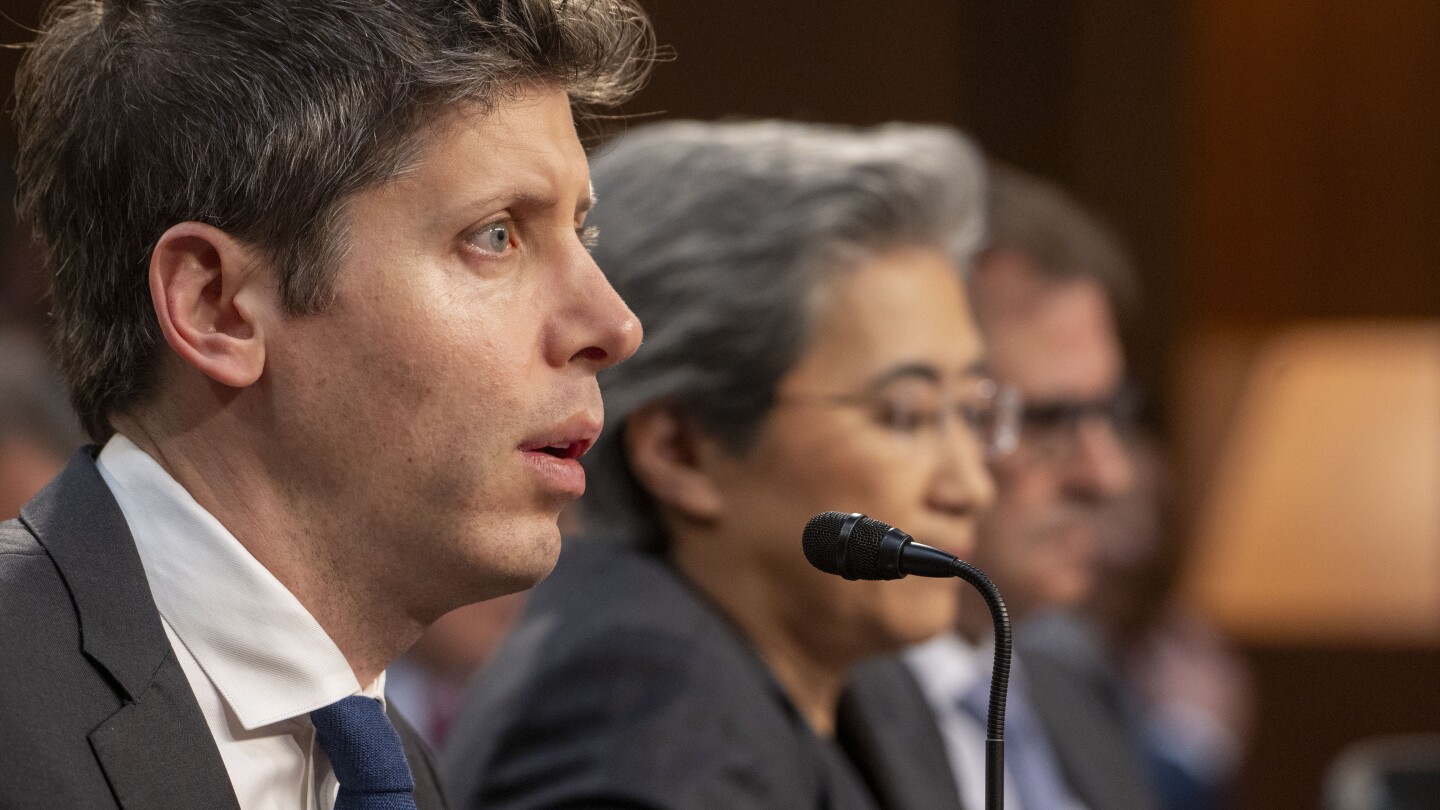
WASHINGTON (AP) — OpenAI CEO Sam Altman and executives from Microsoft and chipmaker Advanced Micro Devices testified on Capitol Hill about the biggest opportunities, risks and needs facing an industry which lawmakers and technologists agree could fundamentally transform global business, culture and geopolitics.
The hearing comes as the race to control the future of artificial intelligence is heating up between companies and countries. Altman’s OpenAI is in a furious race to develop the best artificial intelligence model against tech rivals like Alphabet and Meta, as well as against those developed by Chinese competitors.
“I believe this will be at least as big as the internet, maybe bigger,” Altman said in his opening remarks about AI’s potential to transform society. “For that to happen, investment in infrastructure is critical.” Altman urged senators to help usher in the “dual revolutions” of artificial intelligence and energy production that “will change the world we live in, I think, in incredibly positive ways.”
The witnesses included Altman; Lisa Su, chief executive of semiconductor maker AMD; Michael Intrator, co-founder of AI cloud computing startup CoreWeave; and Brad Smith, vice chair and president of Microsoft. They four executives unanimously urged lawmakers to help streamline policy for AI-related projects and fundraising.
The hearing spanned topics ranging from industry debates over chip performance, jobs, human relationships and power generation to grander questions about the global competition with China and the European Union.
“China aims to lead the world in AI by 2030,” said Sen. Ted Cruz, chair of the Senate Commerce, Science and Transportation Committee. “In this race, the United States is facing a fork in the road. Do we go down the path that embraces our history of entrepreneurial freedom and technological innovation? Or do we adopt the command and control policies of Europe?”
Senators were broadly sober in their questioning and united in their concern that the U.S. maintain its dominance in artificial intelligence. Lawmakers from both parties also raised concerns over cybersecurity, data privacy and AI’s ability to create content that could confuse or mislead people.
Some partisan fighting did arise. Sen. Bernie Moreno, an Ohio Republican, pressed Su and Smith on whether the Biden administration’s sustainable energy policies hindered the goal of producing more power for AI-related infrastructure.
And Sen. Tammy Duckworth, an Illinois Democrat, criticized cuts by President Donald Trump and billionaire Elon Musk to federal funding for research and to agencies like the Energy Department’s national laboratories and National Science Foundation, painting them as “a self sabotaging attack.”
“Does anyone truly have confidence that had DOGE been around decades ago, they would not have cut the project that created the internet as an example of wasteful, publicly funded research and development?” asked Duckworth.
But despite some barbs, the hearing maintained a low-key tenor and some bipartisan joking as lawmakers and executives discussed the potential of a technology all present agreed would determine humanity’s future.
“Look, there is a race, but we need to understand what we’re racing for,” Sen. Brian Schatz, a Hawaii Democrat, told the witnesses. “It’s not just a sort of commercial race, so we can edge out our nearest competitor in the public sector or the private sector. We’re trying to win a race so that American values prevail.”
Trade policy and AI
Several of the executives warned against U.S. export controls that could end up pushing other countries toward China’s AI technology.
“We totally understand as an industry the importance of national security,” Su said. But she added, if not able to “have our technology adopted in the rest of the world, there will be other technologies that will come to play.” Those technologies are less advanced today but will mature over time, she said.
Altman drew a direct connection between the United State’s ability to attract global talent and ability to sell its products globally to national security and its international influence.
“The leverage and the power the U.S. gets from having iPhones be the mobile device people most want, and Google being the search engine that people most want around the world is huge,” Altman said. “We talk maybe less about how much people want to use chips and other infrastructure developed here, but I think it’s no less important, and we should aim to have the entire U.S. stack be adopted by as much of the world as possible.”
Trade rivalry between the U.S. and China has been weighing heavily on the AI industry, including California-based chipmakers Nvidia and AMD.
The Trump administration announced in April that it would restrict sales of Nvidia’s H20 chips and AMD’s MI308 chips to China.
Nvidia has said the tighter export controls will cost the company an extra $5.5 billion. AMD said after reporting its quarterly earnings this week that it will cost the firm $1.5 billion in lost revenue over the coming months.
Still uncertain are the effects on additional AI chip controls set by former President Joe Biden’s administration that are set to take effect next week targeting more than 100 countries. The policy drew strong opposition from Nvidia and other tech companies, while it was supported by others, including AI company Anthropic, as a way to prevent China’s “sophisticated smuggling operations” to obtain chips from shell companies in third countries.
The Commerce Department said in an email Thursday that Trump plans to replace Biden’s “overly complex, overly bureaucratic” rule with a simpler one but didn’t say when.
AI data center expansion and state competition
The day before the hearing, Altman visited the Abilene, Texas, site of the massive Stargate data center project being built for OpenAI in collaboration with Oracle and other partners. The site was chosen for its potential access to a variety of energy resources, including wind and solar power.
Altman, during the hearing, said that Texas had been “unbelievable” in incentivizing major AI projects. “I think that would be a good thing for other states to study,” Altman said. He predicted that the Abilene site would be the “largest AI training facility in the world.”
But Altman also later cautioned against a patchwork regulatory framework for AI.
“It is very difficult to imagine us figuring out how to comply with 50 different sets of regulations,” said Altman. “One federal framework that is light touch, that we can understand, and it lets us move with the speed that this moment calls for, seems important and fine.”
While the tech industry has long relied on data centers to run online services, from email and social media to financial transactions, new AI technology behind popular chatbots and generative AI tools requires even more powerful computation to build and operate.
A report released by the Department of Energy late last year estimated that the electricity needed for data centers in the U.S. tripled over the past decade and is projected to double or triple again by 2028 when it could consume up to 12% of the nation’s electricity.
——
The Associated Press and OpenAI have a licensing and technology agreement that allows OpenAI access to part of AP’s text archives.
——
AP Technology Writer Matt O’Brien contributed to this report from Providence, Rhode Island.
