



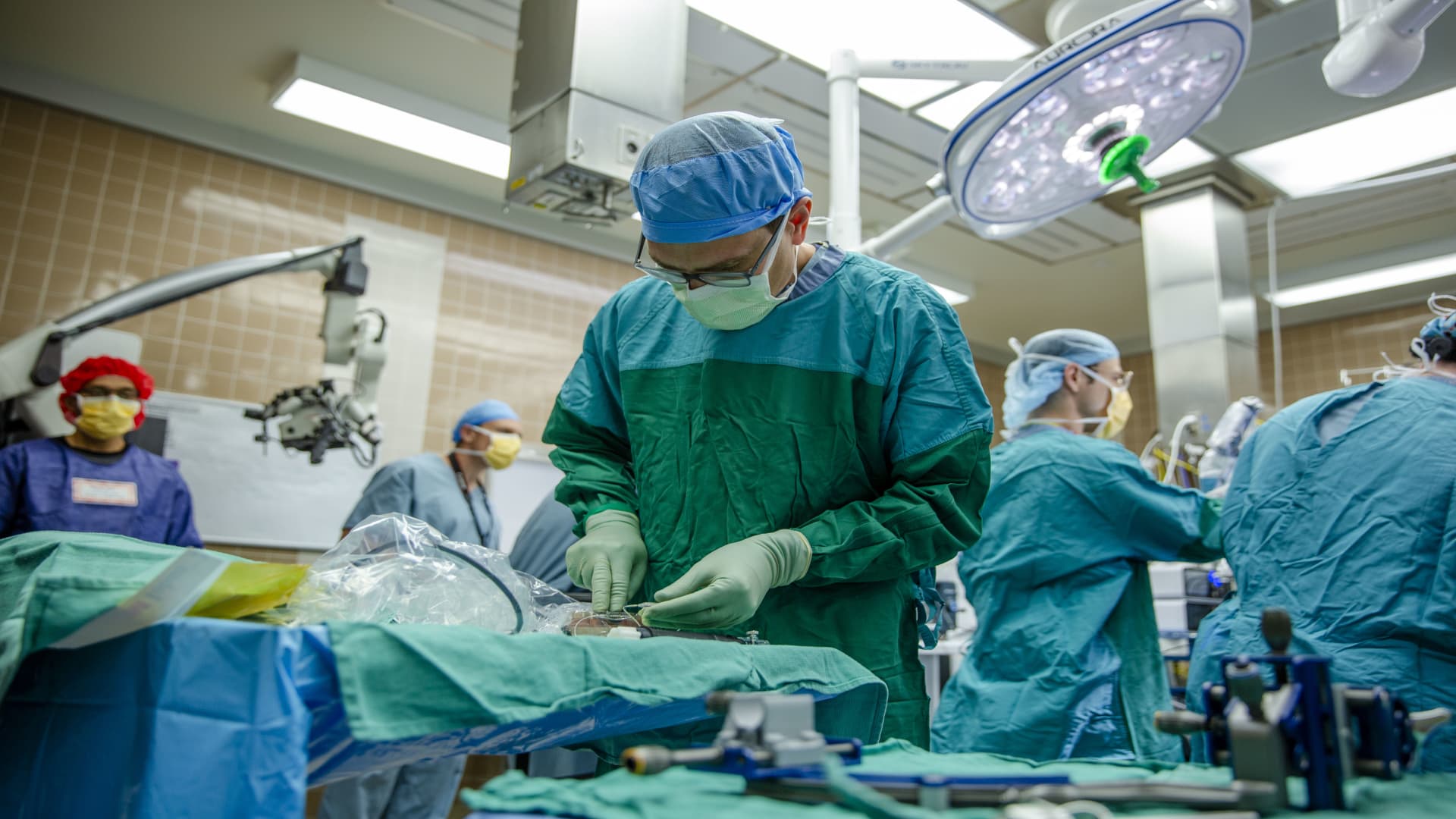
Dr. Matthew Willsey working in the operating room.
Courtesy of the University of Michigan
Neurotech startup Paradromics on Monday announced it has implanted its brain-computer interface in a human for the first time.
The procedure took place May 14 at the University of Michigan with a patient who was already undergoing neurosurgery to treat epilepsy. The company’s technology was implanted and removed from the patient’s brain in about 20 minutes during that surgery.
Paradromics said the procedure demonstrated that its system can be safely implanted and record neural activity. It’s a major milestone for the nearly 10-year-old startup, as it marks the beginning of its next chapter as a clinical-stage company.
Once regulators give it the green light, Paradromics plans to kick off a clinical trial later this year that will study the long-term safety and use of its technology in humans.
“We’ve shown in sheep that our device is best in class from a data and longevity standpoint, and now we’ve also shown that it’s compatible with humans,” Paradromics founder and CEO Matt Angle told CNBC in an interview. “That’s really exciting and raises a lot of excitement for our upcoming clinical trial.”
A brain-computer interface, or BCI, is a system that deciphers brain signals and translates them into commands for external technologies. Paradromics’ system is called the Connexus Brain-Computer Interface, and the company says it will initially help patients with severe motor impairments such as paralysis speak through a computer.
Paradromics’ BCI has not been cleared by the U.S. Food and Drug Administration, and it still has a long road ahead before it reaches commercialization.
But for Angle, who founded the company in 2015, the procedure in May was a success, and one that was years in the making.
“You do all of these steps, you validate the hardware, you have this really high degree of rational certainty that things are going to work,” he said, “but still emotionally when it works and when it happens the way you expected it to, it’s still very, very gratifying.”
Though Paradromics’ BCI has not been officially cleared for use by regulators, organizations like the University of Michigan can use new devices for research as long as they can demonstrate that there is not a significant risk to patients.
Dr. Oren Sagher, professor of neurosurgery at the University of Michigan, oversaw the traditional clinical component of the procedure in May. Dr. Matthew Willsey, assistant professor of neurosurgery and biomedical engineering at the University of Michigan, led the research component, including the placement of Paradromics’ device.
BCIs have been studied in academia for decades, and several other startups, including Elon Musk’s Neuralink, are developing their own systems.
Paradromics’ Connexus Brain-Computer Interface.
Courtesy: Paradromics
“It’s absolutely thrilling,” Willsey said in an interview. “It’s motivating, and this is the kind of thing that helps me get up in the morning and go to work.”
Each company’s BCI is slightly different, but Paradromics is designing a BCI that can record brain activity at the level of individual neurons.
Angle compared this approach to placing microphones inside vs. outside a stadium. Inside a stadium, microphones would capture more detail, such as individual conversations. Outside a stadium, microphones would only capture the roar of the crowd, he said.
Other prominent BCI companies include Synchron, which is backed by Jeff Bezos and Bill Gates, and Precision Neuroscience. Both have implanted their systems in humans.
Paradromics has raised nearly $100 million as of February, according to PitchBook. The company announced a strategic partnership with Saudi Arabia’s Neom in February, but declined to disclose the investment amount.
“The last demonstration stuff has been shown, and we’re really excited about the clinical trial that’s coming up,” Angle said.
WATCH: Inside Paradromics, the Neuralink competitor hoping to commercialize brain implants before the end of the decade

