



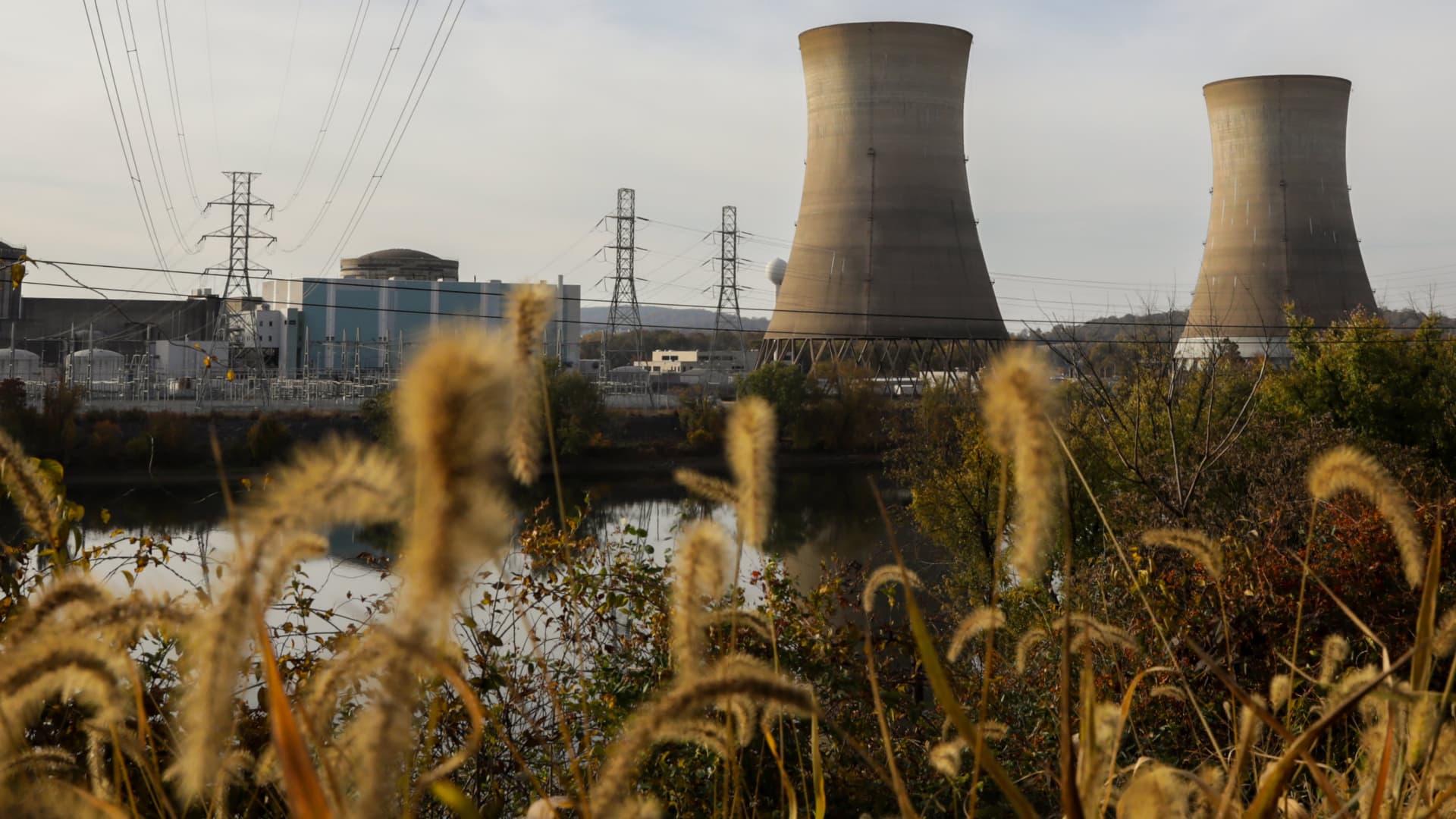
Cooling towers at the Three Mile Island nuclear power plant in Middletown, Pennsylvania, Oct. 30, 2024.
Danielle DeVries | CNBC
If there is one thing the U.S. needs to lead the artificial intelligence revolution, it’s electricity. Insane amounts of it.
A 2024 report commissioned by the U.S. Department of Energy found that data centers — the backbone of artificial intelligence — already accounted for more than 4% of U.S. electricity use, and the report said that could grow to 12% by 2028. That would be 580 billion kilowatt hours, or nearly 20 times the annual power consumption of the city of Chicago.
“Data centers run 24/7, and need to be able to support the needs of our users,” said Rachel Peterson, vice president of data centers for Meta. The parent of Facebook, Instagram and WhatsApp has announced a massive push into AI.
“We use a lot of power. We need to make sure we have a robust grid,” she said.
Meta is not alone, say economic development experts.
“The big issues right now are deliverability of sites,” said Tom Stringer, a principal and leader of the site selection and incentives practice at Grassi Advisors in New York. “And maybe the biggest component of that is adequate power.”
The deals keep coming. On Tuesday, Google announced it would spend $25 billion to develop data centers along the nation’s largest multi-state grid, an electricity region covering 13 states in all. Meanwhile. CoreWeave announced a $6 billion AI data center project in Pennsylvania.
CNBC considers each state’s electrical grid in our annual competitiveness study, America’s Top States for Business. Under the study’s methodology, we use U.S. Department of Energy data on grid reliability — the duration of power outages per year — as well as the retail price of electricity.
With a wealth of inexpensive, reliable electricity, these states are the best equipped to power the AI revolution, and everything else.
Washington
Diablo dam on Skagit river in Washington state.
Crady Von Pawlak | Moment | Getty Images
The power grid in Washington — and across the Pacific Northwest — faces no shortage of challenges. While demand grows, climate change is intensifying the storms that batter the area every year and threatening the consistency of hydroelectric power, an important source for the region. But so far, the state is meeting the demand at a reasonable price.
Largest electric utility: Puget Sound Energy
Power outages statewide: 2.53 hours/year (2023)
Average retail price of electricity (all sectors): $10.16/kWh (2024)
Power from renewable sources: 10.2%
New Mexico
Vera Leader / 500px | 500px | Getty Images
New Mexico is the seventh largest generator of wind energy, according to the Energy Department, and it is seeking to increase the use of other alternative sources like solar power to meet relentless demand. The state is also seeking to modernize its grid with tools like smart meters that will help the state better coordinate supply and demand.
Largest electric utility: Public Service Company of New Mexico
Power outages statewide: 2.82 hours/year
Average retail price of electricity (all sectors): $9.30/kWh
Power from renewable sources: 59.6%
Montana
Linemen work on a rebuild of Northwestern Energy electric transmissions lines in Park County on May 14, 2020 in Livingston, Montana.
William Campbell | Getty Images News | Getty Images
Montana is home to the Western end of the North Plains Connector, a 420-mile, 525-kilovolt-transmission line that will connect the Eastern and Western U.S. electrical grids for the first time. The $3.2 billion project, funded in part by the Bipartisan Infrastructure Law of 2021, aims to make the grid more resilient and responsive to demand, with the ability to move electricity in either direction between Montana and North Dakota. The project is in the permitting phase, with construction expected to begin in 2028, and electricity expected to begin flowing in 2032.
Largest electric utility: NorthWestern Energy
Power outages statewide: 1.98 hours/year
Average retail price of electricity (all sectors): $10.84/kWh
Power from renewable sources: 25.1%
North Dakota
Valley Camp, North Dakota, Wind farm. Replacement blades are stacked near some of the turbines. (Photo by: Jim West/UCG/Universal Images Group via Getty Images)
Ucg | Universal Images Group | Getty Images
North Dakotans enjoy the cheapest electricity of any state — roughly 30% cheaper than in neighboring Minnesota. One reason, the U.S. Department of Energy says, is that the state has abundant supplies of coal and natural gas, and a small population. That allows the state to produce far more energy than it consumes. But the state also boasts the most abundant wind energy resources in the nation, and it is rich in other renewable sources like biomass. In all, North Dakota generates about one-third of its power from renewable sources, and efforts are underway to increase that. EmPower North Dakota, an agency created by the state legislature in 2007, aims to diversify the state’s grid beyond fossil fuels.
Largest electric utility: Xcel Energy
Power outages statewide: 3.48 hours/year
Average retail price of electricity (all sectors): $8.00/kWh
Power from renewable sources: 34.7%
Idaho
Cows graze on a pasture surrounded by solar panels.
Robert Gauthier | Los Angeles Times | Getty Images
Idaho was early to the data center sweepstakes, landing Meta’s massive Kuna data center back in 2022. The roughly 1-million-square-foot facility is expected to begin operations next year. To fulfill Meta’s promise that the center will run on 100% renewable energy, the company is helping to develop a 200-megawatt solar facility nearby. But Idaho is also rich in other renewable sources, most notably hydroelectric power. Idaho is also one of the only states capable of generating significant amounts of electricity through geothermal power.
Largest electric utility: Idaho Power (IDACORP)
Power outages statewide: 2.29 hours/year
Average retail price of electricity (all sectors): $9.52/kWh
Power from renewable sources: 29%
South Dakota
Torrents of water roar through the Gavins Point Dam just outside Yankton, South Dakota.
Kansas City Star | Tribune News Service | Getty Images
South Dakota is meeting the voracious demand for energy with a heavy reliance on renewables — especially wind, which accounts for 55% of the state’s electricity generation, according to the Energy Department. The only state more reliant on wind is Iowa. The Energy Department notes that wind power surpassed hydropower in South Dakota for the first time in 2021. By 2023, wind energy had surged to three times as much electricity generation as hydropower. All the while, South Dakota has maintained one of the most reliable grids in the nation.
Largest electric utility: Xcel Energy
Power outages statewide: 1.28 hours/year
Average retail price of electricity (all sectors): $11/kWh
Power from renewable sources: 62.5%
Utah
Conveyors for moving coal at the Savage Energy Terminal, a coal transfer facility in Price, Utah.
Vw Pics | Universal Images Group | Getty Images
While coal still accounts for nearly half of Utah’s electricity generation, that is down sharply from 75% a decade ago, according to the Energy Department. The Utah Office of Energy Development says its Strategic Energy Plan differs from energy policies in many other states because it prioritizes the human consequences of its actions.
“While other states enact energy policies focused on energy resources and emissions, Utah is focused on ensuring our citizens maintain their standard of living and have the chance to thrive,” the office’s website says.
The policy aims to double the state’s power production by 2025, while keeping costs affordable, increasing efficiency, and protecting the environment.
Largest electric utility: Rocky Mountain Power – a division of Berkshire Hathaway‘s PacifiCorp
Power outages statewide: 2.12 hours/year
Average retail price of electricity (all sectors): $9.03/kWh
Power from renewable sources: 32%
Wyoming
Coal-fired power plant on river in eastern Wyoming
Philaugustavo | E+ | Getty Images
Wyoming is coal country — home to about one-third of the nation’s recoverable coal reserves, according to the Energy Department. So, it should come as no surprise that coal-fired power plants produce around three-quarters of Wyoming’s electricity, more than any state except West Virginia. But that is down from 97% in 2003. Since then, coal’s decline as a preferred energy source nationwide has profoundly affected Wyoming’s economy. Still, with the smallest population of any state, and all that coal — plus abundant wind, hydroelectric, natural gas and solar power — Wyoming produces far more power than it consumes. That makes for very low costs on a reliable grid.
Largest electric utility: Rocky Mountain Power – a division of Berkshire Hathaway’s PacifiCorp
Power outages statewide: 1.99 hours/year
Average retail price of electricity (all sectors): $9.15/kWh
Power from renewable sources: 24.8%
Iowa
A composite wind blade, used in the construction of power-generating wind turbines, is displayed in front of the TPI Composites, Inc. manufacturing facility on July 02, 2025 in Newton, Iowa.
Scott Olson | Getty Images News | Getty Images
No state gets more of its electricity from wind than Iowa, according to the Energy Department, which says Iowa’s power mix has changed rapidly over the past decade or so. Coal, which was dominant until around 2019, now accounts for less than a quarter of the state’s electricity production. The state’s only nuclear plant, the Duane Arnold Energy Center near Cedar Rapids, ceased operations after sustaining damage in the infamous 2020 derecho. Now, the plant’s owner, NextEra Energy Resources, is looking into the possibility of restarting the plant to help meet demand from projects like data centers. But the company is also developing two new solar farms on the site.
Largest electric utility: MidAmerican Energy (Berkshire Hathaway)
Power outages statewide: 1.75 hours/year
Average retail price of electricity (all sectors): $9.43/kWh
Power from renewable sources: 65.6%
Nebraska
Sign outside of the Google Data Center on September 10, 2024 in in Papillion, Nebraska.
The Washington Post | The Washington Post | Getty Images
Nebraska offers America’s most reliable power grid, at among the lowest cost. The Energy Department says Nebraska is the only state in which all electricity providers are owned by the public — either through public power districts, municipal power systems, or rural electric cooperatives. Most of the state’s electricity still comes from coal-fired power plants, but the amount of electricity generated by coal is the lowest in a generation.
In May, Gov. Jim Pillen signed legislation placing new restrictions on cryptocurrency mining — another major user of electricity. The law requires miners to contribute to grid improvements, and it allows utilities to require them to shut down during times of peak demand.
Largest electric utility: Nebraska Public Power District
Power outages statewide: 1.21 hours/year
Average retail price of electricity (all sectors): $9.19/kWh
Power from renewable sources: 33.6%
