



Modern fighter jets contain hundreds or even thousands of sensors. Some of those sensors collect data every second, others every nanosecond. For the engineering teams building and testing those jets, all those data points are hugely valuable — if they can make sense of them.
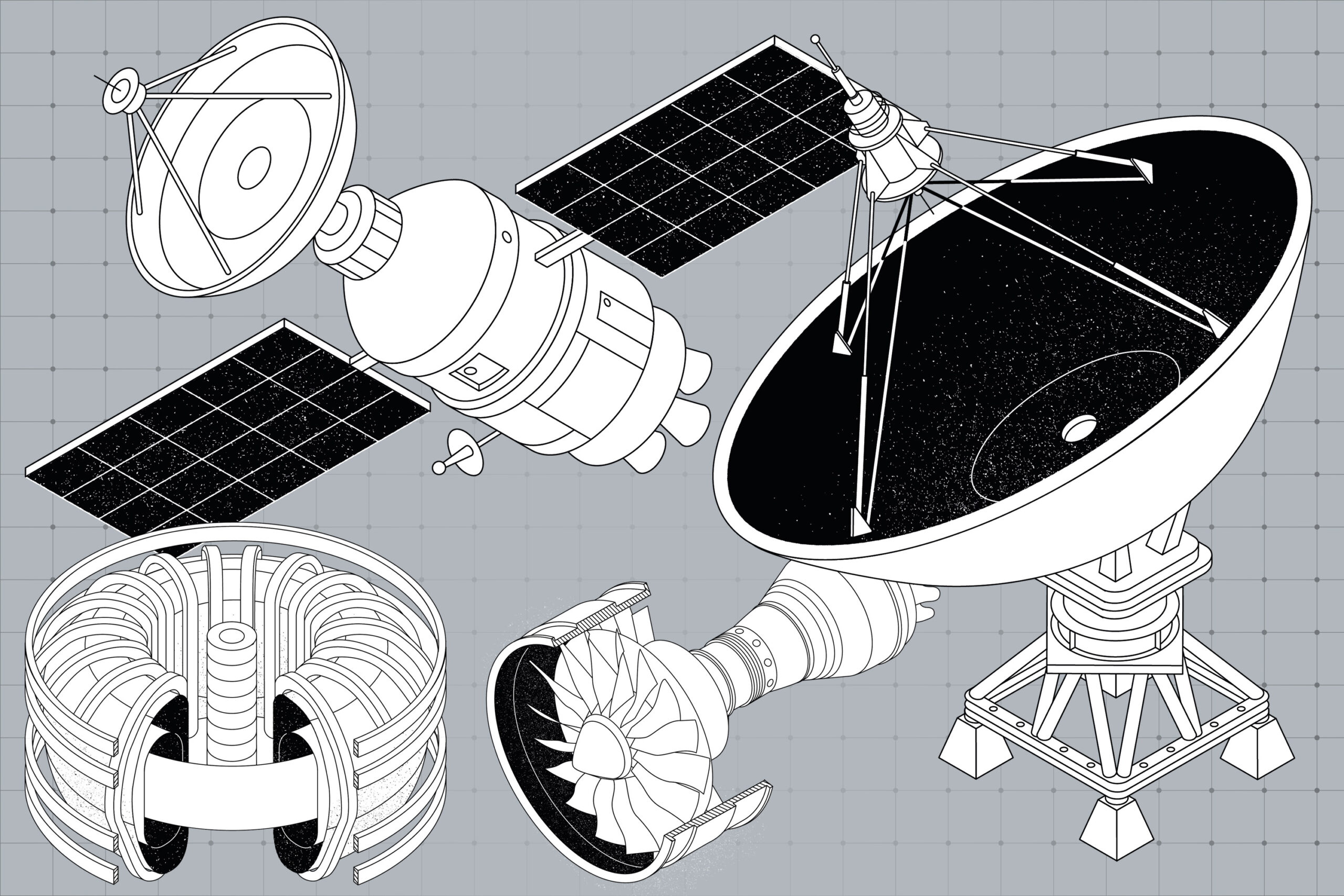
Nominal is an advanced software platform made for engineers building complex systems ranging from fighter jets to nuclear reactors, satellites, rockets, and robots. Nominal’s flagship product, Nominal Core, helps teams organize, visualize, and securely share data from tests and operations. The company’s other product, Nominal Connect, helps engineers build custom applications for automating and syncing their hardware systems.
“It’s a very technically challenging problem to take the types of data that our customers are generating and get them into a single place where people can collaborate and get insights,” says Nominal co-founder Jason Hoch ’13. “It’s hard because you’re dealing with a lot of different data sources, and you want to be able to correlate those sources and apply mathematical formulas. We do that automatically.”
Hoch started Nominal with Cameron McCord ’13, SM ’14 and Bryce Strauss after the founders had to work with generic data tools or build their own solutions at places like Lockheed Martin and Anduril. Today, Nominal is working with organizations in aerospace, defense, robotics, manufacturing, and energy to accelerate the development of products critical for applications in U.S. national security and beyond.
“We built Nominal to take the best innovations in software and data technology and tailor them to the workflows that engineers go through when building and testing hardware systems,” McCord says. “We want to be the data and software backbone across all of these types of organizations.”
Accelerating hardware development
Hoch and McCord met during their first week at MIT and joined the same fraternity as undergraduates. Hock double majored in mathematics and computer science and engineering, and McCord participated in the Navy Reserve Officers’ Training Corps (NROTC) while majoring in physics and nuclear science and engineering.
“MIT let me flex my technical skills, but I was also interested in the broader implications of technology and national security,” McCord says. “It was an interesting balance where I was learning the hardcore engineering skills, but always having a wider aperture to understand how the technology I was learning about was going to impact the world.”
Following MIT, McCord spent eight years in the Navy before working at the defense technology company Anduril, where he was charged with building the software systems to test different products. Hoch also worked at the intelligence and defense-oriented software company Palantir.
McCord met Strauss, who had worked as an engineer at Lockheed Martin, while the two were at Harvard Business School. The eventual co-founders realized they had each struggled with software during complex hardware development projects, and set out to build the tools they wished they’d had.
At the heart of Nominal’s platform is a unified database that can connect and organize hundreds of data sources in real-time. Nominal’s system allows engineers to search through or visualize that information, helping them spot trends, catch critical events, and investigate anomalies — what Nominal’s team describes as learning the rules governing complex systems.
“We’re trying to get answers to engineers so they understand what’s happening and can keep projects moving forward,” says Strauss. “Testing and validating these systems are fundamental bottlenecks for hardware progress. Our platform helps engineers answer questions like, ‘When we made a 30-degree turn at 16,000 feet, what happened to the engine’s temperature, and how does that compare to what happened yesterday?’”
By automating tasks like data stitching and visualization, Nominal’s platform helps accelerate post-test analysis and development processes for complex systems. And because the platform is cloud-hosted, engineers can easily share visualizations and other dynamic assets with members of their team as opposed to making static reports, allowing more people in an organization to interact directly with the data.
From satellites to drones, robots to rockets
Nominal recently announced a $75 million Series B funding round, led by Sequoia Capital, to accelerate their growth.
“We’ll use the funds to accelerate product roadmaps for our existing products, launch new products across the hardware test stack, and more than double our team,” says McCord.
Today, aerospace customers are using Nominal’s platform to monitor their assets in orbit. Manufacturers are using Nominal to make sure their components work as expected before they’re integrated into larger systems. Nuclear fusion companies are using Nominal to understand when their parts might fail due to heat.
“The products we’ve built are transferrable,” Hoch says. “It doesn’t matter if you’re building a nuclear fusion reactor or a satellite, those teams can benefit from the Nominal tool chain.”
Ultimately the founders believe the platform helps create better products by enabling a data-driven, iterative design process more commonly seen in the software development industry.
“The concept of continuous integration and development in software revolutionized the industry 20 years ago. Before that, it was common to build software in large, slow batches – developing for months, then testing and releasing all at once,” Strauss explains. “We’re bringing continuous testing to hardware. It’s about constantly creating that feedback loop to improve performance. It’s a new paradigm for how hardware is built. We’ve seen companies like SpaceX do this well to move faster and outpace the competition. Now, that approach is available to everyone.”
