


Close Menu
RoboNewsWire – Latest Insights on AI, Robotics, Crypto and Tech Innovations
  • Home
  • AI
  • Crypto
  • Cybersecurity
  • IT
  • Energy
  • Robotics
  • TechCrunch
  • Technology
What's Hot

Sam Altman’s project World looks to scale its human verification empire. First stop: Tinder.

April 23, 2026

Florida’s attorney general investigates ChatGPT’s role in FSU gunman’s crime

April 22, 2026

China calls for ‘concerted’ efforts to tackle excess solar production

April 22, 2026
Facebook X (Twitter) Instagram
Trending
  • Sam Altman’s project World looks to scale its human verification empire. First stop: Tinder.
  • Florida’s attorney general investigates ChatGPT’s role in FSU gunman’s crime
  • China calls for ‘concerted’ efforts to tackle excess solar production
  • Trump details Cook call to ‘kiss my ass,’ and his dealmaking prowess
  • Once close enough for an acquisition, Stripe and Airwallex are now going after each other
  • Tackling the housing shortage with robotic microfactories | MIT News
  • USA Rare Earth to buy Brazil’s Serra Verde for $2.8 billion
  • The App Store is booming again, and AI may be why
  • Home
  • About Us
  • Advertise
  • Contact Us
  • DMCA
  • Privacy Policy
  • Terms & Conditions
Facebook X (Twitter) Instagram
RoboNewsWire – Latest Insights on AI, Robotics, Crypto and Tech InnovationsRoboNewsWire – Latest Insights on AI, Robotics, Crypto and Tech Innovations
Thursday, April 23
  • Home
  • AI
  • Crypto
  • Cybersecurity
  • IT
  • Energy
  • Robotics
  • TechCrunch
  • Technology
RoboNewsWire – Latest Insights on AI, Robotics, Crypto and Tech Innovations
Home » Light-activated gel could impact wearables, soft robotics, and more | MIT News

Light-activated gel could impact wearables, soft robotics, and more | MIT News

GTBy GTApril 17, 2026 Robotics No Comments3 Mins Read
Share
Facebook Twitter LinkedIn Pinterest Email


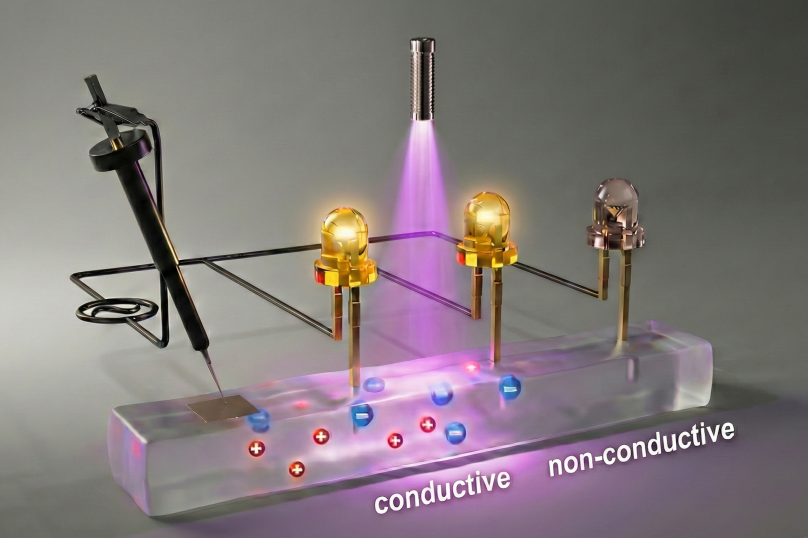
Consider the chief difference between living systems and electronics: The first is generally soft and squishy, while the latter is hard and rigid. Now, in work that could impact human-machine interfaces, biocompatible devices, soft robotics, and more, MIT engineers and colleagues have developed a soft, flexible gel that dramatically changes its conductivity upon the application of light.

Enter the growing field of ionotronics, which involves transferring data through ions, or charged molecules. Electronics does the same, with electrons. But while the latter is well established, ionotronics is still being developed, with one huge exception: living systems. The cells in our bodies communicate with a variety of ions, from potassium to sodium.

Ionotronics, in turn, can provide a bridge between electronics and biological tissues. Potential applications range from soft wearable technology to human-machine interfaces

“We’ve found a mechanism to dynamically control local ion population in a soft material,” says Thomas J. Wallin, the John F. Elliott Career Development Professor in MIT’s Department of Materials Science and Engineering and leader of the work. “That could allow a system that is self-adaptive to environmental stimuli, in this case light.” In other words, the system could automatically change in response to changes in light, which could allow complex signal processing in soft materials.

An open-access paper about the work was published online recently in Nature Communications.

A growing field

Although others have developed ionotronic materials with high conductivities that allow the quick movement of ions, those conductivities cannot be controlled. “What we’re doing is using light to switch a soft material from insulating to something that is 400 times more conductive,” says Xu Liu, first author of the paper and former MIT postdoc in materials science and engineering who is now an incoming assistant professor at King’s College London.

Key to the work is a class of materials known as photo-ion generators (PIGs). These can become some 1,000 times more conductive upon the application of light. The MIT team optimized a way to incorporate a PIG into polyurethane rubber by first dissolving a PIG powder into a solvent, and then using a swelling method to get it into the rubber.

Much potential

In the material reported in the current work, the change in conductivity is irreversible. But Liu is confident that future versions could switch back and forth between insulating and conducting states.

She notes that the current material was developed using only one kind of PIG, polymer (the polyurethane rubber), and solvent, but there are many other kinds of all three. So there is great potential for creating even better light-responsive soft materials.

Liu also notes the potential for developing soft materials that respond to other environmental stimuli, such as heat or magnetism. “We’re inspired to do more work in this field by changing the driving force from light to other forms of environmental stimuli,” she says.

“Our work has the potential to lead to the creation of a subfield that we call soft photo-ionotronics,” Liu continues. “We are also very excited about the opportunities from our work to create new soft machines impacting soft wearable technology, human-machine interfaces, robotics, biomedicine, and other fields.”

Additional authors of the paper are Steven M. Adelmund, Shahriar Safaee, and Wenyang Pan of Reality Labs at Meta. 


Source link

GT
  • Website

Keep Reading

Tackling the housing shortage with robotic microfactories | MIT News

Managing traffic in space | MIT News

Human-machine teaming dives underwater | MIT News

A new type of electrically driven artificial muscle fiber | MIT News

Jennifer Lewis ScD ’91: “Can we make tissues that are made from you, for you?” | MIT News

Vine-inspired robotic gripper gently lifts heavy and fragile objects | MIT News

Add A Comment
Leave A Reply Cancel Reply

Editors Picks

Trump details Cook call to ‘kiss my ass,’ and his dealmaking prowess

April 22, 2026

Amazon pressured companies to hike prices on rivals

April 21, 2026

Amazon invest up to $25 billion in Anthropic part of AI infrastructure

April 21, 2026

Apple new CEO John Ternus faces defining challenge: Fixing AI strategy

April 21, 2026
Latest Posts

Malicious Chrome Extension Steal ChatGPT and DeepSeek Conversations from 900K Users

April 1, 2026

Top 10 Best Server Monitoring Tools

April 1, 2026

10 Best Cybersecurity Risk Management Tools

March 31, 2026

Subscribe to News

Subscribe to our newsletter and never miss our latest news

Subscribe my Newsletter for New Posts & tips Let's stay updated!

Welcome to RoboNewsWire, your trusted source for cutting-edge news and insights in the world of technology. We are dedicated to providing timely and accurate information on the most important trends shaping the future across multiple sectors. Our mission is to keep you informed and ahead of the curve with deep dives, expert analysis, and the latest updates in key industries that are transforming the world.

Subscribe to Updates

Subscribe to our newsletter and never miss our latest news

Subscribe my Newsletter for New Posts & tips Let's stay updated!

Facebook X (Twitter) Instagram
  • Home
  • About Us
  • Advertise
  • Contact Us
  • DMCA
  • Privacy Policy
  • Terms & Conditions
© 2026 Robonewswire. Designed by robonewswire.

Type above and press Enter to search. Press Esc to cancel.