



When ChatGPT or Gemini give what seems to be an expert response to your burning questions, you may not realize how much information it relies on to give that reply. Like other popular generative artificial intelligence (AI) models, these chatbots rely on backbone systems called foundation models that train on billions, or even trillions, of data points.
In a similar vein, engineers are hoping to build foundation models that train a range of robots on new skills like picking up, moving, and putting down objects in places like homes and factories. The problem is that it’s difficult to collect and transfer instructional data across robotic systems. You could teach your system by teleoperating the hardware step-by-step using technology like virtual reality (VR), but that can be time-consuming. Training on videos from the internet is less instructive, since the clips don’t provide a step-by-step, specialized task walk-through for particular robots.
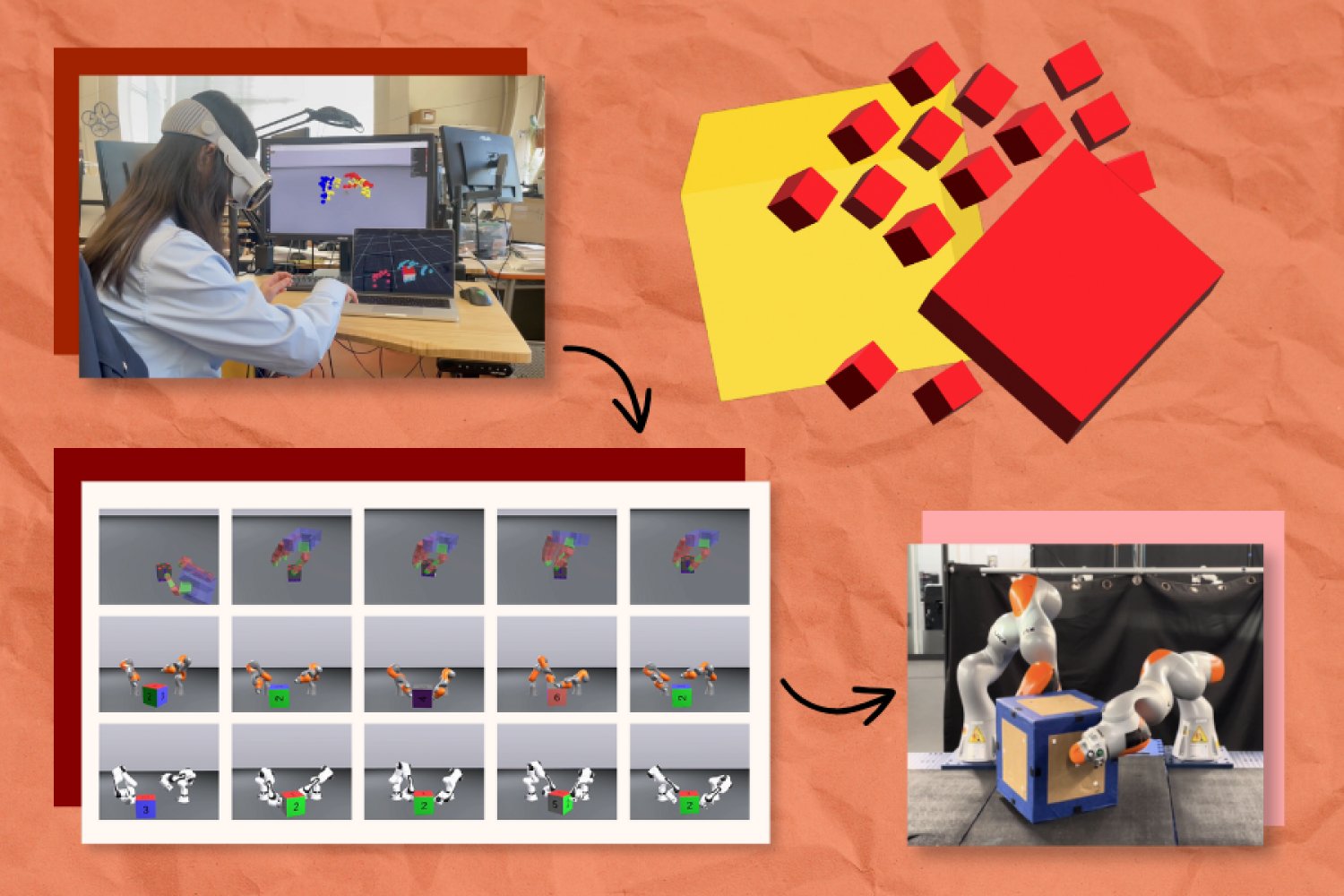
A simulation-driven approach called “PhysicsGen” from MIT’s Computer Science and Artificial Intelligence Laboratory (CSAIL) and the Robotics and AI Institute customizes robot training data to help robots find the most efficient movements for a task. The system can multiply a few dozen VR demonstrations into nearly 3,000 simulations per machine. These high-quality instructions are then mapped to the precise configurations of mechanical companions like robotic arms and hands.
PhysicsGen creates data that generalize to specific robots and condition via a three-step process. First, a VR headset tracks how humans manipulate objects like blocks using their hands. These interactions are mapped in a 3D physics simulator at the same time, visualizing the key points of our hands as small spheres that mirror our gestures. For example, if you flipped a toy over, you’d see 3D shapes representing different parts of your hands rotating a virtual version of that object.
The pipeline then remaps these points to a 3D model of the setup of a specific machine (like a robotic arm), moving them to the precise “joints” where a system twists and turns. Finally, PhysicsGen uses trajectory optimization — essentially simulating the most efficient motions to complete a task — so the robot knows the best ways to do things like repositioning a box.
Each simulation is a detailed training data point that walks a robot through potential ways to handle objects. When implemented into a policy (or the action plan that the robot follows), the machine has a variety of ways to approach a task, and can try out different motions if one doesn’t work.
“We’re creating robot-specific data without needing humans to re-record specialized demonstrations for each machine,” says Lujie Yang, an MIT PhD student in electrical engineering and computer science and CSAIL affiliate who is the lead author of a new paper introducing the project. “We’re scaling up the data in an autonomous and efficient way, making task instructions useful to a wider range of machines.”
Generating so many instructional trajectories for robots could eventually help engineers build a massive dataset to guide machines like robotic arms and dexterous hands. For example, the pipeline might help two robotic arms collaborate on picking up warehouse items and placing them in the right boxes for deliveries. The system may also guide two robots to work together in a household on tasks like putting away cups.
PhysicsGen’s potential also extends to converting data designed for older robots or different environments into useful instructions for new machines. “Despite being collected for a specific type of robot, we can revive these prior datasets to make them more generally useful,” adds Yang.
Addition by multiplication
PhysicsGen turned just 24 human demonstrations into thousands of simulated ones, helping both digital and real-world robots reorient objects.
Yang and her colleagues first tested their pipeline in a virtual experiment where a floating robotic hand needed to rotate a block into a target position. The digital robot executed the task at a rate of 81 percent accuracy by training on PhysicGen’s massive dataset, a 60 percent improvement from a baseline that only learned from human demonstrations.
The researchers also found that PhysicsGen could improve how virtual robotic arms collaborate to manipulate objects. Their system created extra training data that helped two pairs of robots successfully accomplish tasks as much as 30 percent more often than a purely human-taught baseline.
In an experiment with a pair of real-world robotic arms, the researchers observed similar improvements as the machines teamed up to flip a large box into its designated position. When the robots deviated from the intended trajectory or mishandled the object, they were able to recover mid-task by referencing alternative trajectories from their library of instructional data.
Senior author Russ Tedrake, who is the Toyota Professor of Electrical Engineering and Computer Science, Aeronautics and Astronautics, and Mechanical Engineering at MIT, adds that this imitation-guided data generation technique combines the strengths of human demonstration with the power of robot motion planning algorithms.
“Even a single demonstration from a human can make the motion planning problem much easier,” says Tedrake, who is also a senior vice president of large behavior models at the Toyota Research Institute and CSAIL principal investigator. “In the future, perhaps the foundation models will be able to provide this information, and this type of data generation technique will provide a type of post-training recipe for that model.”
The future of PhysicsGen
Soon, PhysicsGen may be extended to a new frontier: diversifying the tasks a machine can execute.
“We’d like to use PhysicsGen to teach a robot to pour water when it’s only been trained to put away dishes, for example,” says Yang. “Our pipeline doesn’t just generate dynamically feasible motions for familiar tasks; it also has the potential of creating a diverse library of physical interactions that we believe can serve as building blocks for accomplishing entirely new tasks a human hasn’t demonstrated.”
Creating lots of widely applicable training data may eventually help build a foundation model for robots, though MIT researchers caution that this is a somewhat distant goal. The CSAIL-led team is investigating how PhysicsGen can harness vast, unstructured resources — like internet videos — as seeds for simulation. The goal: transform everyday visual content into rich, robot-ready data that could teach machines to perform tasks no one explicitly showed them.
Yang and her colleagues also aim to make PhysicsGen even more useful for robots with diverse shapes and configurations in the future. To make that happen, they plan to leverage datasets with demonstrations of real robots, capturing how robotic joints move instead of human ones.
The researchers also plan to incorporate reinforcement learning, where an AI system learns by trial and error, to make PhysicsGen expand its dataset beyond human-provided examples. They may augment their pipeline with advanced perception techniques to help a robot perceive and interpret their environment visually, allowing the machine to analyze and adapt to the complexities of the physical world.
For now, PhysicsGen shows how AI can help us teach different robots to manipulate objects within the same category, particularly rigid ones. The pipeline may soon help robots find the best ways to handle soft items (like fruits) and deformable ones (like clay), but those interactions aren’t easy to simulate yet.
Yang and Tedrake wrote the paper with two CSAIL colleagues: co-lead author and MIT PhD student Hyung Ju “Terry” Suh SM ’22 and MIT PhD student Bernhard Paus Græsdal. Robotics and AI Institute researchers Tong Zhao ’22, MEng ’23, Tarik Kelestemur, Jiuguang Wang, and Tao Pang PhD ’23 are also authors. Their work was supported by the Robotics and AI Institute and Amazon.
The researchers recently presented their work at the Robotics: Science and Systems conference.
