



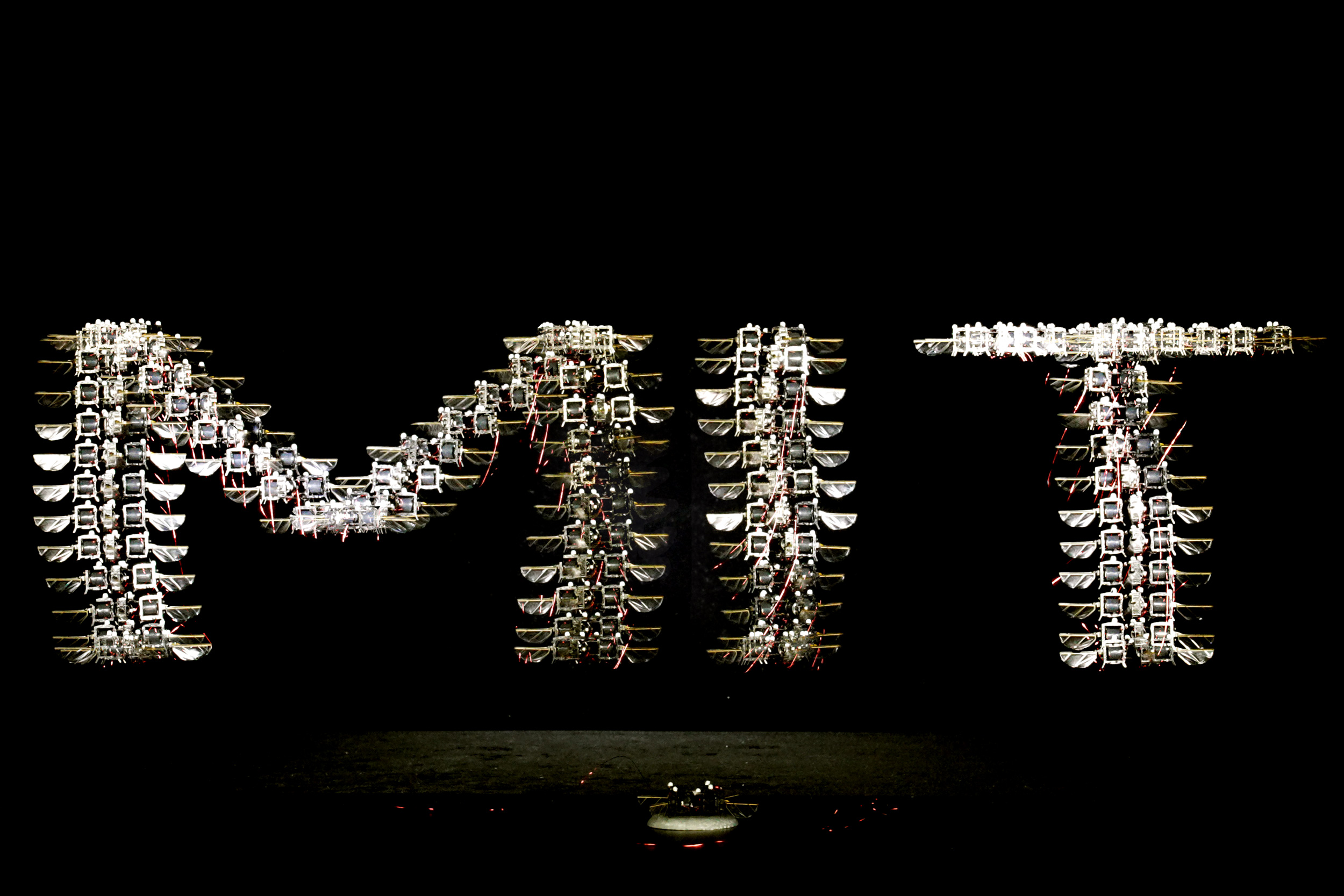
With a more efficient method for artificial pollination, farmers in the future could grow fruits and vegetables inside multilevel warehouses, boosting yields while mitigating some of agriculture’s harmful impacts on the environment.
To help make this idea a reality, MIT researchers are developing robotic insects that could someday swarm out of mechanical hives to rapidly perform precise pollination. However, even the best bug-sized robots are no match for natural pollinators like bees when it comes to endurance, speed, and maneuverability.
Now, inspired by the anatomy of these natural pollinators, the researchers have overhauled their design to produce tiny, aerial robots that are far more agile and durable than prior versions.
The new bots can hover for about 1,000 seconds, which is more than 100 times longer than previously demonstrated. The robotic insect, which weighs less than a paperclip, can fly significantly faster than similar bots while completing acrobatic maneuvers like double aerial flips.
The revamped robot is designed to boost flight precision and agility while minimizing the mechanical stress on its artificial wing flexures, which enables faster maneuvers, increased endurance, and a longer lifespan.
The new design also has enough free space that the robot could carry tiny batteries or sensors, which could enable it to fly on its own outside the lab.
“The amount of flight we demonstrated in this paper is probably longer than the entire amount of flight our field has been able to accumulate with these robotic insects. With the improved lifespan and precision of this robot, we are getting closer to some very exciting applications, like assisted pollination,” says Kevin Chen, an associate professor in the Department of Electrical Engineering and Computer Science (EECS), head of the Soft and Micro Robotics Laboratory within the Research Laboratory of Electronics (RLE), and the senior author of an open-access paper on the new design.
Chen is joined on the paper by co-lead authors Suhan Kim and Yi-Hsuan Hsiao, who are EECS graduate students; as well as EECS graduate student Zhijian Ren and summer visiting student Jiashu Huang. The research appears today in Science Robotics.
Boosting performance
Prior versions of the robotic insect were composed of four identical units, each with two wings, combined into a rectangular device about the size of a microcassette.
“But there is no insect that has eight wings. In our old design, the performance of each individual unit was always better than the assembled robot,” Chen says.
This performance drop was partly caused by the arrangement of the wings, which would blow air into each other when flapping, reducing the lift forces they could generate.
The new design chops the robot in half. Each of the four identical units now has one flapping wing pointing away from the robot’s center, stabilizing the wings and boosting their lift forces. With half as many wings, this design also frees up space so the robot could carry electronics.
In addition, the researchers created more complex transmissions that connect the wings to the actuators, or artificial muscles, that flap them. These durable transmissions, which required the design of longer wing hinges, reduce the mechanical strain that limited the endurance of past versions.
“Compared to the old robot, we can now generate control torque three times larger than before, which is why we can do very sophisticated and very accurate path-finding flights,” Chen says.
Yet even with these design innovations, there is still a gap between the best robotic insects and the real thing. For instance, a bee has only two wings, yet it can perform rapid and highly controlled motions.
“The wings of bees are finely controlled by a very sophisticated set of muscles. That level of fine-tuning is something that truly intrigues us, but we have not yet been able to replicate,” he says.
Less strain, more force
The motion of the robot’s wings is driven by artificial muscles. These tiny, soft actuators are made from layers of elastomer sandwiched between two very thin carbon nanotube electrodes and then rolled into a squishy cylinder. The actuators rapidly compress and elongate, generating mechanical force that flaps the wings.
In previous designs, when the actuator’s movements reach the extremely high frequencies needed for flight, the devices often start buckling. That reduces the power and efficiency of the robot. The new transmissions inhibit this bending-buckling motion, which reduces the strain on the artificial muscles and enables them to apply more force to flap the wings.
Another new design involves a long wing hinge that reduces torsional stress experienced during the flapping-wing motion. Fabricating the hinge, which is about 2 centimeters long but just 200 microns in diameter, was among their greatest challenges.
“If you have even a tiny alignment issue during the fabrication process, the wing hinge will be slanted instead of rectangular, which affects the wing kinematics,” Chen says.
After many attempts, the researchers perfected a multistep laser-cutting process that enabled them to precisely fabricate each wing hinge.
With all four units in place, the new robotic insect can hover for more than 1,000 seconds, which equates to almost 17 minutes, without showing any degradation of flight precision.
“When my student Nemo was performing that flight, he said it was the slowest 1,000 seconds he had spent in his entire life. The experiment was extremely nerve-racking,” Chen says.
The new robot also reached an average speed of 35 centimeters per second, the fastest flight researchers have reported, while performing body rolls and double flips. It can even precisely track a trajectory that spells M-I-T.
“At the end of the day, we’ve shown flight that is 100 times longer than anyone else in the field has been able to do, so this is an extremely exciting result,” he says.
From here, Chen and his students want to see how far they can push this new design, with the goal of achieving flight for longer than 10,000 seconds.
They also want to improve the precision of the robots so they could land and take off from the center of a flower. In the long run, the researchers hope to install tiny batteries and sensors onto the aerial robots so they could fly and navigate outside the lab.
“This new robot platform is a major result from our group and leads to many exciting directions. For example, incorporating sensors, batteries, and computing capabilities on this robot will be a central focus in the next three to five years,” Chen says.
This research is funded, in part, by the U.S. National Science Foundation and a Mathworks Fellowship.
