



We move thanks to coordination among many skeletal muscle fibers, all twitching and pulling in sync. While some muscles align in one direction, others form intricate patterns, helping parts of the body move in multiple ways.
In recent years, scientists and engineers have looked to muscles as potential actuators for “biohybrid” robots — machines powered by soft, artificially grown muscle fibers. Such bio-bots could squirm and wiggle through spaces where traditional machines cannot. For the most part, however, researchers have only been able to fabricate artificial muscle that pulls in one direction, limiting any robot’s range of motion.
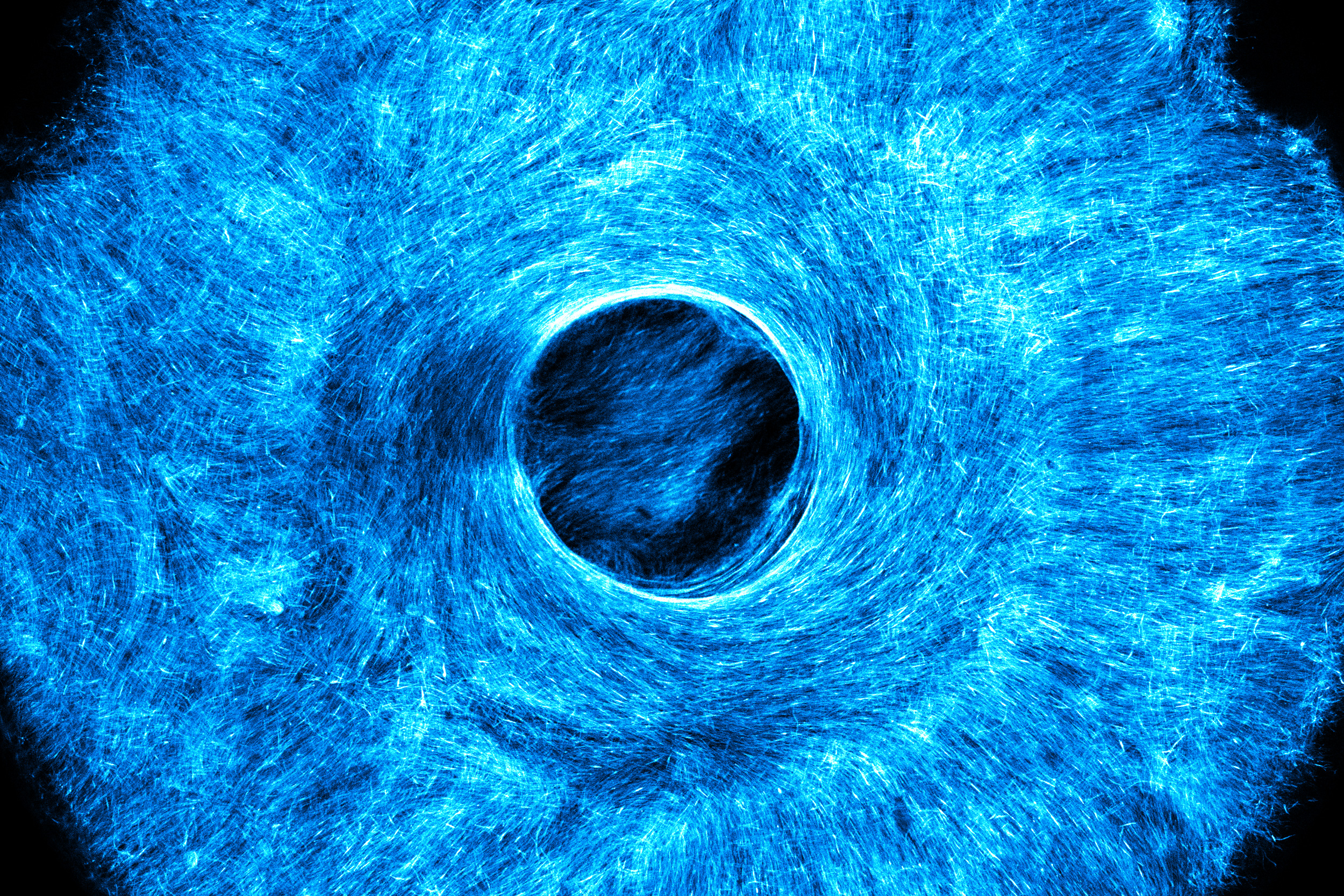
Now MIT engineers have developed a method to grow artificial muscle tissue that twitches and flexes in multiple coordinated directions. As a demonstration, they grew an artificial, muscle-powered structure that pulls both concentrically and radially, much like how the iris in the human eye acts to dilate and constrict the pupil.
The researchers fabricated the artificial iris using a new “stamping” approach they developed. First, they 3D-printed a small, handheld stamp patterned with microscopic grooves, each as small as a single cell. Then they pressed the stamp into a soft hydrogel and seeded the resulting grooves with real muscle cells. The cells grew along these grooves within the hydrogel, forming fibers. When the researchers stimulated the fibers, the muscle contracted in multiple directions, following the fibers’ orientation.
“With the iris design, we believe we have demonstrated the first skeletal muscle-powered robot that generates force in more than one direction. That was uniquely enabled by this stamp approach,” says Ritu Raman, the Eugene Bell Career Development Professor of Tissue Engineering in MIT’s Department of Mechanical Engineering.
The team says the stamp can be printed using tabletop 3D printers and fitted with different patterns of microscopic grooves. The stamp can be used to grow complex patterns of muscle — and potentially other types of biological tissues, such as neurons and heart cells — that look and act like their natural counterparts.
“We want to make tissues that replicate the architectural complexity of real tissues,” Raman says. “To do that, you really need this kind of precision in your fabrication.”
She and her colleagues published their open-access results Friday in the journal Biomaterials Science. Her MIT co-authors include first author Tamara Rossy, Laura Schwendeman, Sonika Kohli, Maheera Bawa, and Pavankumar Umashankar, along with Roi Habba, Oren Tchaicheeyan, and Ayelet Lesman of Tel Aviv University in Israel.
Training space
Raman’s lab at MIT aims to engineer biological materials that mimic the sensing, activity, and responsiveness of real tissues in the body. Broadly, her group seeks to apply these bioengineered materials in areas from medicine to machines. For instance, she is looking to fabricate artificial tissue that can restore function to people with neuromuscular injury. She is also exploring artificial muscles for use in soft robotics, such as muscle-powered swimmers that move through the water with fish-like flexibility.
Raman has previously developed what could be seen as gym platforms and workout routines for lab-grown muscle cells. She and her colleagues designed a hydrogel “mat” that encourages muscle cells to grow and fuse into fibers without peeling away. She also derived a way to “exercise” the cells by genetically engineering them to twitch in response to pulses of light. And, her group has come up with ways to direct muscle cells to grow in long, parallel lines, similar to natural, striated muscles. However, it’s been a challenge, for her group and others, to design artificial muscle tissue that moves in multiple, predictable directions.
“One of the cool things about natural muscle tissues is, they don’t just point in one direction. Take for instance, the circular musculature in our iris and around our trachea. And even within our arms and legs, muscle cells don’t point straight, but at an angle,” Raman notes. “Natural muscle has multiple orientations in the tissue, but we haven’t been able to replicate that in our engineered muscles.”
Muscle blueprint
In thinking of ways to grow multidirectional muscle tissue, the team hit on a surprisingly simple idea: stamps. Inspired in part by the classic Jell-O mold, the team looked to design a stamp, with microscopic patterns that could be imprinted into a hydrogel, similar to the muscle-training mats that the group has previously developed. The patterns of the imprinted mat could then serve as a roadmap along which muscle cells might follow and grow.
“The idea is simple. But how do you make a stamp with features as small as a single cell? And how do you stamp something that’s super soft? This gel is much softer than Jell-O, and it’s something that’s really hard to cast, because it could tear really easily,” Raman says.
The team tried variations on the stamp design and eventually landed on an approach that worked surprisingly well. The researchers fabricated a small, handheld stamp using high-precision printing facilities in MIT.nano, which enabled them to print intricate patterns of grooves, each about as wide as a single muscle cell, onto the bottom of the stamp. Before pressing the stamp into a hydrogel mat, they coated the bottom with a protein that helped the stamp imprint evenly into the gel and peel away without sticking or tearing.
As a demonstration, the researchers printed a stamp with a pattern similar to the microscopic musculature in the human iris. The iris comprises a ring of muscle surrounding the pupil. This ring of muscle is made up of an inner circle of muscle fibers arranged concentrically, following a circular pattern, and an outer circle of fibers that stretch out radially, like the rays of the sun. Together, this complex architecture acts to constrict or dilate the pupil.
Once Raman and her colleagues pressed the iris pattern into a hydrogel mat, they coated the mat with cells that they genetically engineered to respond to light. Within a day, the cells fell into the microscopic grooves and began to fuse into fibers, following the iris-like patterns and eventually growing into a whole muscle, with an architecture and size similar to a real iris.
When the team stimulated the artificial iris with pulses of light, the muscle contracted in multiple directions, similar to the iris in the human eye. Raman notes that the team’s artificial iris is fabricated with skeletal muscle cells, which are involved in voluntary motion, whereas the muscle tissue in the real human iris is made up of smooth muscle cells, which are a type of involuntary muscle tissue. They chose to pattern skeletal muscle cells in an iris-like pattern to demonstrate the ability to fabricate complex, multidirectional muscle tissue.
“In this work, we wanted to show we can use this stamp approach to make a ‘robot’ that can do things that previous muscle-powered robots can’t do,” Raman says. “We chose to work with skeletal muscle cells. But there’s nothing stopping you from doing this with any other cell type.”
She notes that while the team used precision-printing techniques, the stamp design can also be made using conventional tabletop 3D printers. Going forward, she and her colleagues plan to apply the stamping method to other cell types, as well as explore different muscle architectures and ways to activate artificial, multidirectional muscle to do useful work.
“Instead of using rigid actuators that are typical in underwater robots, if we can use soft biological robots, we can navigate and be much more energy-efficient, while also being completely biodegradable and sustainable,” Raman says. “That’s what we hope to build toward.”
This work was supported, in part, by the U.S. Office of Naval Research, the U.S. Army Research Office, the U.S. National Science Foundation, and the U.S. National Institutes of Health.
