



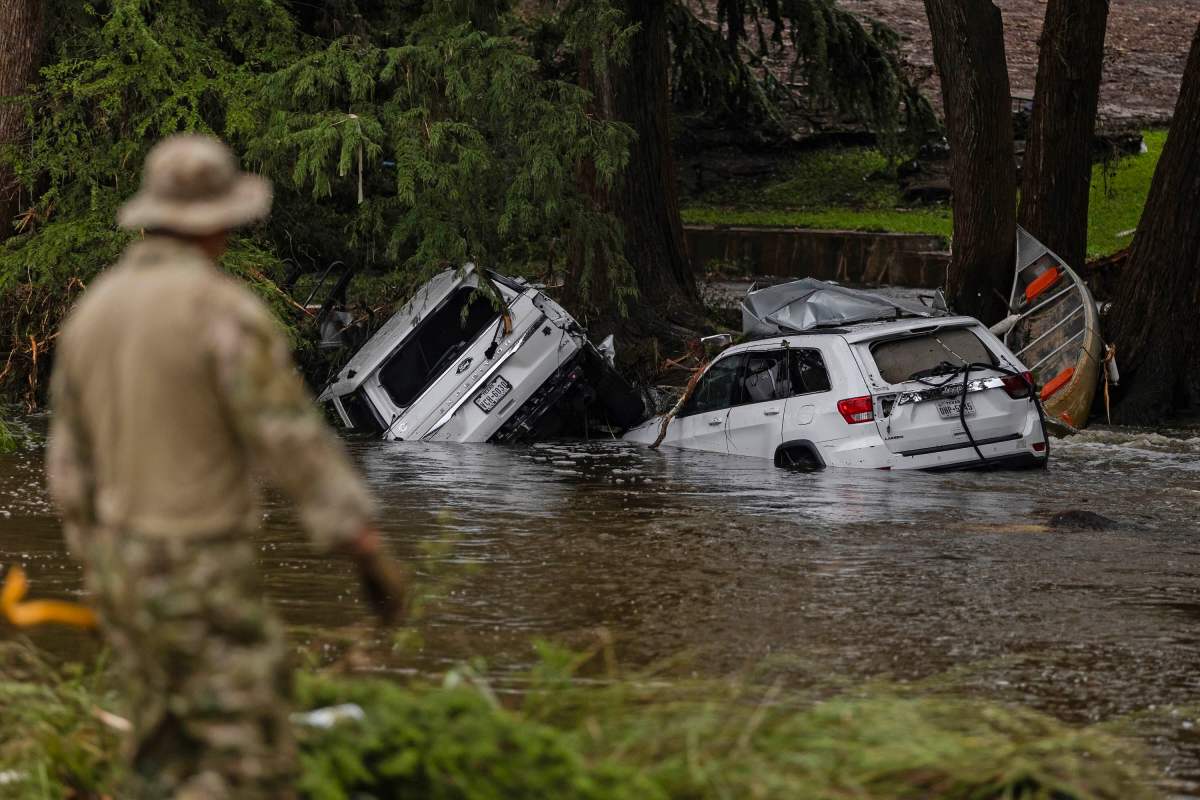
In the wake of a disaster, it’s not uncommon for people to look for answers anywhere they can find them. The devastating floods in Texas are no exception.
There are many potential reasons why so many people were killed by the swiftly rising waters, but one that some people have settled on is a practice known as cloud seeding. They claim that a cloud-seeding startup known as Rainmaker caused the storm to drop more rain than it otherwise would have. However, the data does not back up their concerns.
It’s true that Rainmaker was operating in that area a few days before the storm, but despite the online chatter, “cloud seeding had nothing to do” with the floods, said Katja Friedrich, an atmospheric scientist at the University of Colorado Boulder.
“It’s just a complete conspiracy theory. Somebody is looking for somebody to blame,” Bob Rauber, a professor of atmospheric sciences at the University of Illinois, told TechCrunch.
Cloud seeding is nothing new. It has been practiced since the 1950s, Rauber said. It works by spraying small particles into clouds, usually made of silver iodide.
Silver iodide particles mimic the shape of ice crystals, so when they bump into super-cooled water droplets — water that remains liquid below the freezing point — they trigger the droplets to freeze into ice. That freezing is important, Rauber said. Ice crystals grow in size faster than super-cooled water drops, meaning they are more likely to capture enough water vapor to become large enough to fall out of the cloud. If they had remained as super-cooled water, there’s a good chance they would eventually evaporate.
Only clouds that have a sufficient amount of super-cooled water are good candidates for cloud seeding.
In the U.S., most cloud seeding occurs in the winter near mountain ranges in the West. There, clouds form as the mountains push the air higher, causing it to cool and the water vapor to condense. If properly seeded, such clouds will release some of that water as snow, which is then held captive as snowpack, forming a natural reservoir that, during spring melts, replenishes artificial reservoirs held behind dams.
Though people have been seeding clouds for decades, its impact on precipitation is a newer area of study. “We really didn’t have the technologies to evaluate it until recently,” Rauber said.
In early 2017, Friedrich, Rauber, and their colleagues set up shop in Idaho to perform one of the most detailed studies of cloud seeding to date. On three occasions, they seeded clouds for a total of two hours and 10 minutes. It was enough to add around 186 million gallons of additional precipitation.
That might sound like a lot, and for drought-stricken Western states, it can make a difference. Idaho Power seeds many clouds throughout the winter to boost the amount of water being collected behind their dams so they can generate electricity throughout the year. “Their data shows that it’s cost-effective for them,” Rauber said.
But compared with a big storm, 186 million gallons is peanuts. “When we talk about that huge storm that occurred with the flooding [in Texas], we’re literally talking about the atmosphere processing trillions of gallons of water,” he said.
If Rainmaker influenced the storm, it was so minuscule that it would barely have been a rounding error. But the reality is, it didn’t.
For starters, the company was seeding nearby clouds days before the storm hit. “The air that was over that area two days before was probably somewhere over Canada by the time that storm occurred,” Rauber said.
Second, it’s not clear whether cloud seeding is as effective in the cumulus clouds that occur in Texas in the summer. They’re distinct from the orographic clouds that form near mountain ranges, and they don’t respond the same to cloud seeding. For one, they tend to be short-lived and don’t produce a lot of precipitation.
Cloud seeders might try to coax more out of them anyway, but “the amount of rain that comes out of those seeded clouds is small,” Rauber said.
Those that do last long enough? “Clouds that are deep, like thunderstorms, the natural processes are just fine,” he said. “Those clouds are very efficient. Seeding those clouds is not going to do anything.”
