



As America’s aging roads fall further behind on much-needed repairs, cities and states are turning to artificial intelligence to spot the worst hazards and decide which fixes should come first.
Hawaii officials, for example, are giving away 1,000 dashboard cameras as they try to reverse a recent spike in traffic fatalities. The cameras will use AI to automate inspections of guardrails, road signs and pavement markings, instantly discerning between minor problems and emergencies that warrant sending a maintenance crew.
“This is not something where it’s looked at once a month and then they sit down and figure out where they’re going to put their vans,” said Richard Browning, chief commercial officer at Nextbase, which developed the dashcams and imagery platform for Hawaii.
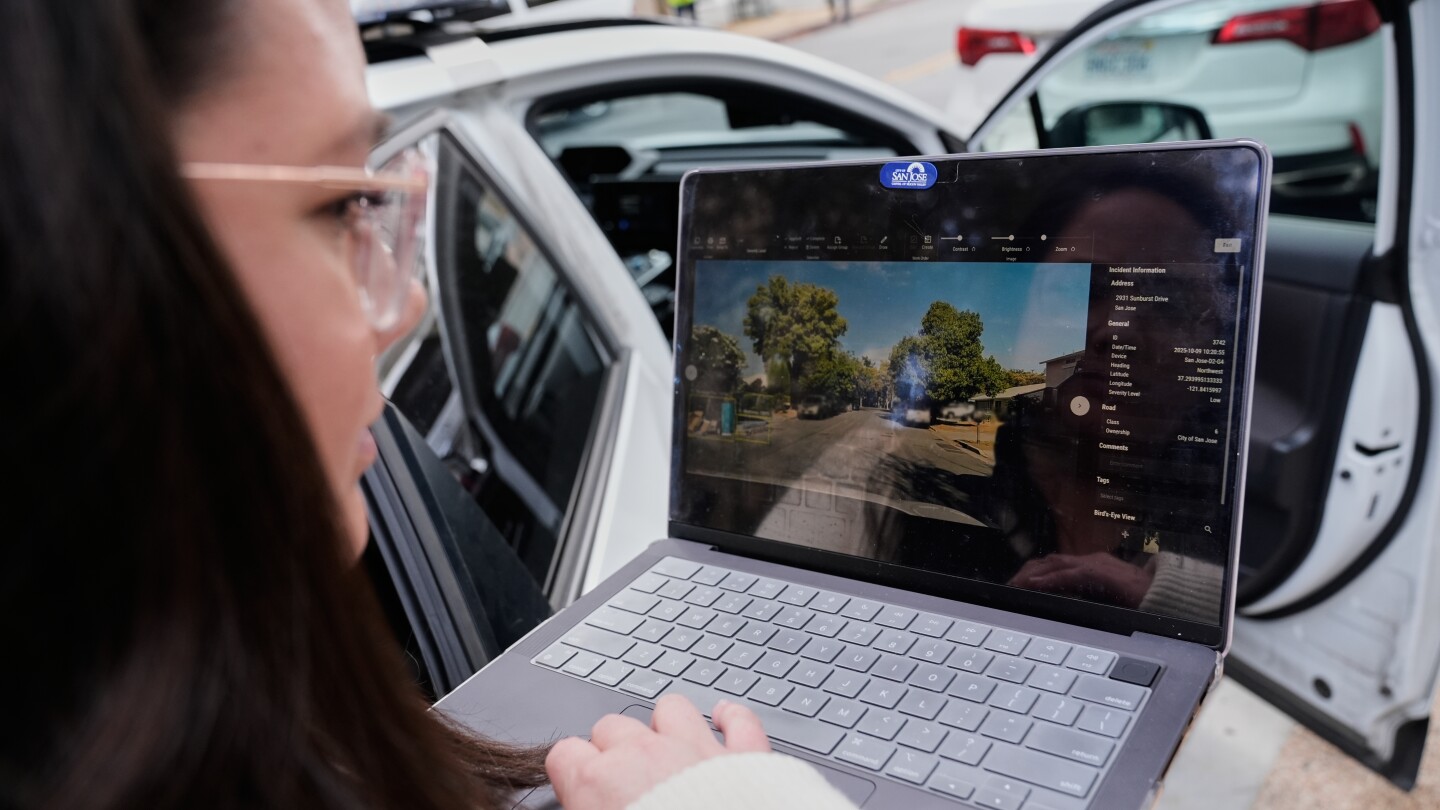
After San Jose, California, started mounting cameras on street sweepers, city staff confirmed the system correctly identified potholes 97% of the time. Now they’re expanding the effort to parking enforcement vehicles.
Texas, where there are more roadway lane miles than the next two states combined, is less than a year into a massive AI plan that uses cameras as well as cellphone data from drivers who enroll to improve safety.
Other states use the technology to inspect street signs or build annual reports about road congestion.
Every guardrail, every day
Hawaii drivers over the next few weeks will be able to sign up for a free dashcam valued at $499 under the “Eyes on the Road” campaign, which was piloted on service vehicles in 2021 before being paused due to wildfires.
Roger Chen, a University of Hawaii associate professor of engineering who is helping facilitate the program, said the state faces unique challenges in maintaining its outdated roadway infrastructure.
“Equipment has to be shipped to the island,” Chen said. “There’s a space constraint and a topography constraint they have to deal with, so it’s not an easy problem.”
Although the program also monitors such things as street debris and faded paint on lane lines, the companies behind the technology particularly tout its ability to detect damaged guardrails.
“They’re analyzing all guardrails in their state, every single day,” said Mark Pittman, CEO of Blyncsy, which combines the dashboard feeds with mapping software to analyze road conditions.
Hawaii transportation officials are well aware of the risks that can stem from broken guardrails. Last year, the state reached a $3.9 million settlement with the family of a driver who was killed in 2020 after slamming into a guardrail that had been damaged in a crash 18 months earlier but never repaired.
In October, Hawaii recorded its 106th traffic fatality of 2025 — more than all of 2024. It’s unclear how many of the deaths were related to road problems, but Chen said the grim trend underscores the timeliness of the dashboard program.
Building a larger AI database
San Jose has reported strong early success in identifying potholes and road debris just by mounting cameras on a few street sweepers and parking enforcement vehicles.
But Mayor Matt Mahan, a Democrat who founded two tech startups before entering politics, said the effort will be much more effective if cities contribute their images to a shared AI database. The system can recognize a road problem that it has seen before — even if it happened somewhere else, Mahan said.
“It sees, ‘Oh, that actually is a cardboard box wedged between those two parked vehicles, and that counts as debris on a roadway,’” Mahan said. “We could wait five years for that to happen here, or maybe we have it at our fingertips.”
San Jose officials helped establish the GovAI Coalition, which went public in March 2024 for governments to share best practices and eventually data. Other local governments in California, Minnesota, Oregon, Texas and Washington, as well as the state of Colorado, are members.
Some solutions are simple
Not all AI approaches to improving road safety require cameras.
Massachusetts-based Cambridge Mobile Telematics launched a system called StreetVision that uses cellphone data to identify risky driving behavior. The company works with state transportation departments to pinpoint where specific road conditions are fueling those dangers.
Ryan McMahon, the company’s senior vice president of strategy & corporate development, was attending a conference in Washington, D.C., when he noticed the StreetVision software was showing a massive number of vehicles braking aggressively on a nearby road.
The reason: a bush was obstructing a stop sign, which drivers weren’t seeing until the last second.
“What we’re looking at is the accumulation of events,” McMahon said. “That brought me to an infrastructure problem, and the solution to the infrastructure problem was a pair of garden shears.”
Texas officials have been using StreetVision and various other AI tools to address safety concerns. The approach was particularly helpful recently when they scanned 250,000 lane miles (402,000 kilometers) to identify old street signs long overdue for replacement.
“If something was installed 10 or 15 years ago and the work order was on paper, God help you trying to find that in the digits somewhere,” said Jim Markham, who deals with crash data for the Texas Department of Transportation. “Having AI that can go through and screen for that is a force multiplier that basically allows us to look wider and further much faster than we could just driving stuff around.”
Autonomous vehicles are next
Experts in AI-based road safety techniques say what’s being done now is largely just a stepping stone for a time when a large proportion of vehicles on the road will be driverless.
Pittman, the Blyncsy CEO who has worked on the Hawaii dashcam program, predicts that within eight years almost every new vehicle — with or without a driver — will come with a camera.
“How do we see our roadways today from the perspective of grandma in a Buick but also Elon and his Tesla?” Pittman said. “This is really important nuance for departments of transportation and city agencies. They’re now building infrastructure for humans and automated drivers alike, and they need to start bridging that divide.”
