



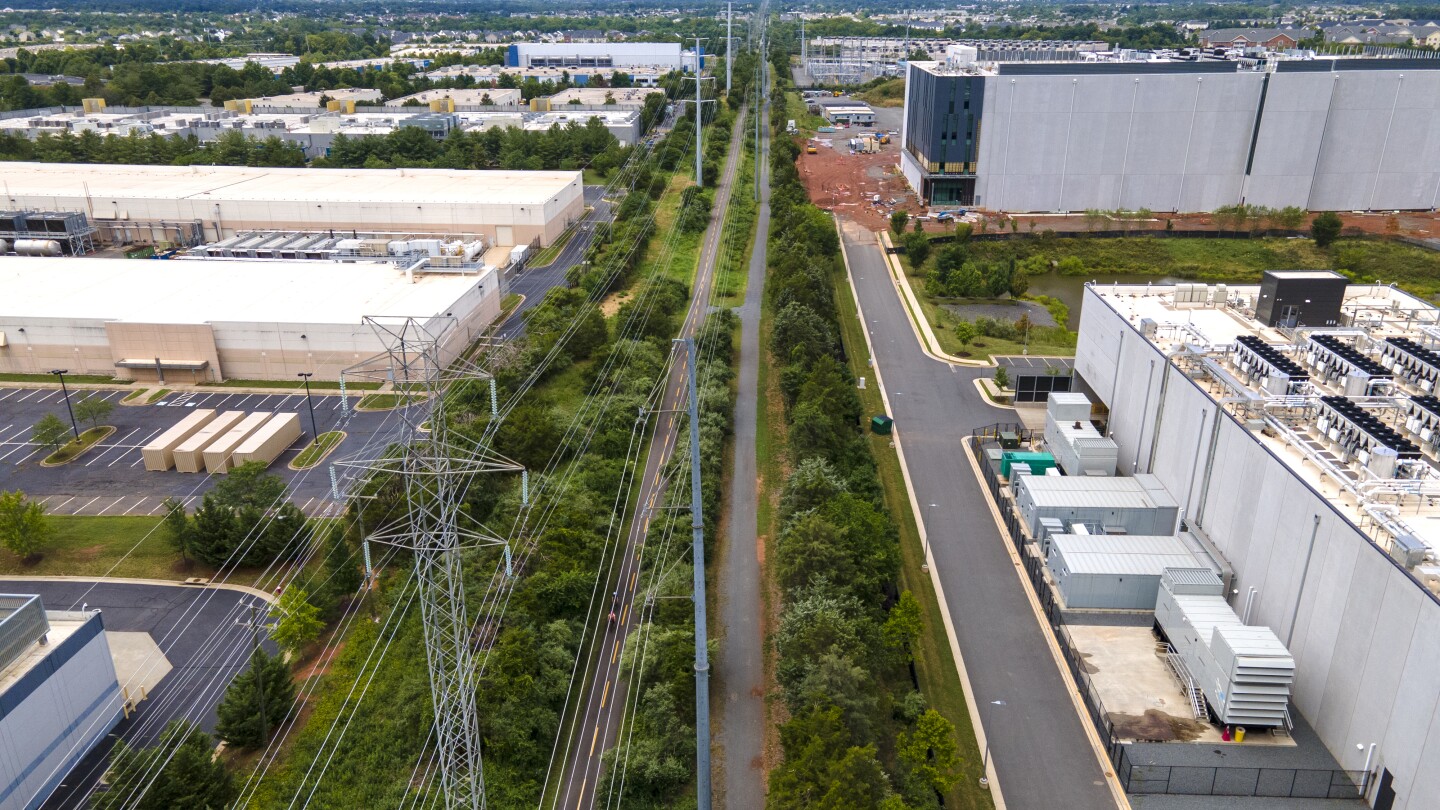
HARRISBURG, Pa. (AP) — With the explosive growth of Big Tech’s data centers threatening to overload U.S. electricity grids, policymakers are taking a hard look at a tough-love solution: bumping the energy-hungry data centers off grids during power emergencies.
Texas moved first, as state lawmakers try to protect residents in the data-center hotspot from another deadly blackout, like the winter storm in 2021 when dozens died.
Now the concept is emerging in the 13-state mid-Atlantic grid and elsewhere as massive data centers are coming online faster than power plants can be built and connected to grids. That has elicited pushback from data centers and Big Tech, for whom a steady power supply is vital.
Like many other states, Texas wants to attract data centers as an economic boon, but it faces the challenge of meeting the huge volumes of electricity the centers demand. Lawmakers there passed a bill in June that, among other things, orders up standards for power emergencies when utilities must disconnect big electric users.
That, in theory, would save enough electricity to avoid a broad blackout on the handful of days during the year when it is hottest or coldest and power consumption pushes grids to their limits or beyond.
Texas was first, but it won’t be the last, analysts say, now that the late 2022 debut of OpenAI’s ChatGPT ignited worldwide demand for chatbots and other generative AI products that typically require large amounts of computing power to train and operate.
“We’re going to see that kind of thing pop up everywhere,” said Michael Weber, a University of Texas engineering professor who specializes in energy. “Data center flexibility will be expected, required, encouraged, mandated, whatever it is.”
Data centers are threatening grids
That’s because grids can’t keep up with the fast-growing number of data center projects unfolding in Texas and perhaps 20 other states as the U.S. competes in a race against China for artificial intelligence superiority.
Grid operators in Texas, the Great Plains states and the mid-Atlantic region have produced eye-popping projections showing that electricity demand in the coming years will spike, largely due to data centers.
A proposal similar to Texas’ has emerged from the nation’s biggest grid operator, PJM Interconnection, which runs the mid-Atlantic grid that serves 65 million people and data-center hotspots in Virginia, Ohio and Pennsylvania.
The CEO of the Southwest Power Pool, which operates the grid that serves 18 million people primarily in Kansas, Oklahoma and other Great Plains states, said it has no choice but to expand power-reduction programs — likely for the biggest power users — to meet growing demand.
The proposals are cropping up at a time when electricity bills nationally are rising fast — twice the rate of inflation, according to federal data — and growing evidence suggests that the bills of some regular Americans are rising to subsidize the gargantuan energy needs of Big Tech.
Analysts say power plant construction cannot keep up with the growth of data center demand, and that something must change.
“Data center load has the potential to overwhelm the grid, and I think it is on its way to doing that,” said Joe Bowring, who heads Monitoring Analytics, the independent market watchdog in the mid-Atlantic grid.
Data centers might have to adjust
Big Tech is trying to make their data centers more energy efficient. They are also installing backup generators, typically fueled by diesel, to ensure an uninterrupted power supply if there’s a power outage.
Data center operators, however, say they hadn’t anticipated needing that backup power supply to help grid operators meet demand and are closely watching how utility regulators in Texas write the regulations.
The Data Center Coalition, which represents Big Tech companies and data center developers, wants the standards to be flexible, since some data centers may not be able to switch to backup power as easily or as quickly as others.
The grid operator also should balance that system with financial rewards for data centers that voluntarily shut down during emergencies, said Dan Diorio of the Data Center Coalition.
Nation’s largest grid operator has a proposal
PJM’s just-released proposal revolves around a concept in which proposed data centers may not be guaranteed to receive electricity during a power emergency.
That’s caused a stir among power plant owners and the tech industry.
Many questioned PJM’s legal authority to enforce it or warned of destabilizing energy markets and states scaring off investors and developers with uncertainty and risk.
“This is particularly concerning given that states within PJM’s footprint actively compete with other U.S. regions for data center and digital infrastructure investment,” the Digital Power Network, a group of Bitcoin miners and data center developers, said in written comments to PJM.
The governors of Pennsylvania, New Jersey, Illinois and Maryland said they worried that it’s too unpredictable to provide a permanent solution and that it should at least be accompanied by incentives for data centers to build new power sources and voluntarily reduce electricity use.
Others, including consumer advocates, warned that it won’t lower electric bills and that PJM should instead pursue a “bring your own generation” requirement for data centers to, in essence, build their own power source.
A deal is shrouded in secrecy
In Indiana, Google took a voluntary route.
Last month, the electric utility, Indiana & Michigan Power, and the tech giant filed a power-supply contract with Indiana regulators for a proposed $2 billion data center planned in Fort Wayne in which Google agreed to reduce electricity use there when the grid is stressed. The data center would, it said, reduce electricity use by delaying non-urgent tasks to when the electric grid is under less stress.
However, important details are being kept from the public and Ben Inskeep of the Citizens Action Coalition, a consumer advocacy group, said that leaves it unclear how valuable the arrangement really is, if at all.
A new way of thinking about electricity
To an extent, bumping big users off the grid during high-demand periods presents a new approach to electricity.
It could save money for regular ratepayers, since power is most expensive during peak usage periods.
Abe Silverman, an energy researcher at Johns Hopkins University, said that data centers can and do use all the electricity they want on most days.
But taking data centers off the grid for those handful of hours during the most extreme heat or cold would mean not having to spend billions of dollars to build a bunch of power plants, he said.
“And the question is, is that worth it? Is it worth it for society to build those 10 new power plants just to serve the data centers for five hours a year?” Silverman said. “Or is there a better way to do it?”
___
Follow Marc Levy on X at: https://x.com/timelywriter
