


Close Menu
RoboNewsWire – Latest Insights on AI, Robotics, Crypto and Tech Innovations
  • Home
  • AI
  • Crypto
  • Cybersecurity
  • IT
  • Energy
  • Robotics
  • TechCrunch
  • Technology
What's Hot

Investors trust Google more than Meta when comes to spending on AI

April 30, 2026

Paragon is not collaborating with Italian authorities probing spyware attacks, report says

April 28, 2026

Microsoft cuts OpenAI revenue share as their AI alliance loosens

April 28, 2026
Facebook X (Twitter) Instagram
Trending
  • Investors trust Google more than Meta when comes to spending on AI
  • Paragon is not collaborating with Italian authorities probing spyware attacks, report says
  • Microsoft cuts OpenAI revenue share as their AI alliance loosens
  • Robotically assembled building blocks could make construction more efficient and sustainable | MIT News
  • AI showdown: Musk and Altman go to trial in fight over OpenAI’s beginnings
  • U.S., Iran seize ships as war evolves into standoff over Strait of Hormuz
  • Google launches training and inference TPUs in latest shot at Nvidia
  • Zoom teams up with World to verify humans in meetings
  • Home
  • About Us
  • Advertise
  • Contact Us
  • DMCA
  • Privacy Policy
  • Terms & Conditions
Facebook X (Twitter) Instagram
RoboNewsWire – Latest Insights on AI, Robotics, Crypto and Tech InnovationsRoboNewsWire – Latest Insights on AI, Robotics, Crypto and Tech Innovations
Thursday, May 7
  • Home
  • AI
  • Crypto
  • Cybersecurity
  • IT
  • Energy
  • Robotics
  • TechCrunch
  • Technology
RoboNewsWire – Latest Insights on AI, Robotics, Crypto and Tech Innovations
Home » ClickFix Attack Uses Steganography to Hide Malicious Code in Fake Windows Security Update Screen

ClickFix Attack Uses Steganography to Hide Malicious Code in Fake Windows Security Update Screen

GTBy GTNovember 25, 2025 Cybersecurity No Comments3 Mins Read
Share
Facebook Twitter LinkedIn Pinterest Email


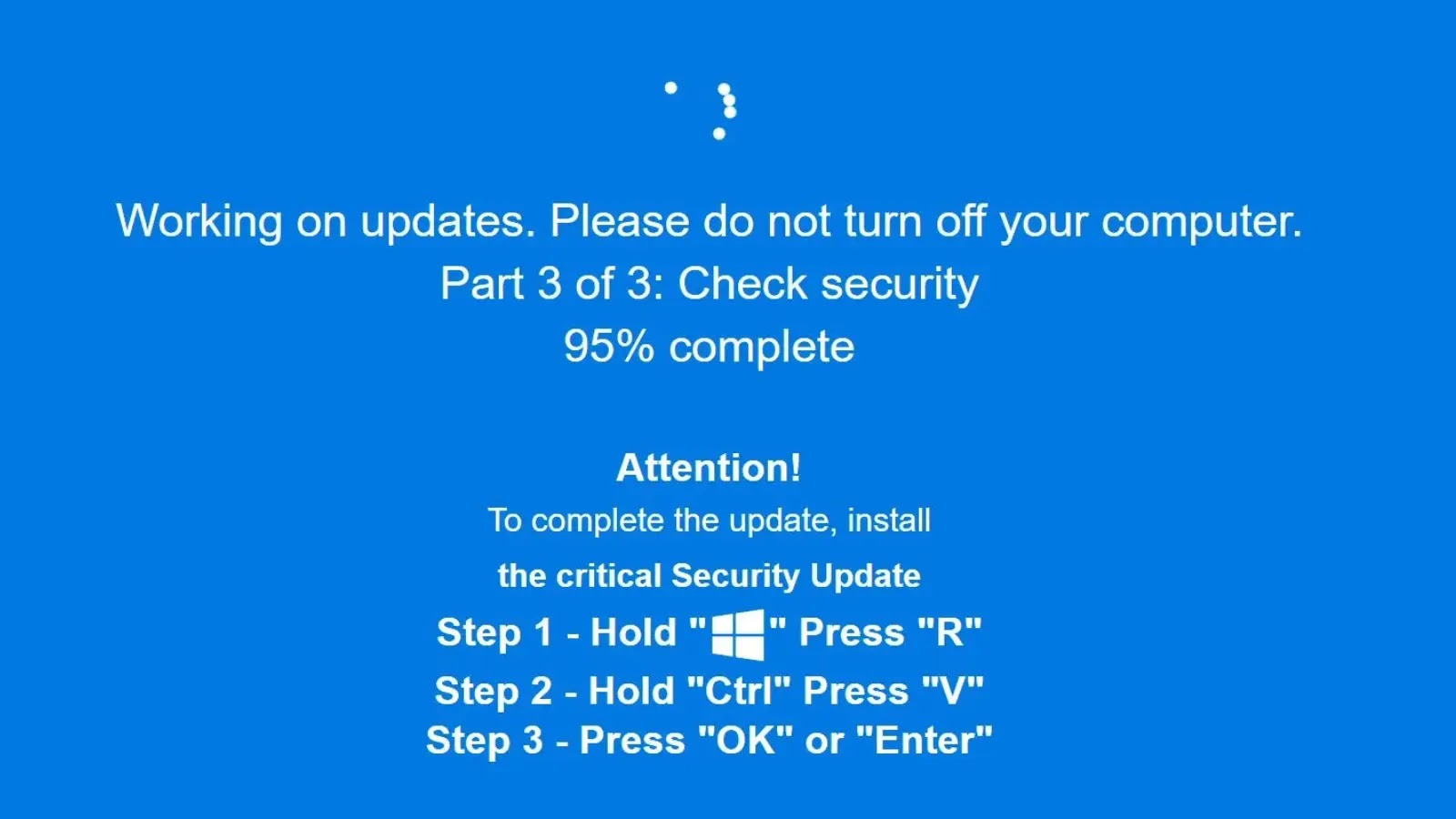
Fake Windows Security Update Screen

A new wave of ClickFix attacks is abusing highly realistic fake Windows Update screens and PNG image steganography to secretly deploy infostealing malware such as LummaC2 and Rhadamanthys on victim systems.

The campaigns rely on tricking users into manually running a pre-staged command, turning simple social engineering into a multi-stage, file-light infection chain that is hard for traditional defenses to spot.​

ClickFix is a social engineering technique in which a web page convinces users to press Win+R, then paste and run a command that has been silently copied to the clipboard.

Earlier lures posed as “Human Verification” or robot-check pages, but newer activity observed by Huntress swaps this for a full-screen, blue Windows Update-style splash screen with convincing progress messages.

Fake Windows Update

Once the fake update “completes,” the page instructs users to follow the familiar pattern and execute the malicious Run-box command.​

That command typically launches mshta.exe with a URL whose second IP octet is hex-encoded, kicking off a staged chain that downloads obfuscated PowerShell and reflective .NET loaders. This approach leans heavily on trusted “living off the land” binaries, making the activity blend in with legitimate Windows behavior.​


google

Malware hidden in PNG pixels

The most distinctive feature of this campaign is its use of a .NET steganographic loader that hides shellcode inside the pixel data of a PNG image.

Instead of appending data, the loader AES-decrypts an embedded PNG resource, reads the raw bitmap bytes, and reconstructs shellcode from a specific color channel, using a custom XOR-based routine to recover the payload in memory.​

The recovered shellcode is Donut-packed and then injected into a target process such as explorer.exe via dynamically compiled C# code that calls standard Windows APIs like VirtualAllocEx, WriteProcessMemory, and CreateRemoteThread.

In analyzed cases, this final stage has delivered LummaC2 and, in a separate Windows Update cluster, the Rhadamanthys information stealer.​

Huntress has tracked ClickFix Windows Update clusters since early October, noting repeated use of the IP address 141.98.80[.]175 and rotating paths such as /tick.odd, /gpsc.dat, and /one.dat for the first mshta.exe stage.

Subsequent PowerShell stages have been hosted on domains like securitysettings[.]live and xoiiasdpsdoasdpojas[.]com, pointing back to the same backend infrastructure.​

These campaigns continued to appear around the time of Operation Endgame 3.0, which targeted Rhadamanthys’ infrastructure in mid-November, disrupting servers and seizing domains linked to the stealer.

Even after the takedown announcement, researchers observed multiple active domains still serving the Windows Update ClickFix lure, though the Rhadamanthys payload itself appeared to be unavailable.​

Because the attack hinges on user interaction with the Run dialog, one strong control is to disable the Windows Run box via Group Policy or registry settings (for example, configuring the NoRun policy under the Explorer key).

Security teams should also use EDR telemetry to watch for explorer.exe spawning mshta.exe, powershell.exe, or other scripting binaries with suspicious command lines.​

User awareness remains critical: employees should be trained that neither CAPTCHA checks nor Windows Update processes will ever require pasting commands into the Run prompt from a web page.

During investigations, analysts can further validate potential ClickFix abuse by reviewing the RunMRU registry key, which records recent commands executed via the Run dialog.​

Follow us on Google News, LinkedIn, and X for daily cybersecurity updates. Contact us to feature your stories.


googlenews


Source link

GT
  • Website

Keep Reading

Malicious Chrome Extension Steal ChatGPT and DeepSeek Conversations from 900K Users

Top 10 Best Server Monitoring Tools

10 Best Cybersecurity Risk Management Tools

Best DDoS Protection Tools & Services in 2026 (Reviewed)

20 Best Malware Protection Solutions In 2026

10 Most Notable Cyber Attacks of 2026

Add A Comment
Leave A Reply Cancel Reply

Editors Picks

Investors trust Google more than Meta when comes to spending on AI

April 30, 2026

Google launches training and inference TPUs in latest shot at Nvidia

April 27, 2026

Meta tracks employee usage on Google, LinkedIn AI training project

April 25, 2026

Meta will cut 10% of workforce as company pushes deeper into AI

April 24, 2026
Latest Posts

Malicious Chrome Extension Steal ChatGPT and DeepSeek Conversations from 900K Users

April 1, 2026

Top 10 Best Server Monitoring Tools

April 1, 2026

10 Best Cybersecurity Risk Management Tools

March 31, 2026

Subscribe to News

Subscribe to our newsletter and never miss our latest news

Subscribe my Newsletter for New Posts & tips Let's stay updated!

Welcome to RoboNewsWire, your trusted source for cutting-edge news and insights in the world of technology. We are dedicated to providing timely and accurate information on the most important trends shaping the future across multiple sectors. Our mission is to keep you informed and ahead of the curve with deep dives, expert analysis, and the latest updates in key industries that are transforming the world.

Subscribe to Updates

Subscribe to our newsletter and never miss our latest news

Subscribe my Newsletter for New Posts & tips Let's stay updated!

Facebook X (Twitter) Instagram
  • Home
  • About Us
  • Advertise
  • Contact Us
  • DMCA
  • Privacy Policy
  • Terms & Conditions
© 2026 Robonewswire. Designed by robonewswire.

Type above and press Enter to search. Press Esc to cancel.
