



GANZHOU, China (AP) — China’s dominance over critical minerals in global supply chains was a powerful bargaining chip in trade talks between Beijing and Washington that concluded with both sides saying they have a framework to pursue a deal.
China has spent decades building the world’s main industrial chain for mining and processing such materials, which are used in many industries such as electronics, advanced manufacturing, defense and health care.
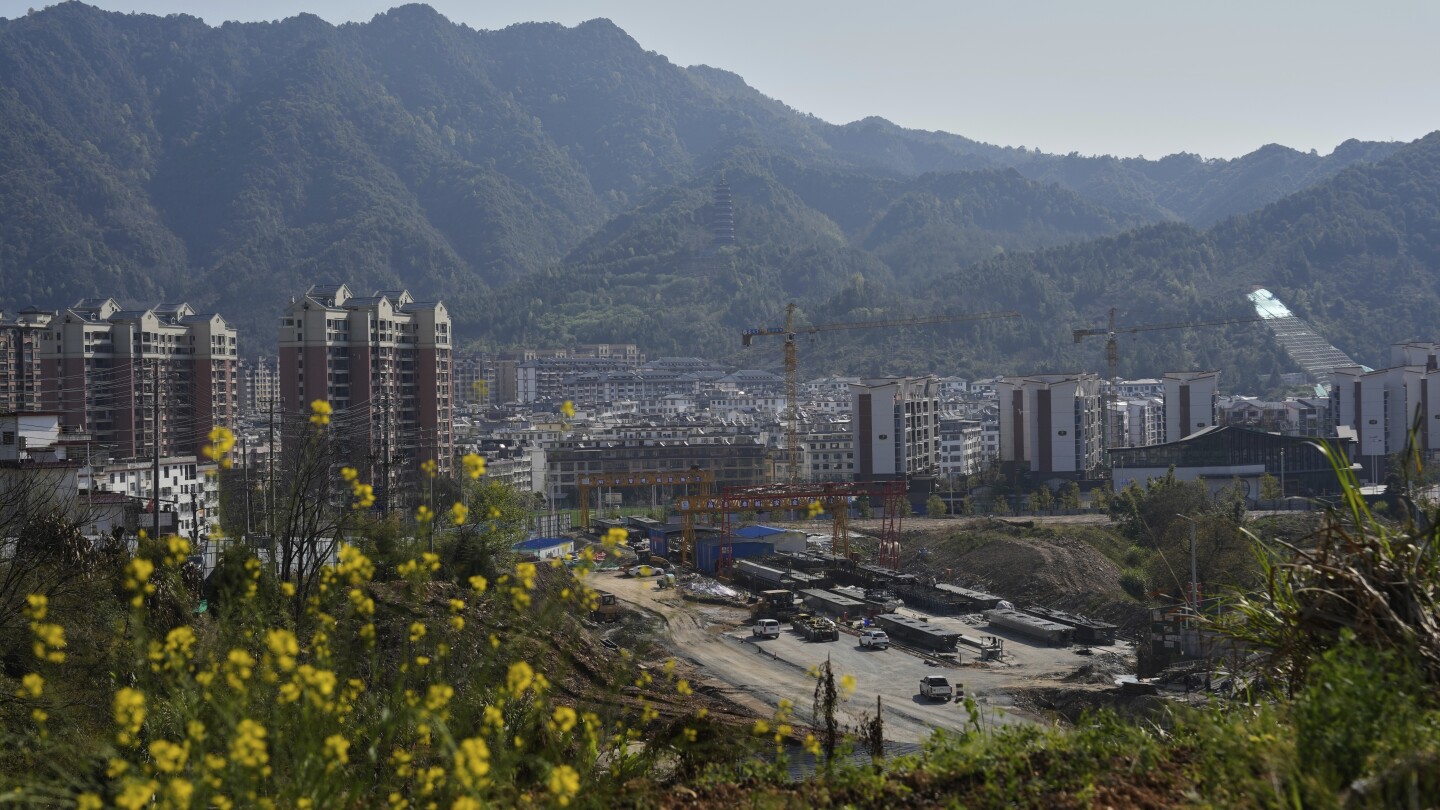
Mines and factories in and around Ganzhou, a key production hub for rare earths, underpin China’s control over the minerals. Many residents grew up collecting rocks containing the valuable minerals from the forested hills surrounding the southern city and today make a living from mining, trading or processing them.
Critical minerals as a trade issue
Responding to ever higher tariffs and other controls on advanced technology, China told exporters of certain key rare earths and other critical minerals to obtain licenses for every shipment abroad. Approvals can take weeks, leading to supply chain disruptions in the U.S. and other countries.
President Donald Trump said Wednesday that China would make it easier for American industry to obtain much-needed needed magnets and rare earth minerals, clearing the way for talks to continue between the world’s two biggest economies. In return, Trump said, the U.S. will stop efforts to revoke the visas of Chinese nationals on U.S. college campuses.
But details remain scarce. Beijing has not confirmed what the negotiators agreed to, and Chinese President Xi Jinping and Trump himself have yet to sign off on it.
The Chinese Commerce Ministry said Saturday it had approved a “certain number” of export licenses for rare earth products, apparently acknowledging Trump’s personal request to Xi during a phone call last week. And on Wednesday, the Ganzhou-based rare-earth conglomerate JL MAG Rare-Earth Co. confirmed it had obtained some export licenses for shipments to destinations including the U.S., Europe and Southeast Asia.
Experts say, however, Beijing is unlikely to do away with the permit system enabling it to control access to those valuable resources.
The only scenario in which China might deregulate its critical minerals export is if the U.S. first fully removes tariffs imposed on Chinese goods as part of the trade war, said Wang Yiwei, a professor of international affairs at Renmin University, echoing the Chinese government’s earlier stance.
“Without that,” he said, “it will be difficult to blame China for continuing to strengthen its export controls.”
An industry built over decades with government support
In 1992, Deng Xiaoping, the leader who launched China’s ascent as the world’s biggest manufacturing power, famously said “the Middle East has oil, China has rare earths,” signaling a desire to leverage access to the key minerals.
Several generations later, Beijing has made its rich reserves of rare earths, a group of 17 minerals that are abundant in the earth’s crust but hard, expensive and environmentally polluting to process, a key element of China’s economic security. In 2019, during a visit to a rare earth processing plant in Ganzhou, Xi described rare earths as a “vital strategic resource.”
China today has an essential monopoly over “heavy rare earths,” used for making powerful, heat-resistance magnets used in industries such as defense and electric vehicles.
The country also produces around 80% of the world’s tungsten, gallium and antimony, and 60% of the world’s germanium -– all minerals used in the making of semiconductors, among other advanced technologies.
The risks of dependency on Chinese suppliers first came into focus in 2010, when Beijing suspended rare earths exports to Japan due to a territorial dispute. The ban was lifted after about two months, but as a precaution, Japan invested in rare earths processing plants in other countries and began stockpiling the materials.
Beijing’s across-the-board requirement for export licenses for some critical minerals has put pressure on world electronics manufacturers and automakers.
Some auto parts makers in Europe have shut down production lines due to delays in supply deliveries, according to the European Association of Automotive Suppliers. In the U.S., Tesla CEO Elon Musk said a shortage of rare earths is affecting his company’s work on humanoid robots.
China’s critical minerals resources are dwindling
In the drab industrial hub of Ganzhou, cradled by the scenic Dayu Mountains, the U.S.-China trade war is still a distant stressor. Miners and small mineral traders interviewed by The Associated Press said they are more concerned about depleting the mountains’ once-abundant resources.
Zhong, a tungsten factory manager in Ganzhou who would only give his last name, worked his way up to manager from a miner, but he’s unsure there is a future for him and others in the industry.
“I find growing difficulties to source tungsten these days,” he said, adding that smaller mines and trading companies are slowly disappearing as the resources are dwindling. Tungsten is an ultra-hard metal used in armor-piercing ammunition, nuclear reactors and semiconductors.
At least five tungsten mines have closed in the area in recent years, according to state media. Remaining reserves are deeper and harder to extract and process after decades of exploitation, said Li Shangkui, chairman of the Ganzhou-based Jiangxi Yuean Advanced Materials Co., Ltd.
Processing factories in Ganzhou now routinely source materials from other provinces or other countries. Zhong’s plant imports some raw materials from places like Africa and Cambodia.
Major state-owned and private companies in Ganzhou are also ramping up investments abroad. Tungsten producer Ganzhou Haisheng, for instance, announced last year a $25 million investment in a new tungsten plant in Thailand.
Whatever the challenges in procuring raw materials, China likely will seek to maintain its dominance in critical minerals, said Fabian Villalobos, an engineer and critical minerals expert at the RAND think tank.
The U.S. lags far behind China on critical minerals
Between 2020 and 2023, the U.S. imported at least 70% of the rare earth compounds it used from China, according to the U.S. Geological Survey. It has diversified its sources in recent years, but still mainly relies on China.
Since beginning his second term in office, Trump has made improving access to critical minerals a matter of national security. But the U.S. has an incredibly long way to go to catch up with China, experts say.
The sole operational U.S. rare earths mine, in Mountain Pass, California, is unable to separate heavy rare earths. It sends its ore to China for processing. The U.S. Defense Department has provided funding to the mine’s owner, MP Materials, to build new separation facilities. It will take months to build and still only produce a fraction of what is needed.
Friction over the issue has opened the way for government-backed financing that was unavailable before, said Mark Smith, who ran the Mountain Pass mine in the early 2010s and now leads NioCorp. It’s seeking about $780 million in financing through the U.S. Export-Import Bank to build a processing facility in Nebraska for critical minerals including rare earths.
The Defense Department has committed $439 million to building domestic rare earth supply chains, but building a complete mining and processing industrial chain like China’s could take decades.
“There are going to be some real issues here unless we can figure out how to get along with China for a period of time while we’re developing our own resources and our mainstream processing,” Smith said.
The spotlight on critical minerals also provides opportunities for smaller miners to invest in extracting and processing some critical minerals, such as tungsten, considered “niche” because they are needed in relatively small amounts in key industries, said Milo McBride, an expert on sustainability and geopolitics at the Carnegie Endowment for International Peace.
“For many of these companies, the business strategy hedges on a scenario where the U.S. and China become more confrontational and where trade relations become more uncomfortable,” McBride said. “And all of a sudden, what was once an uneconomic project somewhere outside of China starts to make more sense.”
___
Associated Press news researcher Shihuan Chen contributed to this story.
