



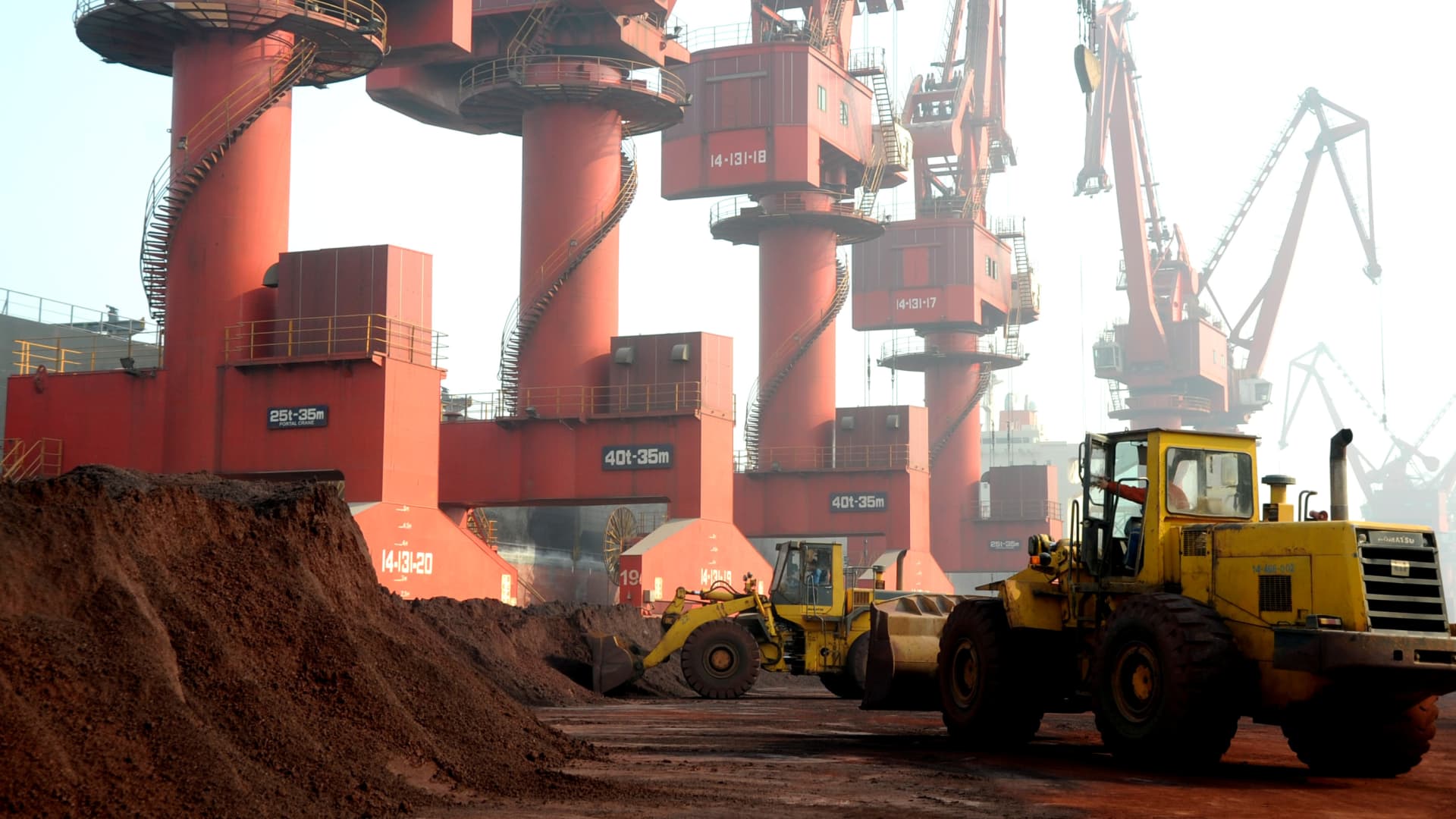
Workers transport soil containing rare earth elements for export at a port in Lianyungang, Jiangsu province, China.
China Stringer Network | Reuters
Like the U.S., Europe is also feeling the pressure to keep China sweet in order to maintain supplies of rare earth elements, which are vital for its strategic industries in the region such as auto production, green energy and defense.
Europe is heavily dependent on China for supplies of the world’s 17 rare earth elements and has been looking to calm stormy waters with Beijing over supplies, while looking for alternative sources of critical minerals — including in its own back yard.
That’s a long process, however, and for now, Europe is as vulnerable as other major consumers of rare earths, and particularly the U.S., when it comes to Beijing’s ability to turn the tap off on supplies.
Officials from Germany and the Netherlands are in Beijing this week for talks with their Chinese counterparts on China’s controls on rare earths exports and semiconductor chips which have made European industries vulnerable to global supply chain disruptions.
China dominates the rare earths market from mining to refining, with data from the International Energy Agency showing that, in 2024, China was responsible for 59% of the world’s rare earths mining, 91% of its refining and 94% of the manufacuring of permanent magnets which are commonly used in electric vehicles, wind turbines, industrial motors, data centers and defense systems.
As the world’s single largest supplier of a component that’s critical to so much manufacturing, China’s dominance has made “global supply chains in strategic sectors – such as energy, automotive, defense and AI data centres – vulnerable to potential disruptions,” the IEA noted.
That potential for disruption came to the fore this year when, in April and October, Beijing announced licensing requirements, and later export controls, on its rare earth supplies and technologies.
Those controls were suspended for a year as a result of a trade truce reached in October between China and the U.S. reached but major rare earth importers such as the U.S. and EU, which imports around 70% of rare earth supplies — and almost all of its rare earth magnets — from China, are all too aware of its vulnerabilities to geopolitical disruptions.
Barriers to diversification
Last month, European Commission President Ursula von der Leyen announced that the bloc was launching the “RESourceEU” plan aimed at reducing reliance on critical raw materials from China “in the short, medium and long term.” She said the bloc could do this by recycling existing raw materials, such as those in batteries, and by joint purchasing to stockpiling.
Von der Leyen also said the EU would boost investment in strategic projects “for the production and processing of critical raw materials here in Europe,” and would speed up work on critical raw materials partnerships with countries like Ukraine, Australia, Canada, Kazakhstan, Uzbekistan, Chile and Greenland.
“The world we face today rewards speed, not hesitation, because today’s world is unforgiving. And the global economy is completely different than it was even a few years ago. Europe cannot do things the same way anymore. We learned this lesson painfully with energy; we will not repeat it with critical materials,” she said, referencing the bloc’s reliance, before the Ukraine war, on Russian oil and gas.

Valdis Dombrovskis, European Commissioner for Economy and Productivity, told CNBC Monday that the bloc was working to diversify its rare earth supplies but that this would take time.
“I would say there is some positive news, so China has suspended now for 12 months those additional export controls, which were announced in October, which gives us some time. But I also would say it emphasizes the need for the EU to diversify its rare earth and critical minerals supplies, because of many on those rare earths, we are depending more than 90% on China’s supplies,” Dombrovskis said.
Necessity the mother of invention?
Europe itself has reserves of rare earth materials with deposits found in Turkey, Sweden and Norway but the problem is that it doesn’t have the operations to mine those materials, let alone refine and process them — unlike China, which has decades of experience, investment and infrastructure that has fueled its global processing dominance.
Europe is also more encumbered with long approval processes and environmental standards when it comes to mining, meaning any regional plans to develop those rare earth deposits could take years. Public opposition is also a factor that has not shackled China.
A view of the NEO magnetic plant in Narva, a city in northeastern Estonia. A plant producing rare-earth magnets for Europe’s electric vehicle and wind-energy sectors.
Xinhua News Agency | Xinhua News Agency | Getty Images
The need to diversify from China quickly could cause officials to lower those barriers, however and there are already signs of action, with Europe’s first rare earth magnet production plant being opened in Estonia in September. Backed by funding from both Canada and the EU, the plant’s raw materials are coming from Australia and Malaysia.
“There’s probably a lot more deposits in Europe but … there are barriers to bringing that online,” Willis Thomas, principal consultant at CRU Group, told CNBC.
“But if we’re getting into a world where risks are being realized on trade tensions, I think that that will continue to push everyone to build out the supply chain and a bit more resilience on it, but it does take some time, and there’s limited expertise.”
What’s also worrying for Europe is that being unable to control the sources and supply of raw materials could mean that its technological and green ambitions suffer.
“Europe’s race towards net zero and digital leadership depend on materials it does not control,” Hamed Ghiaie, professor of Economics and Public Policy at ESCP Europe, and Filippo Gorelli, an analyst at Nexans, said in analysis for the World Economic Forum.
“For decades, Europe treated raw materials as a commodity issue, rather than a strategic one. That complacency is becoming costly,” they added.
“What is at stake is climate targets and economic resilience. Shortages of rare earths, gallium or germanium could slow semiconductor fabrication, AI development and even wind-power installation. In short, Europe cannot build a green or digital future on supply chains it doesn’t control,” they concluded.
