



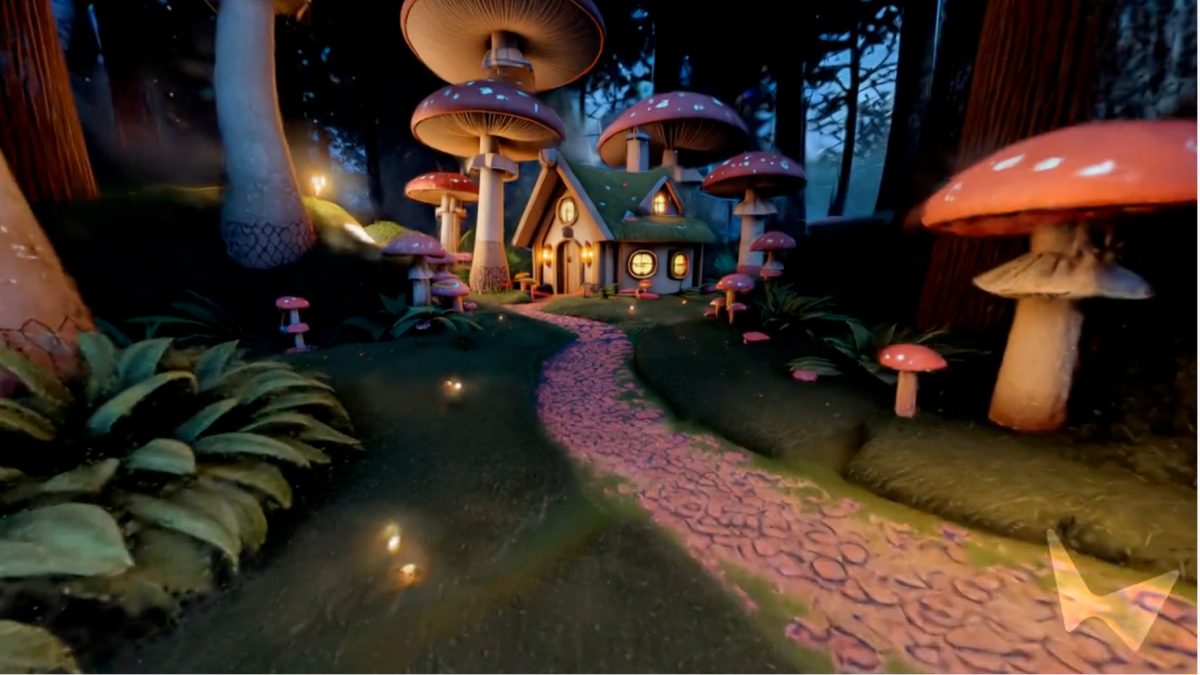
World Labs, the startup founded by AI pioneer Fei-Fei Li, is launching its first commercial world model product. Marble is now available via freemium and paid tiers that let users turn text prompts, photos, videos, 3D layouts or panoramas into editable, downloadable 3D environments.
The launch of the generative world model, first released in limited beta preview two months ago, comes a little over a year after World Labs came out of stealth with $230 million in funding, and puts the startup ahead of competitors building world models. World models are AI systems that generate an internal representation of an environment, and can be used to predict future outcomes and plan actions.
Startups like Decart and Odyssey have released free demos, and Google’s Genie is still in limited research preview. Marble differs from these — and even World Labs’s own real-time model, RTFM — because it creates persistent, downloadable 3D environments rather than generating worlds on-the-fly as you explore. This, the company says, results in less morphing or inconsistency, and lets users export worlds as Gaussian splats, meshes or videos.
Marble is also the first model of its kind to offer AI-native editing tools and a hybrid 3D editor that lets users block out spatial structures before AI fills in the visual details.

“This is a brand new category of model that’s generating 3D worlds, and this is something that’s going to get better over time. It’s something we’ve already improved quite a lot,” Justin Johnson, co-founder of World Labs, told TechCrunch.
Last December, World Labs showed how its early models could generate interactive 3D scenes based on a single image. While impressive, the somewhat cartoonish scenes weren’t fully explorable since movements were limited to a small area, and there were occasional rendering errors.
In my trial of the beta preview, I found Marble generated impressive worlds from image prompts alone — from game-like environments to photorealistic versions of my living room. Scenes morphed at the edges, though that’s apparently been improved in today’s launch. That said, a world I’d generated in the beta using a single prompt looked better and matched my intent more closely than the same prompt does now.
Techcrunch event
San Francisco
|
October 13-15, 2026
I haven’t yet tested the editing features, though Johnson says they make Marble practical for near-term gaming, VFX and virtual reality (VR) projects.
“One of our main themes for Marble going forward is creative control,” Johnson said. “There should always be a quick pathway to generate something, but you should be able to dive even deeper and get a lot of control over the things that you’re generating. You don’t want the machine to just take the wheel and pull all that creativity away from you.”

Marble’s take on creative control starts with input flexibility. The beta only accepted single images, forcing the model to invent unseen details for a 360-degree view. With the full launch, users can now upload multiple images or short clips to show a space from different angles and have the model generate fairly realistic digital twins.
Then we have Chisel, an experimental 3D editor that lets users block out coarse spatial layouts (think walls, boxes, or planes) and then add text prompts to guide the visual style. Marble generates the world, decoupling structure from style — similar to how HTML provides the structure of a website and CSS adds in color. Unlike text-based editing, Chisel lets you directly manipulate objects.

“I can just go in there and grab the 3D block that represents the couch and move it somewhere else,” Johnson said.
Another new feature that gives you more editing control is the ability to expand a world.
“Once you generate a world, you can expand it up to once,” Johnson said. “When you move to a piece of the world that’s starting to break apart, you can basically tell the model to expand there or generate more world in the vicinity of where you currently are, and then it can add more detail in that region.”
Users who want to create extremely large spaces can combine multiple worlds with “composer mode.” Johnson demonstrated this for me with two worlds he had already built – a room made of cheese with grape chairs, and another of a futuristic meeting room in space.
The path to spatial intelligence

Marble is available via four subscription tiers: Free (four generations from text, image, or panorama), Standard ($20/month, 12 generations plus multi-image/video input and advanced editing), Pro ($35/month, 25 generations with scene expansion and commercial rights), and Max ($95/month, all features and 75 generations).
Johnson thinks the initial use cases for Marble will be gaming, visual effects for film, and virtual reality.
Game developers have mixed feelings about the tech. A recent Game Developers Conference survey found a third of respondents believed generative AI has a negative impact on the games industry – 12% more than the survey indicated year earlier. Intellectual property theft, energy consumption and a decrease in quality from AI-generated content were among the top concerns aired. And last year, a Wired investigation found game studios like Activision Blizzard are using AI to cut corners and combat attrition.
In gaming, Johnson sees developers using Marble to generate background environments and ambient spaces and then importing those assets into game engines like Unity or Unreal Engine to add interactive elements, logic and code.
“It’s not designed to replace the entire existing pipeline for gaming, but to just give you assets that you can drop into that pipeline,” he said.
For VFX work, Marble sidesteps the inconsistency and poor camera control that plague AI video generators, per Johnson. Its 3D assets let artists stage scenes and control camera movements with frame-perfect precision, he said.
While Johnson said World Labs isn’t focusing on virtual reality (VR) applications right now, he noted the industry is “starved for content” and excited about the launch. Marble is already compatible with the Vision Pro and Quest 3 VR headsets, and every generated world can be viewed in VR today.
Marble may also have potential use cases for robotics. Johnson noted that unlike image and video generation, robotics doesn’t have the benefit of a large repository of training data. But with generators like Marble, it becomes easier to simulate training environments.
According to a recent manifesto by Fei-Fei Li, CEO and co-founder of World Labs, Marble represents the first step towards creating “a truly spatially intelligent world model.”
Li believes “the next generation of world models will enable machines to achieve spatial intelligence on an entirely new level.” If large language models can teach machines to read and write, Li hopes systems like Marble can teach them to see and build. She says the ability to understand how things exist and interact in three-dimensional spaces can eventually help machines make breakthroughs beyond gaming and robotics, and even into science and medicine.
“Our dreams of truly intelligent machines will not be complete without spatial intelligence,” Li wrote.
Got a sensitive tip or confidential documents? We’re reporting on the inner workings of the AI industry — from the companies shaping its future to the people impacted by their decisions. Reach out to Rebecca Bellan at [email protected] or Russell Brandom at [email protected]. For secure communication, you can contact them via Signal at @rebeccabellan.491 and russellbrandom.49.
