



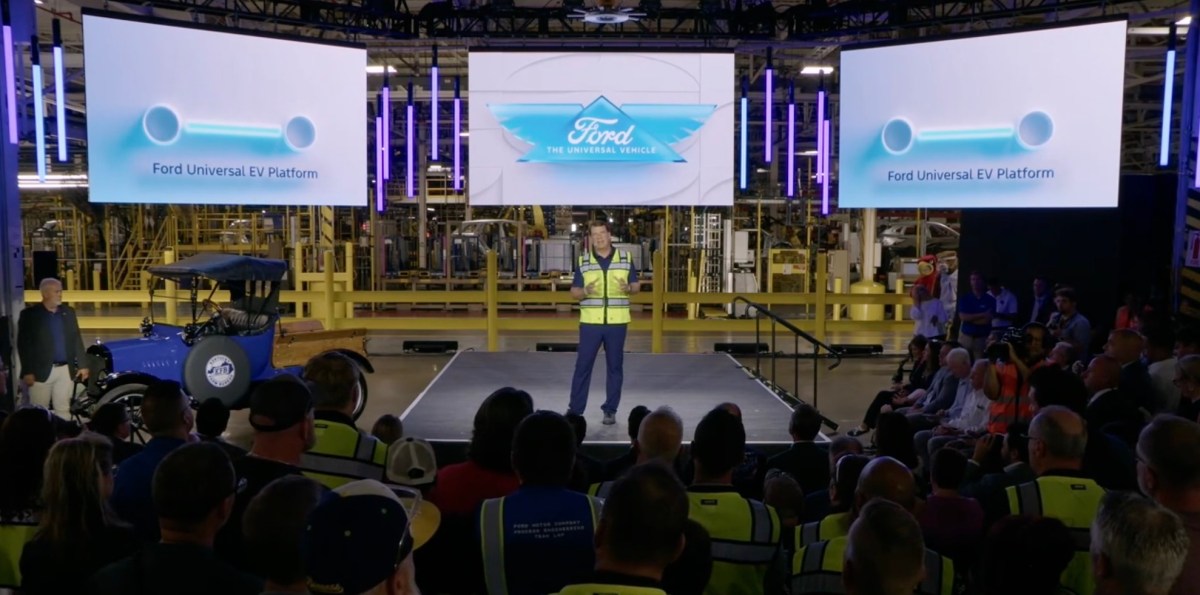
Ford said Monday it will invest $2 billion to transform its Louisville Assembly Plant into a factory capable of making a new generation of affordable EVs, starting with a mid-sized pickup truck with a base price of $30,000 that is slated to launch in 2027.
This is not a standard factory upgrade. To reduce the cost of manufacturing, Ford has upended the moving assembly line system launched by its founder Henry Ford more than 112 years ago.
The automaker’s willingness to change the century-old system that made Ford a household name reflects the high-stakes juggling act of selling a line of affordable electric vehicles that could be made in the United States faster, more efficiently, and with fewer parts, all while preserving profit margins. And as Ford’s chief EV, digital, and design officer Doug Field noted Monday, it’s not just about driving down individual costs, but a change that will allow the automaker to compete with China.
Ford CEO Jim Farley described the new production system, line of EVs, and $2 billion investment as a bet.
“There are no guarantees with this project,” he said during an event livestreamed from the Kentucky plant. “We’re doing so many new things I can’t tell you with 100% uncertainty that this will all go just right, it is a bet. There is risk.”
It’s a bet Farley believes is worth making. The company’s EV division posted a loss of around $1.3 billion in the second quarter of 2025 and sales of its top two EVs, the F-150 Lightning and the Mustang Mach-E, are falling.
And it’s a bet that began several years ago with a skunkworks team of about 500 people in California — led by former Tesla executive Alan Clarke and filled with talent from companies like Tesla, Rivian, Apple, and Lucid Motors. The team, which is split between Palo Alto and a new office in Long Beach, developed the new production system and underlying vehicle platform that will be used in the Louisville factory.
Techcrunch event
San Francisco
|
October 27-29, 2025
The end result is what Ford calls the “universal production system,” which changes its single conveyor line into a three-branched assembly tree. Ford has also developed a universal EV platform that will use lithium iron phosphate batteries using tech licensed from China’s CATL and manufactured at its new $3 billion BlueOval Battery Park factory in Michigan. That factory, which is expected to come online in 2026, will employ 1,700 hourly workers.
The new EV platform will consist of large single-piece aluminum unicastings that use far fewer parts and will allow the front and rear of the vehicle to be assembled separately on two of the branches. The third branch is perhaps most notable; this is where the structural battery will be assembled with seats, consoles, and carpeting. The three components will come together at the end of the line to form the vehicle.
The end result is an EV that has 20% fewer parts, including 50% fewer cooling hoses and connections, and 25% fewer fasteners, according to Ford. The first EV off the line will be a mid-sized pickup that is about the same size as a Ford Maverick, but roomier on the inside.
Unlike a traditional assembly line, where the workers move along adding the wire harness and other parts to the frame, the EV platform will consist of three kits. Within that kit, all fasteners, scanners, and power tools required for the job are included — and in the correct orientation for use, according to Ford. The system also reduces the number of dock stations by 40%.

The EV platform will be produced 15% faster, the company said.
“I’ve certainly never seen anything in the public domain that looks anything like this,” Clarke told TechCrunch in an interview ahead of the launch. “And I think that a manufacturing expert would look at this, and especially if they’ve been in the automotive industry for a few decades, would sort of scoff at it and say, ‘why would you do it this way?’”
Clarke is convinced that once manufacturing experts see how quickly a vehicle can go from start to finish, others will attempt to emulate this.
The new format and accompanying EV platform will change how the Louisville factory operates and reduce the number of workers employed there. The transformation will likely ripple through the broader supply chain as well. Ultimately, Clarke says, this will preserve American jobs.
Ford employs about 2,808 hourly workers at its Louisville assembly plant, which makes the Ford Escape and Lincoln Cosair. Production of those two vehicles will continue at the plant through the end of this year, before Ford begins retooling the factory and switching to the new family of EVs. Eventually, the plant will support 2,200 hourly workers — 600 fewer than today.
A Ford spokesperson said the automaker has offered a special retirement incentive program for workers. If fewer than 600 workers take the early retirement offer, they will be offered roles at other facilities.
Fewer workers and a “significant” increase in automation might typically prompt protests from the United Auto Workers. But Clarke says Ford worked with the UAW closely from the beginning and that there is “buy in.”
“The teams are really excited about what’s coming because they know that we have to be competitive and we have to make money from this project for jobs to stay in America,” he said, later adding, “This isn’t really, you know, optional.”
Several UAW representatives spoke during the event and supported the change, which they said will reduce the twisting, turning, and bending required of assembly workers and improve safety.
“Ergonomics has been taken into it a whole lot more,” Brandon Reisinger, UAW chairperson of the Louisville assembly plant, said at the event. “We should have a healthier workforce. Should be able to go home to your families and not be sore at the end of the day, which is going to be great.”
We’re always looking to evolve, and by providing some insight into your perspective and feedback into TechCrunch, you can help us! Fill out this survey to let us know how we’re doing.
