



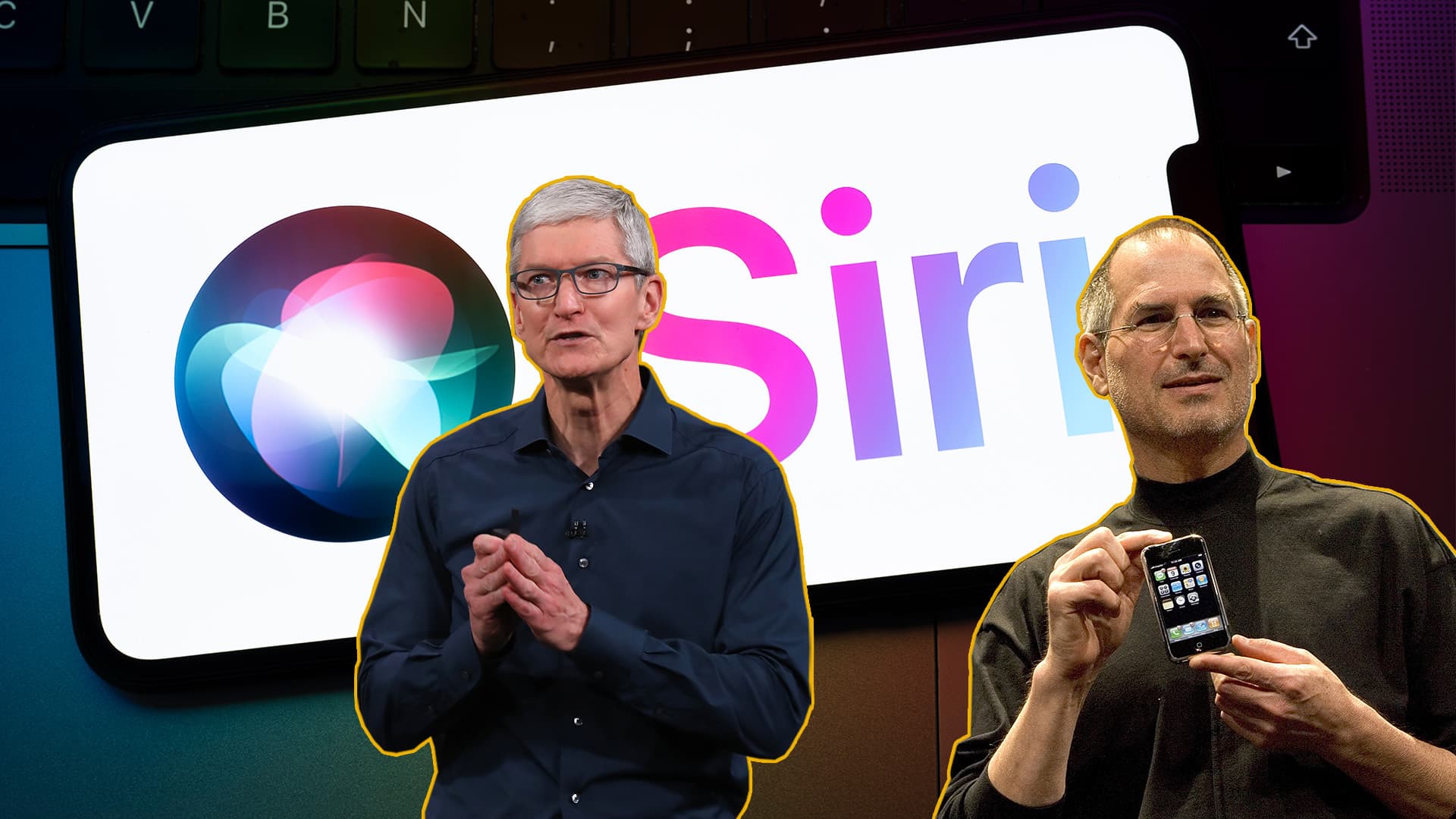

CUPERTINO, Calif. — Nasdaq brought its market open festivities to Apple’s sprawling Silicon Valley headquarters on Tuesday, the eve of the company’s 50th birthday.
From a desk inside Apple Park, the ring-shaped campus that Steve Jobs spent his last years helping design, Tim Cook rang the opening bell and, in the process, ushered in the iPhone maker’s second half-century.
It was a celebratory occasion, but one arriving at a pivotal point for an iconic American company that faces major challenges today and in the years ahead as the technology industry gets swept up by artificial intelligence.
Prior to the AI boom, which started with the launch of OpenAI’s ChatGPT in late 2022, Apple was able to win by dominating the consumer device market and adding its Siri voice assistant across its product portfolio.
The pitch has always been simple: Pay a premium for a device, and trust that what happens on it stays yours, whether it’s messages, photos or notes. Personal data isn’t fuel for an advertising engine.
Two of Apple’s megacap tech peers took the opposite approach. Google and Meta are the giants of digital advertising, giving away their key services for free and making tens of billions of dollars a year in profit by targeting users with promotions.
Apple’s principle came from Jobs, its co-founder and longtime CEO. Cook, his successor, has been preaching it since becoming CEO in 2011, shortly before Jobs’ death. For much of Apple’s 50-year history, it’s been gospel in Cupertino.
That’s why Apple’s latest move feels so out of character.

In January, Apple struck a multiyear deal to use Google’s Gemini AI as part of a rebooted Siri. Google has already been paying in the range of $20 billion a year to be the default search engine on the iPhone. In AI, that relationship flips: Apple becomes the one paying for the underlying intelligence by licensing Google’s technology.
Money isn’t the main issue — Apple recorded net cash of $54 billion in the latest quarter and returned $32 billion to shareholders, mostly through buybacks. Rather, the concern, according to Asymco analyst Horace Dediu, is what the arrangement with Google means for user data and whether the search company uses it to bolster its algorithms.
“That’s where the wall has to be,” Dediu said. “That they don’t give that information to Google, and Google doesn’t get smarter and improve its core business because Apple is sharing information with them.” He added that, “To the extent that the intelligence improves, that should stay within Apple.”
Apple declined to make anyone available for this story, but CNBC spoke with former employees and people who spent decades studying the business. The general sentiment is that Apple is at a crossroads, caught between the ethos that shaped the company and a technological shift that’s forcing it to compete on unfamiliar ground.
Apple is in this quandary in part because, compared to its tech peers, the company has been slow to AI. The long-awaited AI update to Siri has faced delays, though Apple says it’s still coming by year-end. In 2024, the company launched Apple Intelligence, which includes image generators, text rewriters, the ability to summarize push notifications and an integration with ChatGPT. Consumer response has been mixed.
Where Apple has really bucked the trend is in keeping capital expenditures in check, rather than following the path of Amazon, Microsoft, Alphabet and Meta, which are collectively committing hundreds of billions of dollars a year to new AI infrastructure so they can support cutting-edge models and workloads.
As rivals were building giant model businesses, involving training through scraping of information and data, Apple steered clear, a decision that many in the industry say left the company at a disadvantage in generative AI.
Apple CEO Tim Cook holds an iPhone 17 pro and an iPhone air, as Apple holds an event at the Steve Jobs Theater on its campus in Cupertino, California, U.S. Sept. 9, 2025.
Manuel Orbegozo | Reuters
‘Fork in the road’
Cook has called privacy a “fundamental human right” for years. In an appearance on ABC’s “Good Morning America” in mid-March, he reiterated that Apple does as much processing as possible on the device. When necessary, Apple uses what it calls Private Cloud Compute, which is essentially a secure extension of the device in the cloud.
Gene Munster of Deepwater Asset Management says Apple’s leadership misread the market.
“It comes down to a failure to recognize where the world was going and the speed things were happening,” he said, leaving the company now at a “fork in the road” when it comes to the long-term relevance of its products.
The challenge, Munster said, is in “powering an AI digital assistant.” If Apple doesn’t solve that, he warned, somebody else will, a development that could eat away at Apple’s control over the future.
Siri should have given Apple a head start. It launched in October 2011, a day after Jobs’ death. It would be years before Amazon Alexa or Google Assistant hit the market. But the product stagnated.
Apple “basically blew a five-year lead” said Walt Mossberg, a former Wall Street Journal columnist who long chronicled Apple.
Dag Kittlaus, Siri’s co-founder, left Apple after Jobs died, telling CNBC recently, “I didn’t want to work without him.”
Kittlaus said that Siri kept improving on the technical side, particularly in speech recognition. But without Jobs’ instincts and product vision, the company never really expanded Siri’s capabilities, he said.
“There are no further technical barriers to any part of the Siri vision that we had from the old days,” Kittlaus said. “We would kill to have the technology back then that exists now.”
Adam Cheyer, co-founder of Siri and Viv Labs
Photo courtesy of Adam Cheyer
Adam Cheyer, who created Siri alongside Kittlaus, said the original vision was far more ambitious than what shipped. The idea was to create a system that could both answer questions and take action, eventually supporting a broader ecosystem that could be used by outside businesses, similar to the App Store. He said the challenge was combining “knowing and doing” in a single system.
The first company that can do that with “the right experience” will be “the dominant technology company for this next AI age,” Cheyer said. “And I think Apple can still play there.”
Today, AI is a cloud business. The models behind ChatGPT, Gemini and Anthropic’s Claude are too big to run on a phone. But models are shrinking. Within a few years, hefty workloads will run on a chip inside the phone.
That’s Apple’s bet, and the company has been integrating AI-capable silicon into its devices since 2017. When AI moves onto the device, the thinking goes, Apple’s privacy problem starts to solve itself. User queries all get processed locally, never touching a cloud server.
Dediu says it follows a historical pattern of computing moving from the center to the edge, from mainframes to PCs to phones.
Tony Fadell, who built the iPod and the first three iPhones before co-founding Nest and selling it to Google, said early signs of the computing shift are already visible. As more people experiment with personal AI agents, some are running the infrastructure themselves, often on devices like a Mac Mini at home.
The Google partnership could be the bridge for Apple, Kittlaus said.
“People get motivated when they see a path to victory,” he said. “I think that is the moment.”

The OpenAI challenge
As AI moves to the edge, the question for Apple is whether the device it’s spent the past two decades perfecting remains the center of computing.
Last year, OpenAI bought Jony Ive’s design firm, io, for $6.4 billion and charged the former Apple design chief with building something as consequential for the AI era as the iPhone was for the move to mobile.
“That’s an amazingly big ask and amazingly big vision,” said John Sculley, who was Apple’s CEO from 1983 to 1993, in an interview. “You can’t underestimate someone as brilliant as Jony Ive.”
Ive, who designed the iPod, iPhone, iPad and Apple Watch, among other gadgets, is reportedly developing a family of screenless devices for Sam Altman’s company.
Dediu said that’s the scenario Apple should worry about — not a better device, but a simpler one that doesn’t need a screen. If the AI interface turns out to be something people wear rather than hold, Apple’s advantage in visual design stops mattering.
It’s not an approach that’s worked yet.
Ken Kocienda, who spent 15 years at Apple and invented keyboard autocorrect for the original iPhone, left in 2017 and joined AI hardware startup Humane a few years later. Humane attempted a screenless, AI-native device, but the effort failed.
Kocienda said the idea may still prove to be right, just too early. Fadell is less concerned.
“These pins, pens, all these pendants — I think they’re all accessories to the phone,” he said. “You’re going to see a federation of devices … and they’ll all be AI-enabled, as opposed to removing devices from your life.”
If the future of AI hardware revolves around the phone, Apple may be poised to lead again, with a next chapter shaped by the same strengths that built the company.
That was the backdrop at Apple Park before dawn on Tuesday. As employees and Cook gathered on the lawn, the grass still held the night’s rain.
The sky cleared just as Nasdaq’s opening anthem rolled across the yard, and Cook stepped forward to ring the bell. The whole scene felt almost impossibly controlled, as if even the weather had deferred to Apple’s choreography.
Everything came together just in time to show Wall Street, and the company is betting its Siri refresh will do the same.
The anniversary celebration was capped by a performance from Paul McCartney, another flourish in a production designed to project confidence in the path forward as Wall Street waits expectantly for Apple’s AI comeback.
WATCH: Warren Buffett on Apple: I sold too soon

