



Fusion startups have a tough row to hoe. Their mission? To create a new kind of power plant that produces more energy than it consumes — something no one has ever done with fusion energy before. That means proving their technology works, showing it can be scaled up, and convincing investors it can all be done profitably. That’s already a tall order. But there’s another big challenge that gets far less attention: where to get the fuel.
Most fusion startups will say that they’ll be producing their own fuel, thank you very much. And technically, they’re right. But that answer glosses over a key point: to make tritium — one of the key ingredients for fusion — they first need a specific isotope of lithium, one that’s in very short supply today.
That thought dawned on Charlie Jarrott a few years ago when he was working at fusion startup Focused Energy.
“I realized no one is working on this supply chain stuff. There’s a whole bunch of fusion companies. There isn’t a single company that is going to make the fuel for those companies,” he told TechCrunch.
So Jarrott and his Focused Energy colleague Jacob Peterson decided to set off on their own, founding Hexium with an eye toward solving fusion’s future fuel problems.
Hexium, which has been operating in stealth, emerged on Tuesday with $9.5 million in seed funding and $2.5 million in a credit facility, the company exclusively told TechCrunch. MaC Venture Capital and Refactor led the round, with Humba Ventures, Julian Capital, Overture VC, and R7 Partners participating.
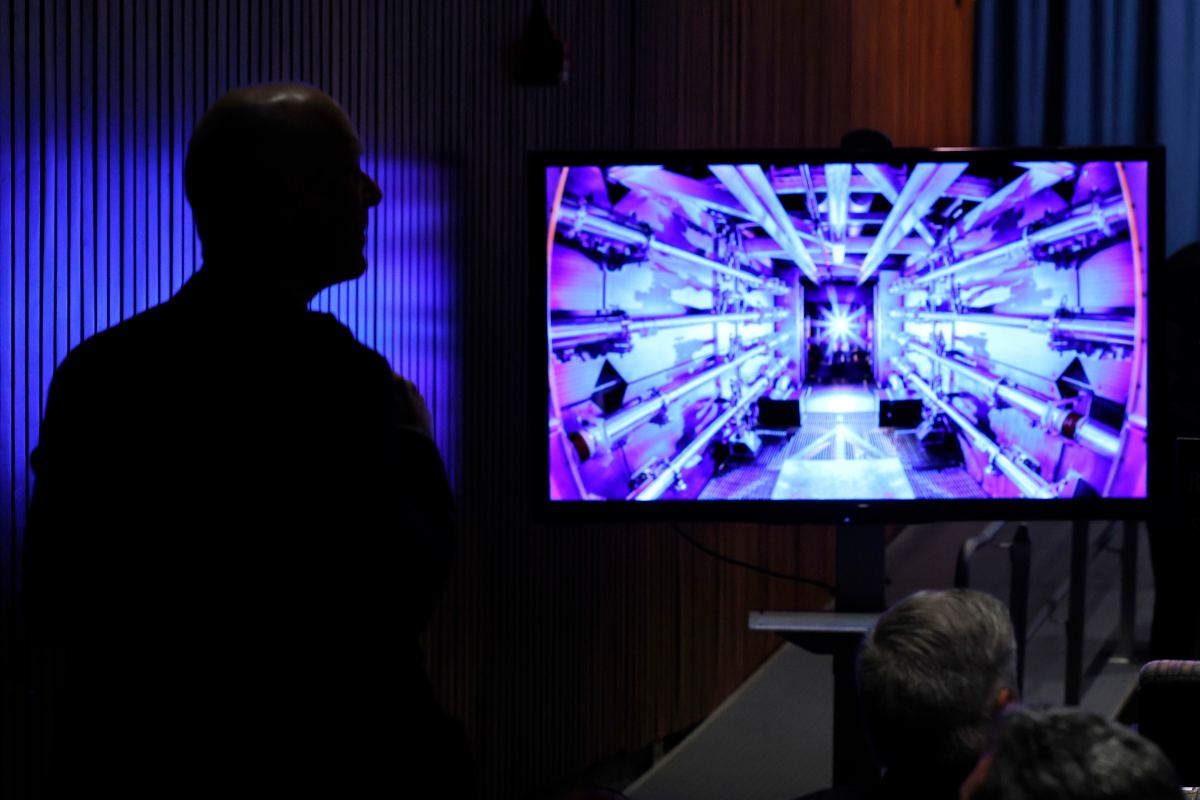
Hexium’s key technology uses a decades-old method that uses lasers to separate isotopes of lithium. Atomic vapor laser isotope separation (AVLIS) was perfected by the Department of Energy in the 1980s to sort uranium isotopes. But after spending $2 billion getting AVLIS ready to produce uranium for nuclear power plants, the Cold War ended and thousands of tons of nuclear fuel flooded the market by way of old Soviet weapons-grade uranium.
As a result, AVLIS sat more or less unused until a few years ago, when Hexium picked up the technology and tweaked it to sort lithium isotopes.
To do that, the startup will use lasers that can be tuned with picometer precision. The ones that Hexium will use are relatively low power — “we’re talking tattoo removal energy,” Peterson said — but their precision allows them to interact with a specific lithium isotope.
Like most elements, lithium isn’t just one configuration of protons, neutrons, and electrons. In the wild, there are two stable isotopes: lithium-6, which has three protons, three neutrons, and three electrons; and lithium-7, which has an additional neutron. Each isotope has its own signature, so to speak, that’s expressed as a wave function. Think of it like how different people’s voices produce different waves when visualized on a computer. Hexium tunes its lasers to interact with lithium-6’s wave function alone.
“It’ll just blow right by a lithium-7 atom. It’ll go unnoticed,” Jarrott said.
To separate lithium-6 from lithium-7, the company will shine its lasers into vaporized clouds of the metal. When the laser hits a lithium-6 atom, it’ll become ionized. The ionized atom will then be drawn to an electrically charged plate where it will condense into a liquid and run down into a trough, like beads of water on the outside of an icy glass.
Hexium can then package the lithium-6 and sell it to fusion companies, which will use the metal to both breed tritium fuel and protect their pilot and commercial reactors from harmful radiation. As for the remaining lithium-7? It’ll get sold to operators of conventional nuclear reactors, which use that isotope as a protective additive in cooling water.
Over the coming year, Hexium will be using its seed funding to build and run a pilot plant. If all goes well, Hexium will replicate that design in modular fashion to produce anywhere from tens to hundreds of kilograms of lithium-6.
“We don’t have to build a facility the size of a Costco or a football stadium,” Peterson said. “We can do it in a facility the size of a Starbucks, and we achieve good economics at very small scale, and then we just parallelize our process.”
Update: Included additional details on seed funding.
