



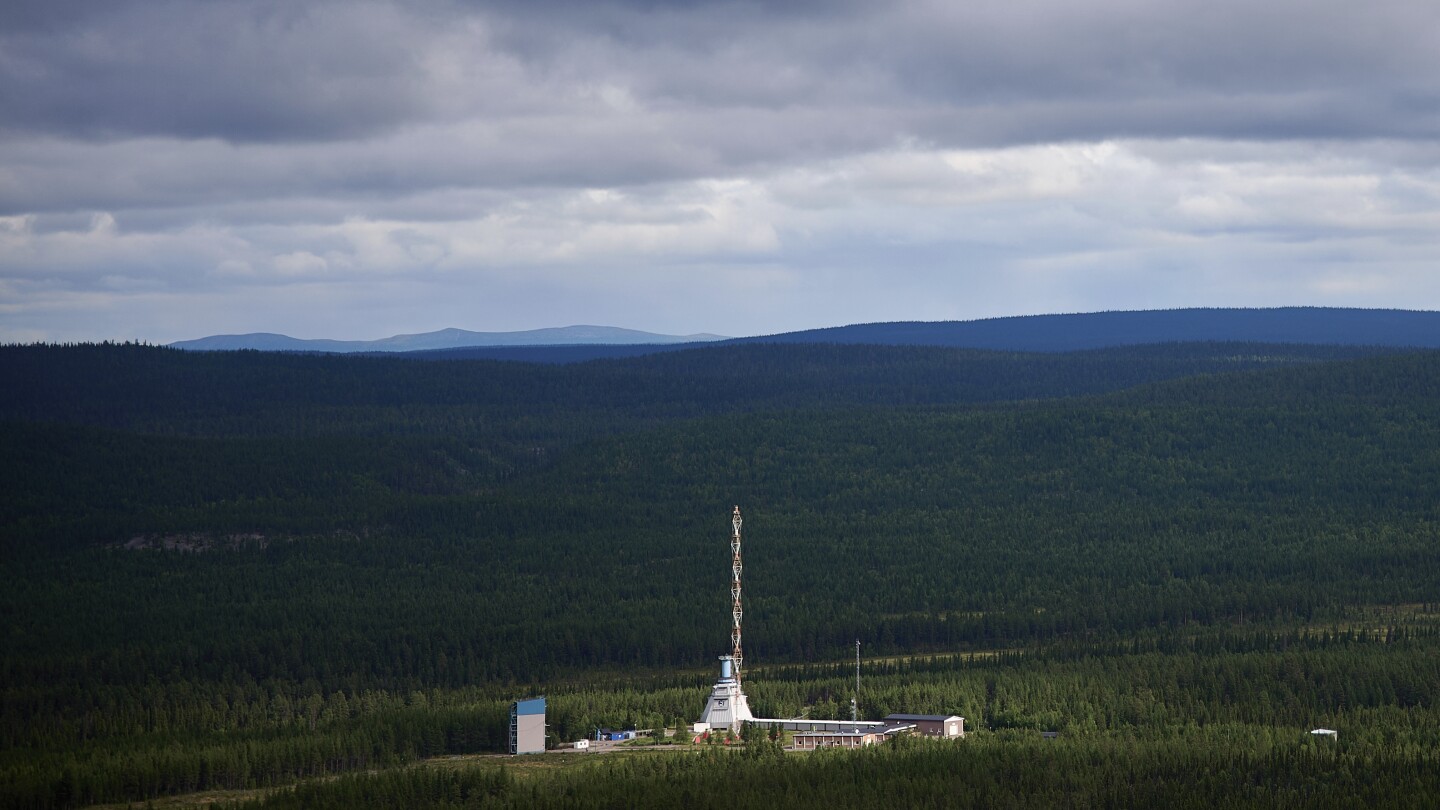
KIRUNA, Sweden (AP) — Deep in the Swedish forest, where reindeer roam and scientists ski in winter, lies one of Europe’s hopes for a spaceport that can ultimately compete with the United States, China and Russia.
For decades, Europe has relied upon the U.S. for its security among the stars. But the Trump administration’s “America First” policies, plus a commercial market that’s growing exponentially, has prompted Europeans to rethink their approach.
The state-owned Esrange Space Center in Kiruna, Sweden, is among the sites building out orbital rocket programs to allow Europe to advance in the global space race and launch satellites from the continent’s mainland.
“The gap is significant,” said Hermann Ludwig Moeller, director of the European Space Policy Institute. “I would argue that Europe, to be anywhere relevant in the next five to 10 years, needs to at least double its investment in space. And saying that it would double doesn’t mean that it would catch up by the same factor, because you can expect that other regions will also continue to step up.”
A European spaceport near the equator
Currently, Europe’s only space base capable of launching rockets and satellites into orbit is in sparsely populated French Guiana, an overseas department of France in South America that’s roughly 500 kilometers (310 miles) north of the equator. Otherwise, Europe borrows NASA’s Cape Canaveral in Florida.
In March, Isar Aerospace launched the first test flight of its orbital launch vehicle from the Andøya Spaceport, another site that’s part of Europe’s efforts to expand its presence in space, on an island in northern Norway.
While the rocket crashed into the sea 30 seconds after liftoff, the private German aerospace company had largely ruled out the possibility of the rocket reaching orbit on its first complete flight and deemed the short journey a success.
Moeller believes a successful orbital launch from continental Europe could occur within the next year, though he won’t guess where.
Portugal, Spain, Italy, Germany and the United Kingdom also are among the countries seeking to be part of Europe’s spaceport portfolio.
Elsewhere on Earth, India — active in space research since the 1960s — has launched satellites for itself and other countries and successfully put one in orbit around Mars in 2014. After a failed attempt to land on the moon in 2019, India became the first country to land a spacecraft near the moon’s south pole in 2023 in a historic voyage to uncharted territory that scientists believe could hold reserves of frozen water. The mission was dubbed a technological triumph for the world’s most populous nation.
New Zealand also has a growing and active launch industry, and Australia is working to develop its commercial space industry.
Northern Europe’s geography
Esrange and Andøya date back to the 1960s and much of their space-bound appeal stems from their far-north geography on Earth.
Esrange, for example, is owned and operated by the Swedish Space Corporation and based more than 200 kilometers (120 miles) north of the Arctic Circle. The space center’s 30-plus antennas can more easily communicate with satellites orbiting the North Pole compared to infrastructure that’s near the equator.
Most important, perhaps, is its size. The base itself encompasses 6 square kilometers (2.3 square miles), where experts conduct Martian lander parachute tests, suborbital rocket launches and stratospheric balloon experiments.
But its key selling point is Esrange’s rocket landing zone: 5,200 square kilometers (2,000 square miles) of birch, pine and spruce trees spread north across the Swedish tundra, nearly to the Norwegian and Finnish borders.
The territory is uninhabited besides the Sami Indigenous reindeer herders who sometimes pass through, and the space center alerts them before any tests occur. The emptiness of the landscape allows scientists to launch and easily recover material for further study.
“The rocket motor will just fall freely into the ground, which means that you need to see to it that no people are in the area,” Mattias Abrahamsson, business development director for the science division at Esrange, said during a recent tour. “We have to see to it that it’s not more dangerous to be in that area, if you want to pick berries or hunt or fish or anything like that, than if you’re in a street in New York or in Stockholm or anywhere.”
Andøya’s remote location on a Norwegian island, meanwhile, means rockets can safely crash down into the sea without risking harm to humans.
Security and defense
During his first week in office earlier this year, U.S. President Donald Trump announced his $175 billion “Golden Dome” missile defense system to protect America from long-range missiles.
If successful, it would mark the first time the U.S. would place weapons in space that are meant to destroy ground-based missiles within seconds of launch. It follows China’s 2021 groundbreaking launch of a warhead system that went into orbit before reentering Earth’s atmosphere.
Europe currently, however, does not have the same capacities and has for decades banked on the U.S. for its security and defense. But U.S. Vice President JD Vance, during a speech in February at the Munich Security Conference, warned Europe against continuing to rely upon America and urged officials to “step up in a big way” to provide for the defense of the continent.
Vance’s remarks, as well as concerns over former Trump ally and tech billionaire Elon Musk’s politics potentially impacting Ukraine’s dependence on his Starlink satellite system in its war with Russia, alarmed European leaders.
It became increasingly clear to them that the continent must have its own space ecosystem, with its “own capabilities to really be able to react with (its) own means and under (its) own control,” Moeller said.
Space as a commercial industry
Beyond the space race between global superpowers, commercial companies are taking to the skies. Musk’s SpaceX and Amazon founder Jeff Bezos’ rocket company Blue Origin, among others, have proven that space isn’t limited to governmental agencies like NASA, and that there’s a lot of money to be made in the solar system.
The number of satellites in space is expected to skyrocket in the next five years. And the Swedish Space Corporation, with its burgeoning orbital launch and rocket test division at Esrange, is among those seeking to capitalize on those dollars.
Ulrika Unell, the division’s president, said satellites in space are crucial to life on Earth. She wants everyone, beyond astronauts and scientists, to consider how they are impacted by what’s orbiting hundreds of kilometers (miles) above the globe.
“I would ask them to think about, when they go around with their mobiles and they use all this data every day: Where does it come from? How is it gathered?” she said. “So space is more and more an asset for the whole society.”
___
Pietro De Cristofaro in Kiruna, Sweden, contributed to this report.
