



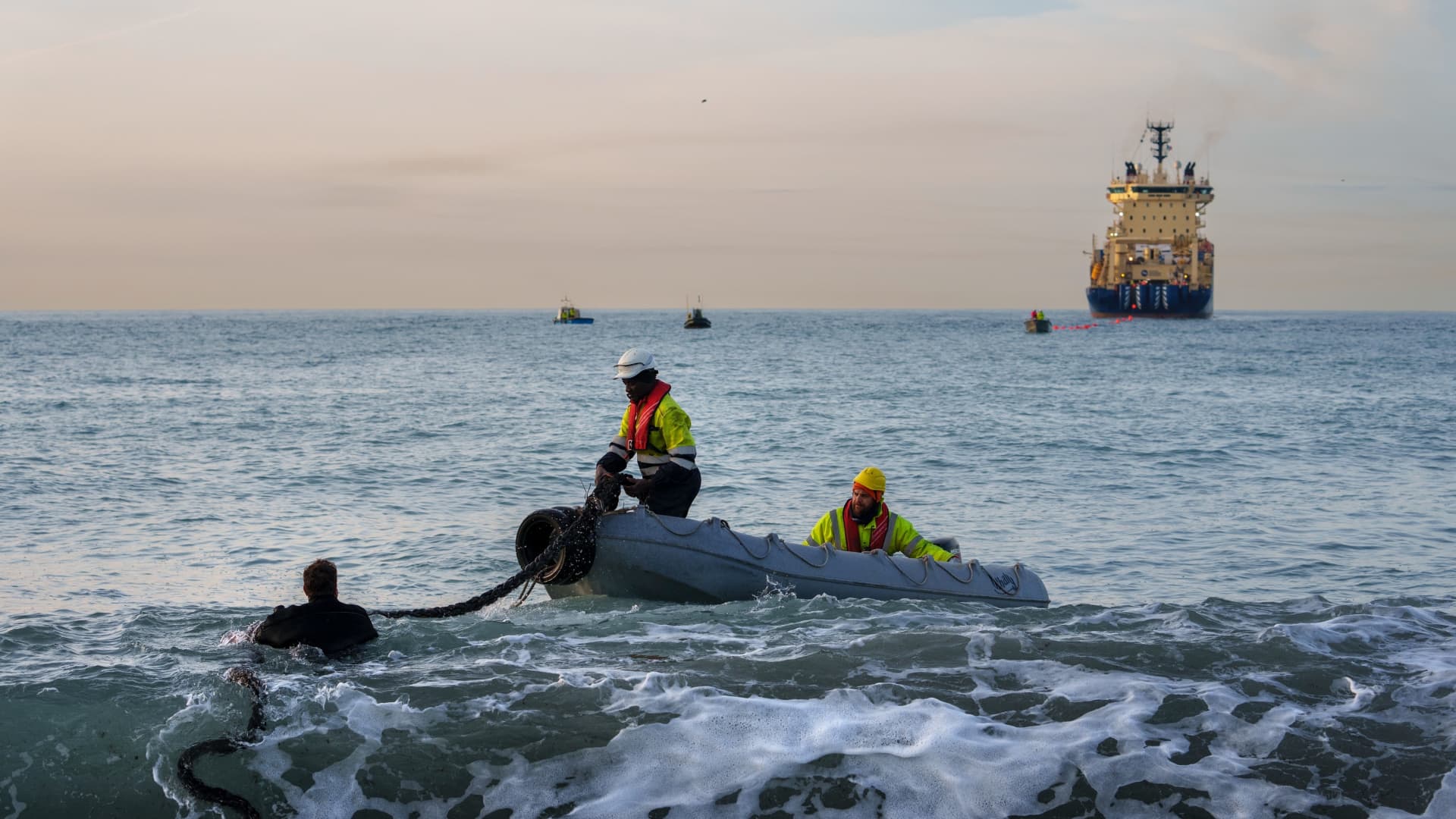
U.S. hyperscalers Meta and Alphabet ‘s Google are rolling out a fast-growing web of transcontinental subsea cables, looking to keep pace with ever-increasing bandwidth demand and artificial intelligence workloads. Submarine cables are the backbone of the world’s internet and telecommunications infrastructure, enabling everything from international phone calls to financial transactions. While satellites play a complementary role, these largely unseen data super-highways carry the vast majority of global internet traffic. By some estimates , as much of 95% of international traffic passes through fiber-optic cables across the ocean floor. Subsea cables have typically been the domain of telecom giants and state-backed consortiums. However, Silicon Valley giants such as Meta, Google, Amazon and Microsoft have taken on the mantle over the past decade. The conversations around the resilience of this global web, this sort of foundation layer of the internet … is coming more and more to the forefront. Senior director of global submarine networks at Google Nigel Bayliff A steady stream of investment has driven ” tremendous growth ” in submarine cable infrastructure in recent years, according to Washington, D.C. -based telecoms research firm TeleGeography, which added the trend shows no sign of slowing. “It’s definitely an amazing technology,” Alan Mauldin, research director at the company, told CNBC by video call. “To be able to send light through an optical fiber thousands and thousands of kilometers across the ocean floor, that’s unbelievable right? And [consider] the fact that it works so well and, generally, you don’t have any problem with the quality.” Project Waterworth Meta recently announced plans to build the world’s longest subsea cable. Known as Project Waterworth, the U.S. tech giant said the multi-billion-dollar cable system will reach five continents and span 50,000 kilometers (31,069 miles) — making it longer than the Earth’s circumference. When completed, the 24 fiber-pair submarine cable is set to bring high-capacity technology to the U.S., India, Brazil and South Africa, among other key regions. Alex Aime, head of network infrastructure at Meta — which owns Facebook, Instagram and WhatsApp — said the landmark project was led by three objectives: achieving capacity, resiliency and global reach. “First, we really need to increase capacity. AI requires a few different things, it requires compute, it requires data and it requires connectivity,” Aime told CNBC by video call. “And when you’re talking connectivity, you’re not just talking about terrestrial connectivity, in terms of data centers, but you’re also talking about intercontinental connectivity.” Aime said Meta has invested in about 30 cables since the early 2010s, although not all of these are currently operational. Read more Baltic Sea nations seek to limit further incidents after cable breaches Undersea cable cuts in the Baltic Sea are stoking geopolitical tensions — here’s what’s going on The next front in U.S.-China tech battle? Underwater cables that power the global internet On resiliency, Aime said that constrained corridors, geopolitical factors and reliability challenges were among the reasons driving the firm’s push to improve the diversity of deep-sea cables. “We fundamentally believe that AI should not be something that is limited to just individuals in the U.S. but something that can benefit everyone. So, Waterworth enables us to ensure that global connectivity,” Aime said. How do subsea cables work? Google, which has invested in more than 30 cables around the world, recently announced the launch of Sol subsea cable system, saying it will connect the U.S., Bermuda, the Azores and Spain. The project is designed to help meet growing customer demand for Google Cloud and AI services across the globe. “In reality, since the dawn of the data age, 99% of all data transmission between countries where they are separated by an ocean has been carried on submarine cables. It facilitates everything,” Nigel Bayliff, senior director of global submarine networks at Google, told CNBC by video call. “The conversations around the resilience of this global web, this sort of foundation layer of the internet … is coming more and more to the forefront,” he added. In practice, subsea cables are about the size of a garden hose and carry a package of fibers to transmit data from point A to point B. The development process of laying one can take about four years, Bayliff said, noting that this includes route selection, survey permits, manufacturing, installation permits, installation, testing, operational permits and building a cable. “It is really very straightforward and no different to how the first cables were laid in the 1850s. We put the cable into a huge ship in a reverse format and we start from one end and very slowly lay it out to the other end,” Bayliff said. “After that, it’s there. We power it. We test the equipment on it and, with our fingers crossed, that should be it for 20 years of solid service.” Researchers at the U.K.’s Oxford Internet Institute said Meta and Google’s rollout of large-scale subsea cables underscores the fact that Big Tech firms “are now large enough to have a business case for individually financing something that previously required a consortium to make economic sense.” This shift may also raise questions for policymakers concerned about the growing concentration of digital infrastructure, the researchers noted in a March blog post .
