


Close Menu
RoboNewsWire – Latest Insights on AI, Robotics, Crypto and Tech Innovations
  • Home
  • AI
  • Crypto
  • Cybersecurity
  • IT
  • Energy
  • Robotics
  • TechCrunch
  • Technology
What's Hot

Investors trust Google more than Meta when comes to spending on AI

April 30, 2026

Paragon is not collaborating with Italian authorities probing spyware attacks, report says

April 28, 2026

Microsoft cuts OpenAI revenue share as their AI alliance loosens

April 28, 2026
Facebook X (Twitter) Instagram
Trending
  • Investors trust Google more than Meta when comes to spending on AI
  • Paragon is not collaborating with Italian authorities probing spyware attacks, report says
  • Microsoft cuts OpenAI revenue share as their AI alliance loosens
  • Robotically assembled building blocks could make construction more efficient and sustainable | MIT News
  • AI showdown: Musk and Altman go to trial in fight over OpenAI’s beginnings
  • U.S., Iran seize ships as war evolves into standoff over Strait of Hormuz
  • Google launches training and inference TPUs in latest shot at Nvidia
  • Zoom teams up with World to verify humans in meetings
  • Home
  • About Us
  • Advertise
  • Contact Us
  • DMCA
  • Privacy Policy
  • Terms & Conditions
Facebook X (Twitter) Instagram
RoboNewsWire – Latest Insights on AI, Robotics, Crypto and Tech InnovationsRoboNewsWire – Latest Insights on AI, Robotics, Crypto and Tech Innovations
Friday, May 8
  • Home
  • AI
  • Crypto
  • Cybersecurity
  • IT
  • Energy
  • Robotics
  • TechCrunch
  • Technology
RoboNewsWire – Latest Insights on AI, Robotics, Crypto and Tech Innovations
Home » New types of organics found spewing from Saturn’s moon Enceladus

New types of organics found spewing from Saturn’s moon Enceladus

GTBy GTOctober 1, 2025 Technology No Comments3 Mins Read
Share
Facebook Twitter LinkedIn Pinterest Email


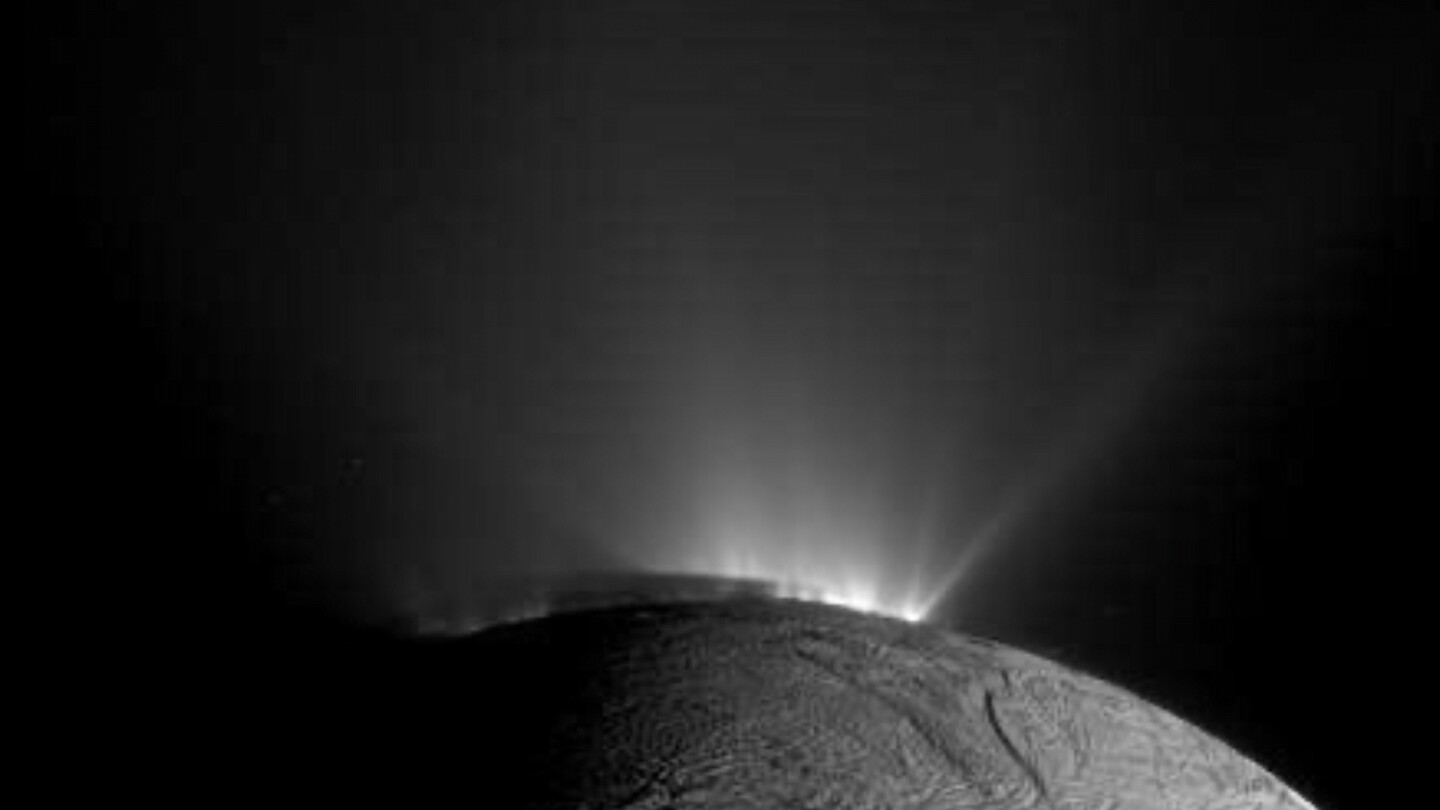
CAPE CANAVERAL, Fla. (AP) — Scientists have uncovered new types of organics in icy geysers spouting from Saturn’s moon Enceladus, bolstering the likelihood that the ocean world may harbor conditions suitable for life.

Their findings, reported Wednesday, are based on observations made by NASA’s Cassini spacecraft in 2008 during a close and fast flyby of Enceladus. The small moon, one of 274 orbiting Saturn, has long been considered a prime candidate in the search for life beyond Earth because of its hidden ocean and plumes of water erupting from cracks near its south pole.

While Enceladus may be habitable, no one is suggesting that life exists.

“Being habitable and being inhabited are two very different things. We believe that Enceladus is habitable, but we do not know if life is indeed present,” said the University of Washington’s Fabian Klenner, who took part in the study.

An international team decided to launch a fresh analysis of tiny grains of ice encountered as Cassini flew through the moon’s geysers. The grains were young compared with the much older geyser particles that ended up in one of Saturn’s outermost rings.

These new grains collided with Cassini’s cosmic dust analyzer at 40,000 mph (64,800 kph), faster than the old ones. The increased speed provided a clearer view of the chemical compounds present, the scientists noted.

Organic molecules already had been spotted in the old geyser grains, but their age raised questions as to whether they had been altered over the years by space radiation.

Scientists found some of the same molecules in the fresh grains, confirming they came from the moon’s underground sea, as well as new chemical compounds. The findings were published in Nature Astronomy.

An ice-encapsulated water world barely 310 miles (500 kilometers) across with a rocky core, Enceladus is suspected of having hydrothermal vents on its ocean floor, quite possibly like those in the Arctic. The moon’s jets of water vapor and frozen particles can stretch thousands of miles (kilometers) into space.

“We are confident that these molecules originate from the subsurface ocean of Enceladus, enhancing its habitability potential,” the Free University of Berlin’s Nozair Khawaja, the lead author, said in an email.

The scientists favor new missions to further explore Enceladus. Launched in 1997, Cassini is long gone; the spacecraft was deliberately plunged into Saturn in 2017 following its joint mission by NASA, the European Space Agency and the Italian Space Agency.

“Having a variety of organic compounds on an extraterrestrial water world is simply phenomenal,” Klenner said in an email.

The European Space Agency is in the early planning stages of a mission to land on Enceladus decades from now. China also has proposed a landing mission.

NASA has a spacecraft en route to another enticing target to hunt for the ingredients of life: Jupiter’s moon Europa. The Europa Clipper is expected to begin orbiting Jupiter in 2030 with dozens of Europa flybys. ESA also has a spacecraft, Juice, that’s headed to Jupiter to explore Europa and two other icy moons that could hold buried oceans.

Underground oceans on moons “are perhaps the best candidates for the emergence of extraterrestrial life in our solar system. This work only confirms the need for further studies,” said University of Kent physics professor Nigel Mason, who was not involved in the latest findings.

___

The Associated Press Health and Science Department receives support from the Howard Hughes Medical Institute’s Department of Science Education and the Robert Wood Johnson Foundation. The AP is solely responsible for all content


Source link

GT
  • Website

Keep Reading

Microsoft cuts OpenAI revenue share as their AI alliance loosens

AI showdown: Musk and Altman go to trial in fight over OpenAI’s beginnings

Apple’s new CEO Ternus is a low profile hardware veteran

US judge overturns Trump administration orders to slow wind and solar projects

UK faces cyberattacks from Russia, Iran, and China, warns NCSC head

New York lawsuit accuses Coinbase and Gemini of enabling illegal gambling

Add A Comment
Leave A Reply Cancel Reply

Editors Picks

Investors trust Google more than Meta when comes to spending on AI

April 30, 2026

Google launches training and inference TPUs in latest shot at Nvidia

April 27, 2026

Meta tracks employee usage on Google, LinkedIn AI training project

April 25, 2026

Meta will cut 10% of workforce as company pushes deeper into AI

April 24, 2026
Latest Posts

Malicious Chrome Extension Steal ChatGPT and DeepSeek Conversations from 900K Users

April 1, 2026

Top 10 Best Server Monitoring Tools

April 1, 2026

10 Best Cybersecurity Risk Management Tools

March 31, 2026

Subscribe to News

Subscribe to our newsletter and never miss our latest news

Subscribe my Newsletter for New Posts & tips Let's stay updated!

Welcome to RoboNewsWire, your trusted source for cutting-edge news and insights in the world of technology. We are dedicated to providing timely and accurate information on the most important trends shaping the future across multiple sectors. Our mission is to keep you informed and ahead of the curve with deep dives, expert analysis, and the latest updates in key industries that are transforming the world.

Subscribe to Updates

Subscribe to our newsletter and never miss our latest news

Subscribe my Newsletter for New Posts & tips Let's stay updated!

Facebook X (Twitter) Instagram
  • Home
  • About Us
  • Advertise
  • Contact Us
  • DMCA
  • Privacy Policy
  • Terms & Conditions
© 2026 Robonewswire. Designed by robonewswire.

Type above and press Enter to search. Press Esc to cancel.