



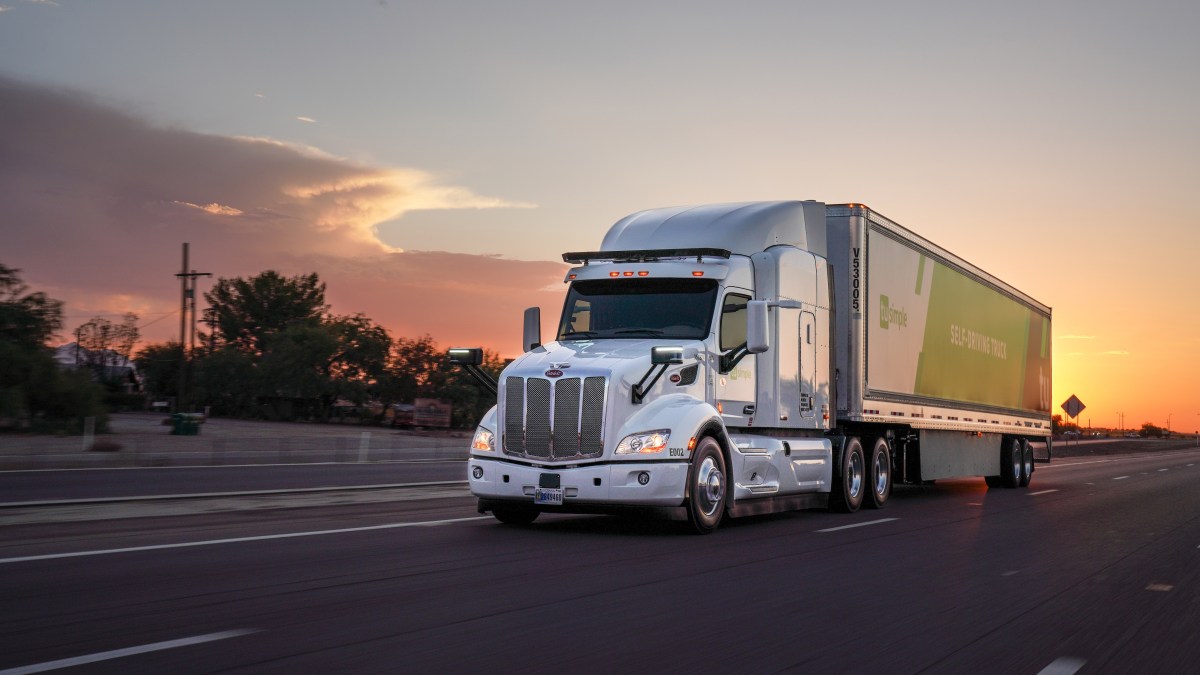
Self-driving truck startup TuSimple (now CreateAI) sent a trove of sensitive data — effectively the blueprint of an American-made autonomous vehicle system — to a Beijing-owned firm after committing to the U.S. government that it would cease such transfers under a national security agreement, according to The Wall Street Journal.
The transfers to Chinese truck manufacturer Foton happened around February 2022, just a week after TuSimple signed the agreement in which U.S. regulators ordered the company to separate its business and technology from China-based employees and partners with firewalls and governance controls. The data sharing continued up until TuSimple’s deadline to comply with the agreement six months later, according to hundreds of pages of correspondence that the Journal viewed.
A subsequent investigation with the Committee on Foreign Investment in the U.S. (CFIUS) found the data sharing didn’t technically violate the agreement, though TuSimple was fined for other infractions and paid a $6 million settlement without admitting fault, per the Journal.
TechCrunch was unable to reach TuSimple, now CreateAI, for comment.
Still, the saga of TuSimple’s data transfers to China exposes the limits of U.S. safeguards meant to balance foreign investment with national security. And it’s not just data that TuSimple has been trying to get across the border.
This latest revelation comes eight months after TechCrunch reported that some of TuSimple’s shareholders were trying to block the company from transferring its U.S. funds — roughly $450 million at the time — to the company’s Chinese subsidiary to fund a pivot to AI animation and content generation. That drama is still unfolding as one of TuSimple’s co-founders, Xiaodi Hou, fights in court for control over his voting shares so he can push for liquidation of the company. In December 2024, TuSimple officially rebranded to CreateAI.
The company has been embroiled in controversy since going public via IPO in 2021. TuSimple started as a China-backed startup founded in 2015 by Hou and Lu Chen, an entrepreneur with ties to Sina Corp. It quickly became an autonomous vehicle industry favorite, managing to raise around $2 billion from a mixture of Chinese and U.S.-based heavy hitters, and was one of the first in the U.S. to successfully complete a fully driverless run on public highways.
TuSimple’s plans took a turn for the worse amid internal struggles and federal investigations into the company’s ties with China, leading to its decision to exit U.S. operations and voluntarily delisting from the stock market in January 2024. The goal was to restart self-driving operations in China, but both the CFIUS agreement and other court orders that barred the company from transferring assets — financial or otherwise — to China made it next to impossible to restart operations there, the company has told TechCrunch.
The Journal’s reporting sheds light on a previously reported controversy regarding Hydron, a Chinese hydrogen trucking startup founded by Chen, which shared an office with TuSimple China. The overlap between Hydron and TuSimple was the subject of the 2022 CFIUS probe, during which TuSimple revealed that its employees spent paid hours working for Hydron in 2021 and shared confidential information with the company.
According to documents the Journal viewed, TuSimple negotiated a deal in 2021 between Hydron and Foton to develop autonomous trucks. Foton, a subsidiary of state-owned BAIC Group, has an agreement with a Chinese military university to work on AV tech.
Through a combination of emails, Slack messages, and video calls, TuSimple sent partners technical instructions for server dimensions, brake designs, sensors, steering, power supply, and chips, per the Journal. Employees also routinely downloaded autonomy source code developed by their American counterparts.
As geopolitical tensions and competition with China rise, TuSimple’s ties are serving as a cautionary tale for Washington that has helped drive a shift in U.S. policy, prompting stricter rules on Chinese-linked tech deals and fueling a broader push to block high-risk transactions outright.
