



When you picture a worker at a retail store, you probably think of someone at a cash register or helping a customer. But employees also spend a lot of their time combing through stockrooms and shop floors, fulfilling requests or online orders and generally trying to keep track of all their inventory.
Keeping track of inventory takes so much time, in part, because retailers don’t always know where everything is located. That’s why when you ask a store associate to check if they have a shirt in your size, it may take them 20 minutes to get back to you.
Cartesian is helping retailers keep track of inventory with a technology invented at MIT. The system uses wireless signals from radio frequency identification (RFID) tags attached to items to find their precise location in a store, from the stockroom to the shop floor.
Last year, Cartesian did a study with a retailer and found its platform delivered meaningful annual savings at the store level by streamlining inventory tracking, optimizing workflows, and improving customer experiences.
“The big problem we’re solving is that about 50 percent of working hours in retail stores go to managing inventory,” says co-founder Fadel Adib SM ’13, PhD ’17, an associate professor at MIT. “That is roughly a $15 billion problem in the U.S. alone. We use algorithms to decipher indoor locations using wireless signals. The core technology enables a new level of indoor localization.”
Cartesian is already deployed in more than 700 stores across 15 countries and is working with one of the world’s largest fashion groups, Inditex, which is the parent company to brands like ZARA, Pull&Bear, and Oysho.
Beyond retailers and warehouses, Cartesian’s platform could also improve indoor location tracking for manufacturers, logistics operators, and robotics companies.
“The broad vision for what we are doing is spatial AI,” says Adib. “Today, AI does extremely well in the digital world. Now it has to move into the physical world. That means allowing machines to perceive their environment in such a way that they can interact with it. That’s where spatial AI comes in and where Cartesian sits.”
From technology to product
Adib, who holds a joint appointment in MIT’s Media Lab and Department of Electrical Engineering and Computer Science, has been studying wireless signals at the Institute for more than 15 years, dating back to research during his master’s degree.
“My group today researches how to use wireless signals to sense the world in ways that were not possible before,” Adib says. “We develop the fundamental technology and then we build systems around them. Our goal is to see these systems deployed in the real world for impact.”
When Adib joined MIT’s faculty, the first project he worked on was indoor localization using RFID tags. Isaac Perper ’20, MEnG ’21 later joined his lab as a student, and together they developed machine-learning algorithms to process RFID data to translate them into location patterns, with an initial focus on helping robots locate RFIDs indoors.
In 2021, Adib went through the National Science Foundation’s I-Corps program, which challenges researchers to interview potential customers to find the right problems to solve with their technologies. That’s when he realized how big of a problem inventory management is for retailers.
Cartesian was officially founded by Adib and Perper in the beginning of 2023, after they received a small business award from the National Science Foundation. The pair worked with MIT’s Technology Licensing Office to license patents from Adib’s lab. They also received support from MIT’s Venture Mentoring Service.
“Our goal was to reduce the cost of the technology to make it scalable,” Adib recalls. “Isaac focused on simplifying the product, leveraging progress in machine learning, and making it fast. It was a lot of iterating and testing early on.”
Retail workers spend much of their time locating items for a number of reasons. They might get an online order to fulfill, need to restock store shelves, or get a customer inquiry about items in the back.
Stores differ in how they organize their inventory. Most separate items by categories in specific shelves and bins then use barcodes or inventory systems that tend to get outdated fast.
“It’s a big problem for stores because customers may just leave before asking an employee to look for their size, or customers may get frustrated and leave if it takes too long,” Adib says. “The associate also wastes time looking for items they could spend doing higher-value work.”
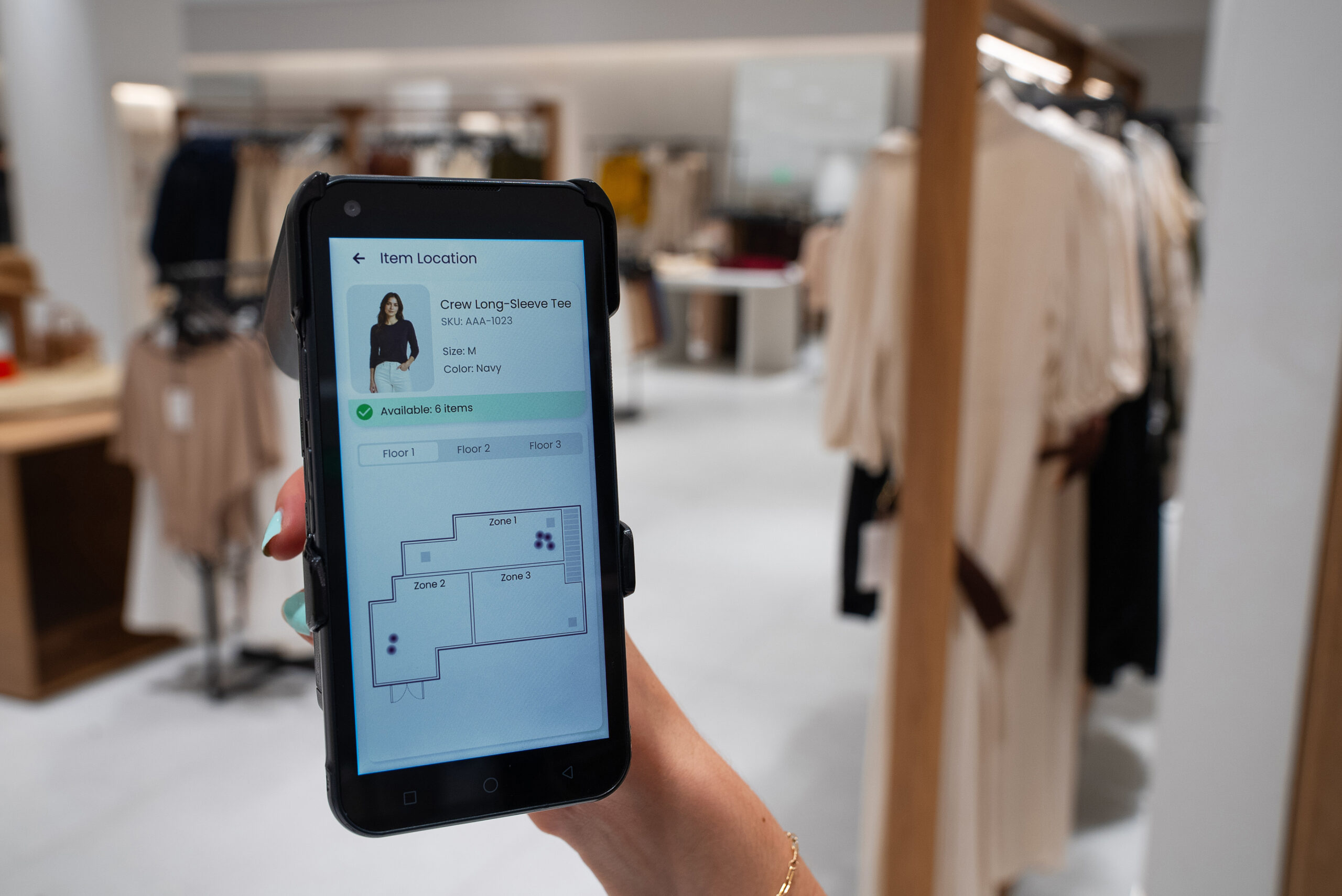
Cartesian’s platform works with retailers’ existing handheld RFID readers, which store associates already use to manage inventory. Each store installs Cartesian’s software into their existing inventory apps or uses a custom app for employees to access directly.
“The RFID readers are how stores tell what’s in stock and what’s out of stock,” Perper says. “We figured out a way to leverage the same scans they’re already using with the reader, put the data they generate into our machine-learning algorithms, and generate maps of where all the items are.”
Customers can build analytics on top of Cartesian’s technology to keep track of inventory levels, show customers maps of where each item is located, and create other services.
“They use our location intelligence platform and build different products on top,” Adib says. “We can work with any device, any store, any type of RFID. It’s a simple interface. All the sophisticated location algorithms sit in the cloud.”
Beyond retail
Cartesian signed its first big contract in 2025 and soon expanded to several hundred stores. One of Cartesian’s advantages is its ability to quickly scale. Perper says they can add a store in about one minute. Cartesian’s team doesn’t even have to travel to a new store to turn on its system if it’s already working with the company.
“It’s as simple as flipping a switch, preparing the data, and sending it to our customers,” Perper says. “One of our first big bets was, ‘Can we build this entirely on existing hardware?’ That bet is starting to pay off.”
Cartesian’s models can also work with Wi-Fi and Bluetooth signals, which the company plans to use with customers in other verticals.
“Right now, we’re focused on applications in retail, but this technology has a lot of value in manufacturing, warehouses, and other locations,” Adib says.
Cartesian’s team aims to be deployed in tens of thousands of stores over the next year and then begin expanding beyond retail into industries like manufacturing and robotics.
“What’s most exciting about Cartesian to me is we’ve built a lot of the technology foundation, and now that we have the fundamentals in place, we hope to build specific application layers,” Perper says. “Then we can ask customers in different verticals about their problems and apply our technology in different ways to solve it.”
