



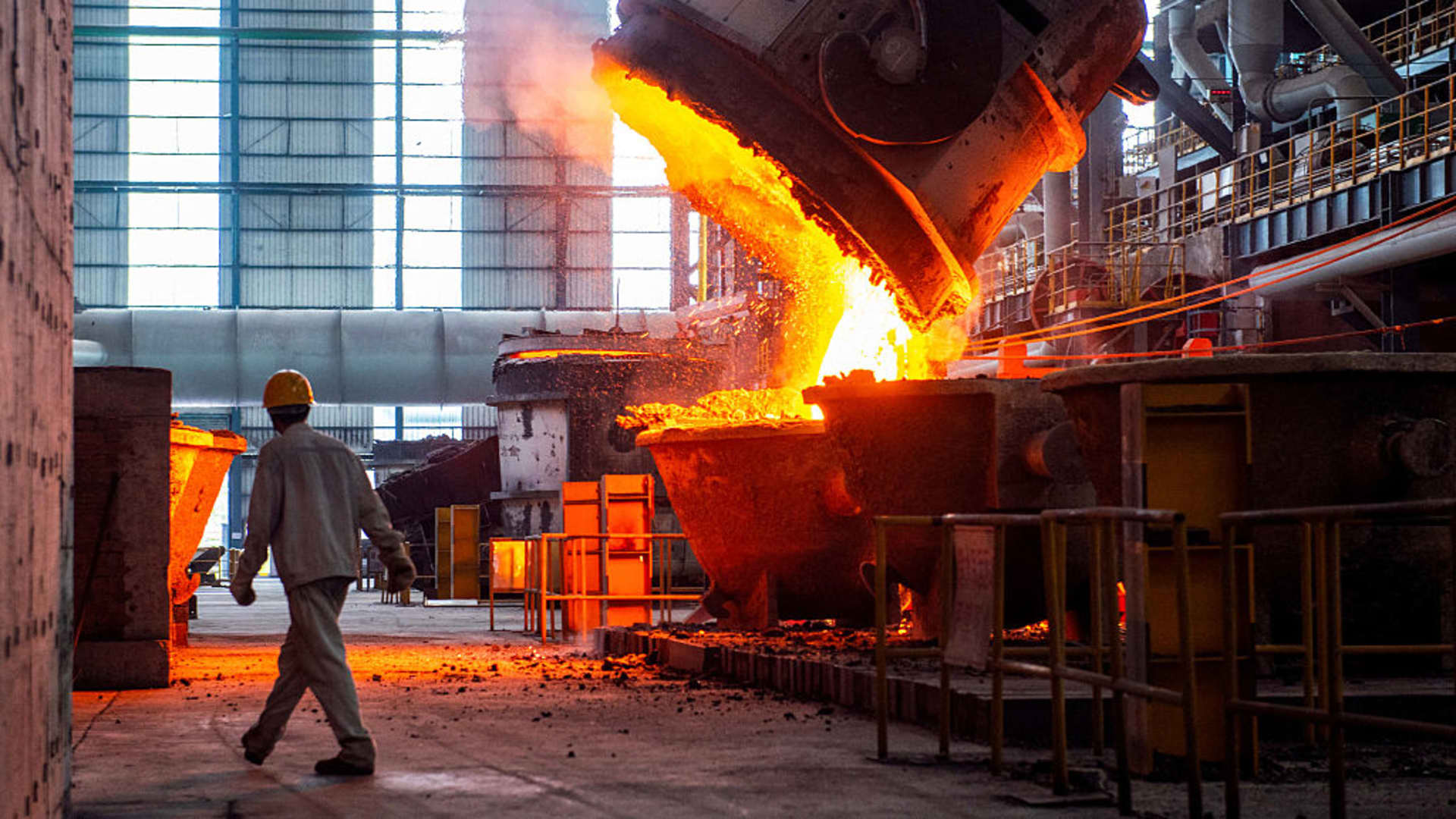
A worker walks past molten steel at a steel factory in Huai’an, in China’s eastern Jiangsu province on July 22, 2025.
– | Afp | Getty Images
The European Union is less than three months away from launching its carbon levy — the world’s first large-scale border tax on carbon-intensive goods.
The forthcoming step, which has the potential to completely transform global trade, comes as part of the bloc’s efforts to slash greenhouse gas emissions from heavy industries and promote cleaner production processes across the globe.
Starting from Jan. 1 next year, the EU’s Carbon Border Adjustment Mechanism (CBAM) will impose a cost on goods such as steel, fertilizers, cement, aluminum and hydrogen imported from outside the 27-nation bloc.
Under the terms of the policy, importers bringing these goods into the EU will be required to purchase CBAM certificates to cover their associated emissions. The cost of these certificates is expected to be the same as the EU Emissions Trading System (ETS) market price.
Vocal opposition
Not everyone is thrilled about the EU’s upcoming carbon border tax. The U.S., China, India and Brazil are among the countries that have raised concerns, with some threatening to take retaliatory measures and others warning the policy might hinder rather than help global climate efforts.
The European Commission, the EU’s executive arm, did not respond to a request for comment when contacted by CNBC.
An aerial view of the Belchatow Power Station, Europe’s largest coal-fired power station near Belchatow, Poland on August 22, 2025. It is Poland’s largest power station with an installed capacity of 5,1 MW. The power plant is one of the candidates to be reconstructed as a future nuclear power site.
Nurphoto | Nurphoto | Getty Images
Nicolas Endress, founder and CEO of ClimEase, a CBAM software solutions company, said the EU’s integrated carbon tax and tariff scheme will reshape global trade in ways most businesses haven’t yet grasped. Steel, cement, fertilizers and aluminum-related sectors are set to be first in the firing line.
It’s “no surprise” that the likes of the U.S., Brazil and India have raised concerns about the policy, Endress said, noting that countries without an emissions trading system (ETS) will be exposed to the border tax.
The EU says the CBAM is designed to put a “fair price” on carbon emitted during the production of emissions-intensive goods.
The tax is also designed to prevent what’s known as “carbon leakage,” which is when companies move production abroad to countries where less stringent climate polices are in place.
A test of climate leadership
The U.S., for its part, has warned that European climate rules could threaten the EU’s trade deal with the White House.
U.S. President Donald Trump struck a framework agreement with European Commission President Ursula von der Leyen in late July, establishing a tariff ceiling of 15% for most EU goods from the start of August.
This rate was significantly lower than the 30% previously threatened by the U.S. president, but above the 10% baseline the EU had been hoping for.
Speaking to the Financial Times last month, U.S. Energy Secretary Chris Wright said that, in the absence of significant modifications, the EU’s CBAM — among other green regulatory policies — would create “huge legal risks” for U.S. companies selling fossil fuels into Europe.
Other countries exposed to the EU’s CBAM have criticized the plans, too. India has reportedly said it will retaliate against the carbon border taxes, saying high-income countries that are historically responsible for the climate crisis should do more to slash greenhouse gas emissions.
China, Brazil and Russia, meanwhile, have all raised concerns about the EU’s carbon border taxes, both at U.N. climate negotiations and with the World Trade Organization.
European Commission President Ursula von der Leyen and NATO Secretary General Mark Rutte hold a joint press statement in Brussels, Belgium on September 30, 2025.
Anadolu | Anadolu | Getty Images
The EU’s von der Leyen, in a 2019 manifesto to become European Commission president, said she intended to introduce a carbon border tax “to avoid carbon leakage” and help EU companies “compete on a level playing field.”
The policy was later introduced as part of the bloc’s effort to reduce emissions by at least 55% by the end of the decade.
Alex Mengden, policy analyst at Tax Foundation Europe, said EU officials have typically sought to downplay the potential for any retaliatory steps from major economies when the final stage of CBAM kicks in.
“It might show that we can only take so much climate leadership because it has real costs on us and if we are not in a global coalition, those costs fall back on ourselves instead of our trading partners, which is essentially the goal,” Mengden told CNBC by video call.
“Now, of course, it might still succeed,” Mengden said. “The success case for policymakers that devise the CBAM policy would be other countries adopting their own ETS systems,” he added.
Not just ‘a European experiment’
For some, the EU’s CBAM marks the first step of what is expected to become a global initiative to tackle the climate crisis.
“Within the next few years, carbon pricing won’t just be a European experiment — it will likely cover as much as 80% of global trade,” ClimEase’s Endress said.
“CBAM is what is making this happen by likely penalising countries without sturdy systems and rewarding those with EU-aligned ETS frameworks,” he added. “Countries that evolve with the change and build credible carbon pricing will defend their industries, while those that pull away will watch their exporters ultimately face the consequences.”
