



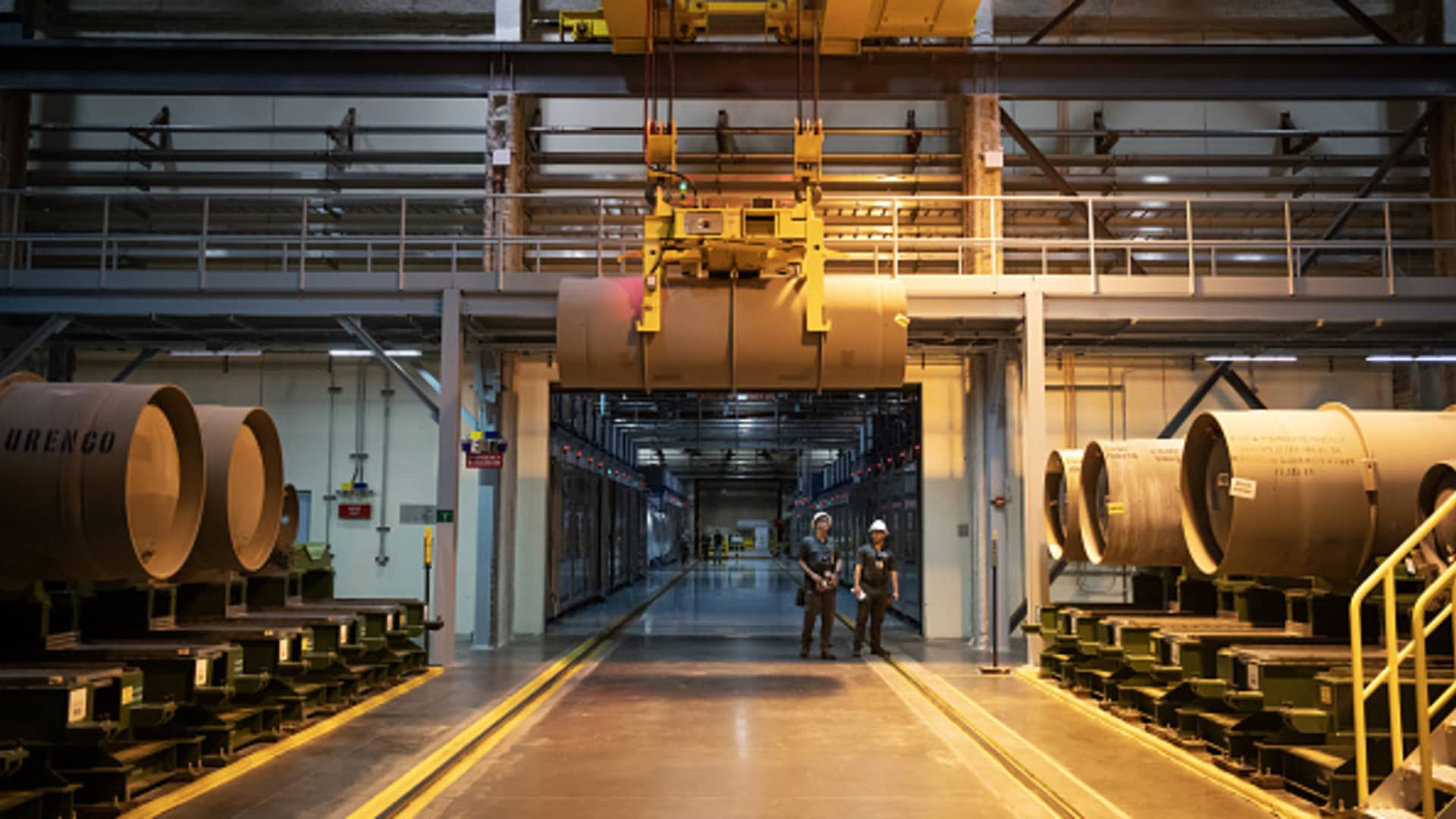
A revival of nuclear energy is spurring demand for uranium, as the hunt for fuel reshapes the investment landscape. Described as “the heavenly atom ,” uranium and its concentrated energy are essential for fueling nuclear reactors. After years of skepticisim following the Fukushima disaster of 2011, a growing need for large, reliable supplies of power to support the world’s AI boom has brought nuclear energy — and the fuel required for it — back into the spotlight. Demand for uranium is forecast to rise by nearly a third to roughly 86,000 tons by 2030 and to rise to 150,000 tons by 2040, according to a report released by the World Nuclear Association last week. In addition to the vast amounts of capital that are required to realize the sector’s nuclear hopes, data also showed that accelerated permitting, mining innovations and new explorations of uranium will need to take place to meet growing demand. Output from existing mines is expected to halve between 2030 and 2040, resulting in a “significant gap” between uranium requirements for nuclear reactors and production volumes, the WNA report said. “The demand signals are there” Mahesh Goenka, founder of market and commercial advisory firm Old Economy, told CNBC. The world has gone from the West looking to shut down capacity to it now extending reactor lifetimes beyond 2050, he said. “The big leg up would come if the order book for new nuclear reactors in the West will start firming up… If the West can indeed build a big pipeline of reactor projects, that would mean demand for uranium grows much more rapidly than in the current scenario,” he said. Boosting supply The uranium market is widely exposed to geopolitical tensions due to sources of the supply. Kazakhstan continues to lead global production with 40% of global supply, of which the country owns around half, according to Old Economy. Meanwhile Russia has around 40% of the world’s enrichment capacity. There’s “momentum in the industry which we have not seen for decades,” Boris Schucht, CEO of uranium enrichment firm Urenco, told CNBC on the sidelines of the World Nuclear Association symposium last week. He added that the seven to 10-billion-euro ($8.2 billion to $11.8 billion) market is seeing steady annual growth of 1-2%. “It’s a small growing market. It’s a limited market, [that’s] not very big, and it’s very expensive to develop technologies in this market. So that makes the market pretty complex,” he said. The Dutch-British-German consortium conducted the “expensive exercise” of terminating all of its existing Russian contracts in 2022 when the Russia-Ukraine war started, Schucht said. The company is now looking to increase its capacity of Low Enriched Uranium (LEU) by 1.8 million Separative Work Units (SWU) across its four sites in Eunice, New Mexico, the Netherlands, Germany and the U.K. “From now on, we will bring new capacity into the market, starting in the U.S., but then the Netherlands and Germany will follow. What we have also seen is that most of our, especially our U.S., customers, were requesting very long term contracts.” Other companies are also looking to increase supply in the U.S. The Uranium Energy Corporation (UEC) last week announced it will launch a subsidiary firm to develop a new Stateside uranium refining and conversion facility. Back in July, Eagle Energy Metals, which touts itself as the first U.S. company to explore uranium with Small Modular Reactor (SMR) tech, announced its plans to go public. Last week, French firm Orano shared plans to expand capacity in anticipation of post-“peak uranium” years. Burgeoning market Old Economy predicts a perceptible drop in existing nuclear projects and supply in the second half of the 2030s due to depletion. Work must start now, for supply to then be made available. Those efforts include exploration, better understanding of resource bases and getting licenses and permitting underway. “There’s a lot for miners to work through, both in terms of understanding the resource base, understanding the flow sheets, and developing the studies, but then also getting the stakeholder support in terms of licensing and social license to operate,” Goenka said, noting that uranium, as a commodity, lacks advanced management systems when it comes to managing price risk. The Chicago Mercantile Exchange’s (CME) introduced a futures contract for uranium in 2007, but the endeavor has had little success, due to a lack of liquidity, according to Goenka. Last year, Trilitech launched the uranium.io platform which uses blockchain technology to enable trading of tokenized uranium. The goal is to open up the market which is traditionally dominated by institutional investors, Ben Elvidge, head of applications at uranium.io, told CNBC at the WNA symposium. “If you take apart the demand as it stands right now, there was already a shortfall of uranium last year to power the current fleet. That gap makes it, like any commodity investment, interesting,” said Elvidge. Early demand came from traders looking to diversify their portfolio of crypto assets, Elvidge said. He added that they’ve also seen interest from traditional investors such as hedge funds and family offices, who might not be familiar with the nuclear thesis, but understand the fundamentals around uranium and don’t want to have the operational burden of trading larger amounts of uranium. Regardless of new developments, Urenco’s Schucht urged caution when it comes to tech involvement in the market, telling CNBC that the current momentum should be harnessed jointly with the government in order to achieve what has been pledged. “We need to be careful the nuclear market stays the nuclear market, and it will be not a [quickly] exploding tech market [as] the processes that you have in nuclear, around nuclear safety, design and planning, will not allow for that,” the CEO said, adding that he was skeptical about the ability of the nuclear industry, with its long cycles, to support short-term solutions from the tech sector. “I strongly believe the market of [small modular reactors] and [advanced modular reactors] will play their role, but it will take time,” he said.
