



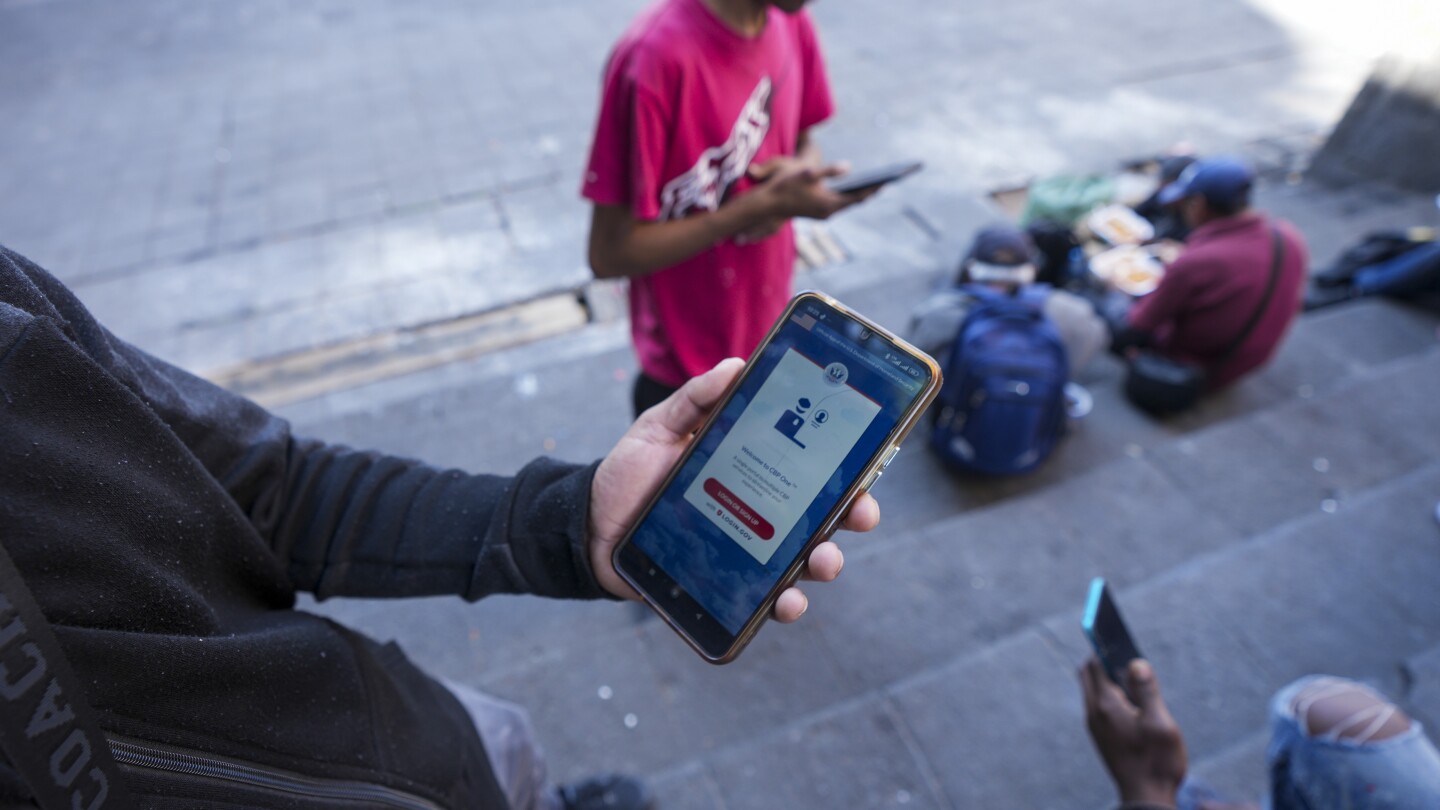
SAN FRANCISCO (AP) — U.S. immigration officials are asking the public and federal agencies to comment on a proposal to collect social media handles from people applying for benefits such as green cards or citizenship, to comply with an executive order from President Donald Trump.
The March 5 notice raised alarms from immigration and free speech advocates because it appears to expand the government’s reach in social media surveillance to people already vetted and in the U.S. legally, such as asylum seekers, green card and citizenship applicants — and not just those applying to enter the country. That said, social media monitoring by immigration officials has been a practice for over a decade, since at least the second Obama administration and ramping up under Trump’s first term.
Below are some questions and answers on what the new proposal means and how it might expand social media surveillance.
What is the proposal?
The Department of Homeland Security issued a 60-day notice asking for public commentary on its plan to comply with Trump’s executive order titled “Protecting the United States from Foreign Terrorists and Other National Security and Public Safety Threats.” The plan calls for “uniform vetting standards” and screening people for grounds of inadmissibility to the U.S., as well as identify verification and “national security screening.” It seeks to collect social media handles and the names of platforms, although not passwords.
The policy seeks to require people to share their social media handles when applying for U.S. citizenship, green card, asylum and other immigration benefits. The proposal is open to feedback from the public until May 5.
What is changing?
“The basic requirements that are in place right now is that people who are applying for immigrant and non-immigrant visas have to provide their social media handles,” said Rachel Levinson-Waldman, managing director of the Brennan Center’s Liberty and National Security Program at New York University. “Where I could see this impacting is someone who came into the country before visa-related social media handle collection started, so they wouldn’t have provided it before and now they’re being required to. Or maybe they did before, but their social media use has changed.”
“This fairly widely expanded policy to collect them for everyone applying for any kind of immigration benefit, including people who have already been vetted quite extensively,” she added.
What this points to — along with other signals the administration is sending such as detaining people and revoking student visas for participating in campus protests that the government deems antisemitic and sympathetic to the militant Palestinian group Hamas — Levinson-Waldman added, is the increased use of social media to “make these very high-stakes determinations about people.”
In a statement, a spokesperson for the United States Citizenship and Immigration Service said the agency seeks to “strengthen fraud detection, prevent identity theft, and support the enforcement of rigorous screening and vetting measures to the fullest extent possible.”
“These efforts ensure that those seeking immigration benefits to live and work in the United States do not threaten public safety, undermine national security, or promote harmful anti-American ideologies,” the statement continued. USCIS estimates that the proposed policy change will affect about 3.6 million people.
How are social media accounts used now?
The U.S. government began ramping up the use of social media for immigration vetting in 2014 under then-President Barack Obama, according to the Brennan Center for Justice. In late 2015, the Department of Homeland Security began both “manual and automatic screening of the social media accounts of a limited number of individuals applying to travel to the United States, through various non-public pilot programs,” the nonpartisan law and policy institute explains on its website.
In May 2017, the U.S. Department of State issued an emergency notice to increase the screening of visa applicants. Brennan, along with other civil and human rights groups, opposed the move, arguing that it is “excessively burdensome and vague, is apt to chill speech, is discriminatory against Muslims, and has no security benefit.”
Two years later, the State Department began collecting social media handles from “nearly all foreigners” applying for visas to travel to the U.S. — about 15 million people a year.
How is AI used?
Artificial intelligence tools used to comb through potentially millions of social media accounts have evolved over the past decade, although experts caution that such tools have limits and can make mistakes.
Leon Rodriguez, who served as the director of USCIS from 2014 to 2017 and now practices as an immigration attorney, said while AI could be used as a first screening tool, he doesn’t think “we’re anywhere close to where AI will be able to exercise the judgment of a trained fraud detection and national security officer” or that of someone in an intelligence agency.
“It’s also possible that I will miss stuff,” he added. “Because AI is still very much driven by specific search criteria and it’s possible that the search criteria won’t hit actionable content.”
What are the concerns?
“Social media is just a stew, so much different information — some of it is reliable, some of it isn’t. Some of it can be clearly attributed to somebody, some of it can’t. And it can be very hard to interpret,” Levinson-Waldman said. “So I think as a baseline matter, just using social media to make high-stakes decisions is quite concerning.”
Then there’s the First Amendment.
“It’s by and large established that people in the U.S. have First Amendment rights,” she said. This includes people who are not citizens. “And obviously, there are complicated ways that that plays out. There is also fairly broad authority for the government to do something like revoking somebody’s visa, if you’re not a citizen, then there’s steps that the government can take — but by and large, with very narrow exceptions, that cannot be on the grounds of speech that would be protected (by the First Amendment).”
