



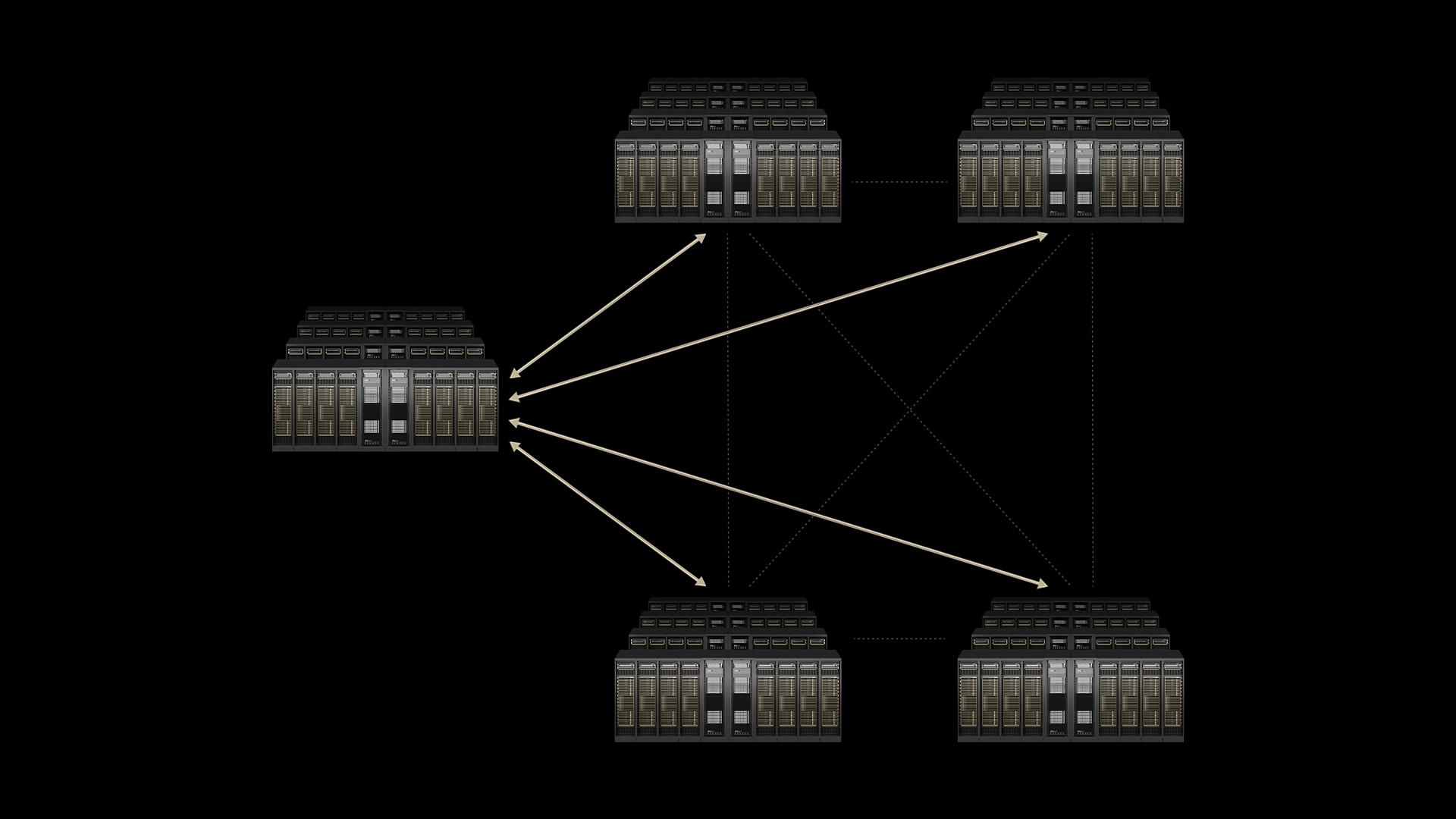
When AI data centres run out of space, they face a costly dilemma: build bigger facilities or find ways to make multiple locations work together seamlessly. NVIDIA’s latest Spectrum-XGS Ethernet technology promises to solve this challenge by connecting AI data centres across vast distances into what the company calls “giga-scale AI super-factories.”
Announced ahead of Hot Chips 2025, this networking innovation represents the company’s answer to a growing problem that’s forcing the AI industry to rethink how computational power gets distributed.
The problem: When one building isn’t enough
As artificial intelligence models become more sophisticated and demanding, they require enormous computational power that often exceeds what any single facility can provide. Traditional AI data centres face constraints in power capacity, physical space, and cooling capabilities.
When companies need more processing power, they typically have to build entirely new facilities—but coordinating work between separate locations has been problematic due to networking limitations. The issue lies in standard Ethernet infrastructure, which suffers from high latency, unpredictable performance fluctuations (called “jitter”), and inconsistent data transfer speeds when connecting distant locations.
These problems make it difficult for AI systems to efficiently distribute complex calculations across multiple sites.
NVIDIA’s solution: Scale-across technology
Spectrum-XGS Ethernet introduces what NVIDIA terms “scale-across” capability—a third approach to AI computing that complements existing “scale-up” (making individual processors more powerful) and “scale-out” (adding more processors within the same location) strategies.
The technology integrates into NVIDIA’s existing Spectrum-X Ethernet platform and includes several key innovations:
Distance-adaptive algorithms that automatically adjust network behaviour based on the physical distance between facilitiesAdvanced congestion control that prevents data bottlenecks during long-distance transmissionPrecision latency management to ensure predictable response timesEnd-to-end telemetry for real-time network monitoring and optimisation
According to NVIDIA’s announcement, these improvements can “nearly double the performance of the NVIDIA Collective Communications Library,” which handles communication between multiple graphics processing units (GPUs) and computing nodes.
Real-world implementation
CoreWeave, a cloud infrastructure company specialising in GPU-accelerated computing, plans to be among the first adopters of Spectrum-XGS Ethernet.
“With NVIDIA Spectrum-XGS, we can connect our data centres into a single, unified supercomputer, giving our customers access to giga-scale AI that will accelerate breakthroughs across every industry,” said Peter Salanki, CoreWeave’s cofounder and chief technology officer.
This deployment will serve as a practical test case for whether the technology can deliver on its promises in real-world conditions.
Industry context and implications
The announcement follows a series of networking-focused releases from NVIDIA, including the original Spectrum-X platform and Quantum-X silicon photonics switches. This pattern suggests the company recognises networking infrastructure as a critical bottleneck in AI development.
“The AI industrial revolution is here, and giant-scale AI factories are the essential infrastructure,” said Jensen Huang, NVIDIA’s founder and CEO, in the press release. While Huang’s characterisation reflects NVIDIA’s marketing perspective, the underlying challenge he describes—the need for more computational capacity—is acknowledged across the AI industry.
The technology could potentially impact how AI data centres are planned and operated. Instead of building massive single facilities that strain local power grids and real estate markets, companies might distribute their infrastructure across multiple smaller locations while maintaining performance levels.
Technical considerations and limitations
However, several factors could influence Spectrum-XGS Ethernet’s practical effectiveness. Network performance across long distances remains subject to physical limitations, including the speed of light and the quality of the underlying internet infrastructure between locations. The technology’s success will largely depend on how well it can work within these constraints.
Additionally, the complexity of managing distributed AI data centres extends beyond networking to include data synchronisation, fault tolerance, and regulatory compliance across different jurisdictions—challenges that networking improvements alone cannot solve.
Availability and market impact
NVIDIA states that Spectrum-XGS Ethernet is “available now” as part of the Spectrum-X platform, though pricing and specific deployment timelines haven’t been disclosed. The technology’s adoption rate will likely depend on cost-effectiveness compared to alternative approaches, such as building larger single-site facilities or using existing networking solutions.
The bottom line for consumers and businesses is this: if NVIDIA’s technology works as promised, we could see faster AI services, more powerful applications, and potentially lower costs as companies gain efficiency through distributed computing. However, if the technology fails to deliver in real-world conditions, AI companies will continue facing the expensive choice between building ever-larger single facilities or accepting performance compromises.
CoreWeave’s upcoming deployment will serve as the first major test of whether connecting AI data centres across distances can truly work at scale. The results will likely determine whether other companies follow suit or stick with traditional approaches. For now, NVIDIA has presented an ambitious vision—but the AI industry is still waiting to see if the reality matches the promise.
See also: New Nvidia Blackwell chip for China may outpace H20 model

Want to learn more about AI and big data from industry leaders? Check out AI & Big Data Expo taking place in Amsterdam, California, and London. The comprehensive event is co-located with other leading events including Intelligent Automation Conference, BlockX, Digital Transformation Week, and Cyber Security & Cloud Expo.
Explore other upcoming enterprise technology events and webinars powered by TechForge here.
