



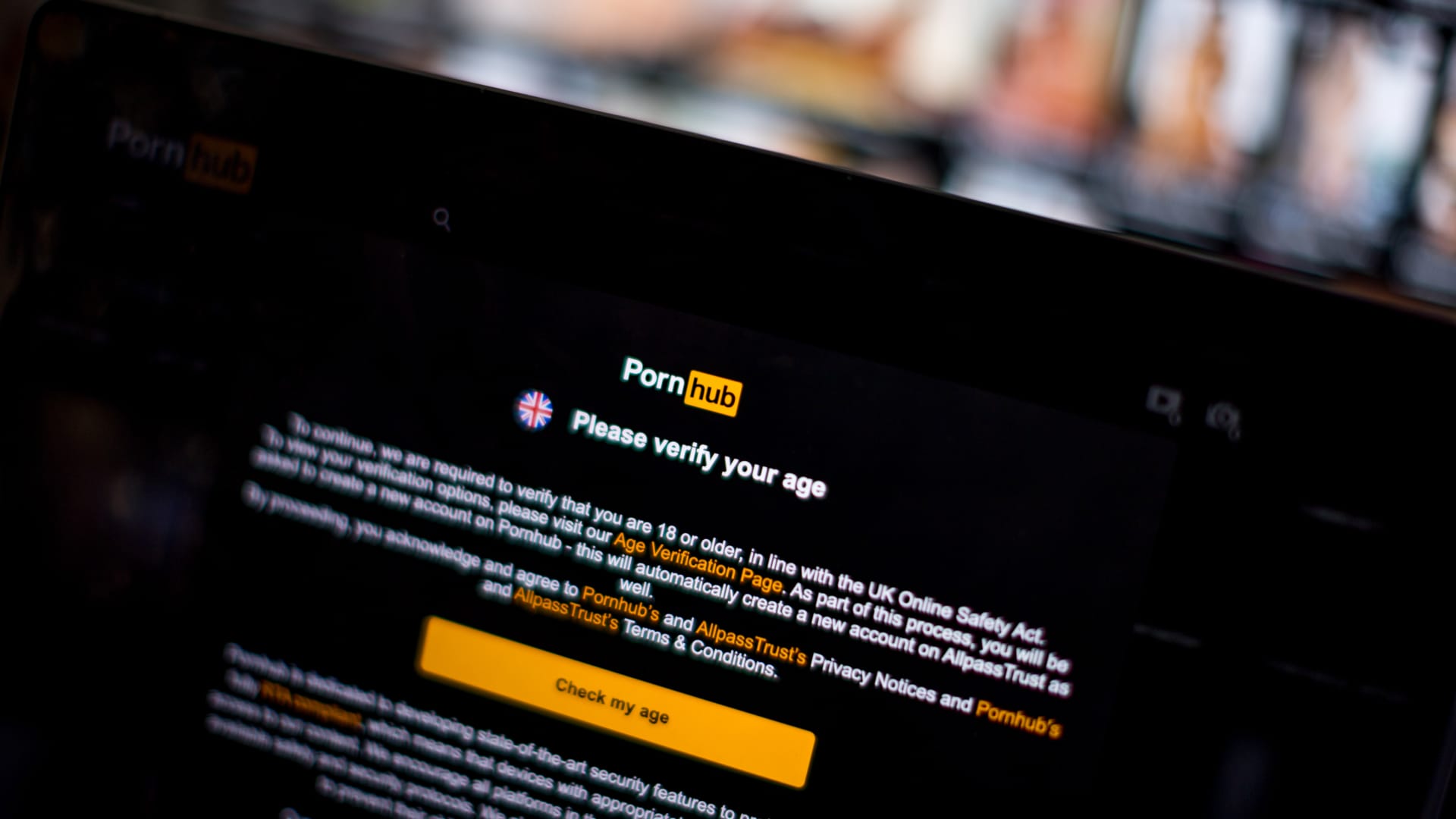
As of July 25, porn sites are required to implement effective age verification methods for U.K. users.
Jack Taylor | Getty Images
It was well intentioned but a U.K. law mandating age verification on adult sites and a number of other platforms has sparked a backlash from both internet users in the country, and U.S. politicians and tech giants.
Last month, new provisions in the Online Safety Act requiring large online platforms to implement age checks to prevent children from accessing pornographic and appropriate material came into force.
The measures have led PornHub, RedTube and other porn sites to force U.K. visitors to sign up and verify their age to gain access to their services.
What is the Online Safety Act?
Broadly, the Online Safety Act is a law that imposes a duty of care on social media firms and other user-generated content sites to ensure they take responsibility for harmful content uploaded and spread on their platforms.
In particular, the legislation aims to prevent children from being exposed to pornographic content and material that promotes suicide, self-harm, eating disorders or abusive and hateful behaviour.
The regulation has been years in the making and faced numerous delays in its development — not least due to concerns that it may infringe internet users’ right to privacy and result in censorship.
Why has it led to backlash?
The latest measures have been imposed with the aim of ensuring children aren’t able to view harmful and inappropriate content.
However, they have led to complaints from internet users due to the requirement of having to share personal information such as their ID, credit card details and selfies — in some cases for platforms that don’t even qualify as porn sites.
Spotify, Reddit, X and a number of other platforms have introduced their own respective age verification systems to stop users under the age of 18 from consuming explicit content.
These moves have subsequently led to providers of virtual private networks (VPNs) to report that their services, which allow users to mask their location, are surging in the U.K.
Meanwhile, on Monday, Wikipedia was dealt a legal blow in the U.K. as a High Court judge ruled the platform should be treated as a “category one” service, which would subject to certain user verification requirements.
The Online Safety Act requires category one platforms to offer users the ability to verify their identity and access tools that reduce their exposure to content from non-verified users.
Wikimedia, the parent company of Wikipedia, has said previously that it could limit visitor numbers from the U.K. in order to exempt it from category one status.
U.S. politicians weigh in
A number of U.S. politicians have blasted the new rules in recent days. Last week, Vice President JD Vance — who has previously criticized the U.K.’s internet safety rules — again raised concerns with the law, fearing it could unfairly restrict American tech companies.
“I just don’t want other countries to follow us down what I think was a very dark path under the Biden administration,” Vance told reporters during a trip to the country last week.
House Judiciary Chairman Jim Jordan, R-Ohio, who also visited the U.K. recently, said in a statement after his return that sweeping online safety laws in Europe are having “a serious chilling effect on free expression and threaten the First Amendment rights of American citizens and companies.”
There has been speculation over whether the U.S. may press Britain to relax the regulations during trade talks — however, U.K. officials say the issue is not open to debate.
Could other countries follow suit?
Other countries are already adopting their own respective internet age verification laws.
Australia and Ireland have both passed similar age verification measures, while Denmark, Greece, Spain, France and Italy have started testing a common age verification app to protect users online.
In the U.S., Louisiana passed a law in 2022 requiring age verification on websites where at least a third of the content is of an adult nature, while several other states are seeking to pass similar legislation.
