



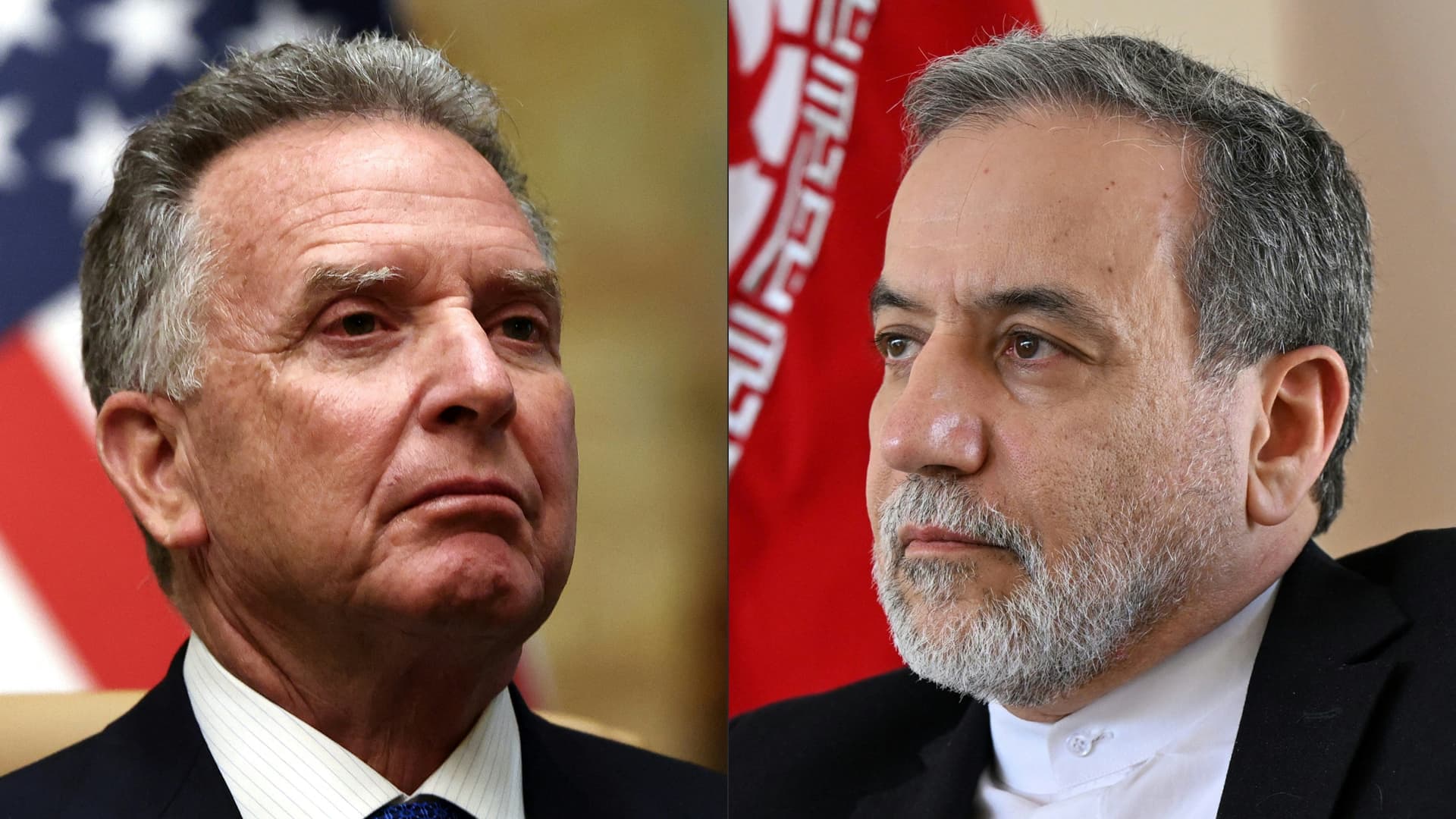
This combination of pictures created on April 09, 2025 shows US Middle East envoy Steve Witkoff after a meeting with Russian officials at Diriyah Palace, in Riyadh, Saudi Arabia, on February 18, 2025 (L); and Iran’s Foreign Minister Abbas Araghchi speaking to AFP during an interview at the Iranian consulate in Jeddah on March 7, 2025.
Evelyn Hockstein | Amer Hilabi | AFP | Getty Images
DUBAI, United Arab Emirates — Talks between U.S. President Donald Trump’s administration and Iran’s government on a potential renewed nuclear agreement began on a positive note over the weekend, representatives of both countries said, despite enduring sticking points and a lack of clarity on the specific conditions held by each side.
Notably, there was more optimism toward a deal and overall communication between the longtime adversaries. Delegates from the U.S. and Iran agreed to hold more talks next week in Rome, while Iran’s Foreign Affairs Ministry described the negotiations of Saturday as having taken place in a “constructive atmosphere and based on mutual respect.”
This highlights the gaping difference between the Biden administration’s attempts to revive the 2015 nuclear deal and the position that the Trump administration finds itself in today: one with dramatically changed advantages for Washington and a much weaker and more vulnerable Iran.
“The Iranians are, I think, a little bit more desperate than they were in 2022, and they are faced with a very weak economy,” Gregory Brew, senior analyst on Iran and energy at political risk consultancy Eurasia Group, told CNBC.
“Iran’s regional position has been significantly weakened. They’re concerned about how much more stress that they can handle — their internal position, the situation of internal discontent is likely only to get worse. So they do have an interest in obtaining a deal sooner rather than later, and Trump is giving them — or potentially giving them — an opportunity to obtain such a deal.”
Biden was also constrained by public opinion, Brew noted, risking criticism of appearing “soft” on Iran. Trump doesn’t face those same limitations, he said — the president is already seen as an Iran hawk and re-implemented “maximum pressure” sanctions on the country soon after entering office.

Iran’s economy has deteriorated dramatically in the years since Trump in 2018 withdrew the U.S. from the multicountry deal, formally titled the Joint Comprehensive Plan of Action, or the JCPOA. The agreement was brokered in 2015 along with Russia, China, the EU and U.K. under the Obama administration to curb and stringently monitor Iran’s nuclear activity in exchange for sanctions relief.
Already facing several years of protests, significantly weakened currency, and a cost-of-living crisis for Iranians, the Islamic Republic was hit with the hammer blow of losing its main ally in the Middle East last year, when the Assad regime collapsed in Syria. Tehran’s arch-enemy Israel meanwhile killed most of the senior leadership of Hezbollah, Iran’s proxy in Lebanon.
Iranian supreme leader Ayatollah Ali Khamenei was formerly staunchly opposed to negotiations with the U.S., but senior Iranian government officials reportedly launched a coordinated effort to change his mind, framing the decision as critical to the regime’s survival.
What kind of a ‘nuclear program’ are we talking about?
Trump has made is abundantly clear that he will not accept a nuclear-armed Iran. Recent years have raised the stakes: in the time since Trump withdrew from the JCPOA, Iran has been enriching and stockpiling uranium at its highest levels ever, prompting the International Atomic Energy Agency, the United Nations’ nuclear watchdog, to issue numerous warnings.
“Iran remains the only non-nuclear weapon state enriching uranium to this level, raising significant concerns over potential weapons development,” a U.N. news release from March 3 read.
Tehran insists that its program is for civilian energy purposes only, but Iran’s nuclear enrichment has reached 60% purity, according to the IAEA — dramatically higher than the enrichment limit posited in the 2015 nuclear deal, and a short technical step from the weapons-grade purity level of 90%.
Trump has repeatedly warned of a U.S. military response if Iran doesn’t change course to Washington’s satisfaction.
“I would like a deal done with Iran on non-nuclear. I would prefer that to bombing the hell out of it,” the American president said in early February in an interview with the New York Post.
That pressure has clearly had an impact on Tehran’s willingness to come to the table, says Ryan Bohl, senior Middle East and North Africa analyst at the RANE Network.
“I think the Iranians are eager to develop a workable framework that will allow extended negotiations that would forestall military action that President Trump certainly has suggested could come in just a few months,” Bohl said.
“Moreover,” he added, “the Iranian economy could use any suggestion of relief to improve conditions on the ground, which would in turn improve public support for the Islamic Republic.”

Still, the specific parameters of a potential deal have not yet been discussed, and further talks will reveal the extent of the differences between each country’s position.
Chief among the remaining sticking points is the fact that Iran is unwilling to give up its nuclear program — that’s a red line for Tehran, its leaders have said. But exactly what kind of program that is may actually be something the Trump administration is willing to show flexibility on, as long as Iran can’t actually develop a bomb.
Subsequent talks will need to reveal Trump’s conditions, which have so far been kept under wraps.
“Ultimately, I think the key to these negotiations was always going to be around what the U.S. demands were towards Iran,” Nader Itayim, Mideast Gulf Editor at Argus Media, told CNBC’s “Access Middle East” on Monday.
“Is the U.S. looking to completely dismantle the Iranian nuclear program, or is it purely a matter of just ensuring verification to make sure there is no weaponization of this program?”
“I think Donald Trump has been very clear over the last two, three weeks in particular: no weaponization. Weaponization is that red line,” Itayim said. “The Iranians can work with that — they’ve always claimed and said that we are not after nuclear weapons. So this was a good starting point.”
Deep distrust remains between the two sides, and Iran hawks — in particular, U.S. ally Israel — are displeased that the negotiations are taking place and oppose any potential flexibility by the Trump administration.
On Wednesday, a few days before the U.S.-Iran talks in Oman, Trump said that Israel would be the “leader” of any potential military strike against Iran, if its government does not give up its nuclear weapons program.
