



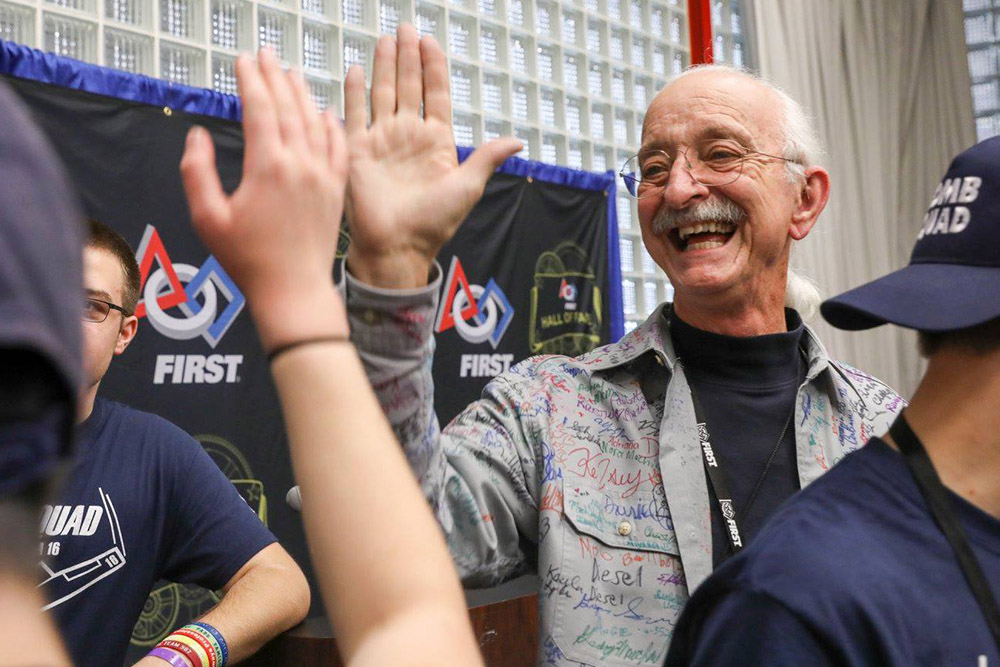
When the late professor emeritus Woodie Flowers SM ’68, MEng ’71, PhD ’73 was a student at MIT, most of his classes involved paper-and-pencil exercises with predetermined solutions. Flowers had an affinity for making things, and for making them work. When he transitioned from student to teacher, he chose to carry this approach into his method of instruction and, in doing so, he helped change the way engineering students are educated — at MIT, and around the world.
Flowers passed away in 2019, but his legacy lives on, and the magnitude of the educational revolution he helped to evolve was profound.
In the 1970s, Flowers took over instruction of 2.70, now called class 2.007 (Design and Manufacturing I). The capstone course is one that many first-year students today look forward to taking, but that wasn’t always the case. Before Flowers took over instruction, class instruction relied heavily on chalkboard demonstrations.
“Their idea of design at the time was to draw drawings of parts,” explains Professor Emeritus David Gossard PhD ’75, Flowers’ longtime friend and colleague. “Woody had a different idea. Give the entire class a kit of materials [and] a common goal, which was to build a machine — to climb a hill, or pick up golf balls, or whatever it did — and make a contest out of it. It was a phenomenal success. The kids loved it, the faculty loved it, the Institute loved it. And over a period of years, it became, I think it’s fair to say, an institution.”
With Flowers at the lead, 2.70 transformed into a project-based, get-your-hands-dirty, robotics-competition-focused experience. By all accounts, he also made the experience incredibly fun — something he valued in his own life. He was fond of skydiving and was often seen rollerblading through the Infinite Corridor. The course, informed by his unique style, was at the forefront of a revolution in engineering education, and it quickly helped solidify the Department of Mechanical Engineering’s reputation for innovative education.
“A lot of kids had never started from scratch and built anything,” Flowers once told The Boston Globe. His advisor, Robert Mann, had similar beliefs in a hands-on, modern pedagogy. Building on Mann’s philosophy, and incorporating his own approach, Flowers breathed new life and provided a new foundation for “the MIT way” of teaching. This was a reinvigoration at the right place and the right time that ultimately had a global butterfly effect on the popularity of science, technology, engineering, and math (STEM) instruction.
“Over the years lectures had displaced the hands-on stuff, and Woodie brought it back,” says Sanjay Sarma, the Fred Fort Flowers (1941) and Daniel Fort Flowers (1941) Professor in Mechanical Engineering. “I can’t think of a single person to have impacted the field of robotics and design in undergraduate, or high school, education as much as Woodie.”
Flowers became interested in mechanical engineering and design at a young age, thanks in large part to his parents. His father was a welder with a penchant for tinkering, inventing, and building, his mother was an elementary school teacher. Flowers grew up taking things apart and putting them back together — an activity which he seemed to believe made students better engineers.
Speaking in 2010 with InfiniteMIT, a digital archive of Institute history made possible by the generosity of Jane and A. Neil Pappalardo ’64, Flowers shared a story about a student who had accepted the task in her group of finding out whether a piece of reinforcement steel rebar could be bent into a tight loop and serve as a bearing.
“She came into lab and I was there early, and she had a slightly bent piece of rebar. It had been heated — you could tell that it had been hot, and she was going to report that she really can’t do that, it just kind of doesn’t work,” Flowers recalled. He suggested they try another approach.
“We went out in the lab and I found another big steel bar and I found the biggest vice I could find,” he continued. Flowers cranked the rebar down against the piece of steel he was going to wrap it around, then took a four-pound sledgehammer to it. “My father had a blacksmith pit, so that was familiar to me. I wrapped [the rebar around the steel and] made a fine bearing. As I finish the last blow, I looked up and three of the best students in the class — really sharp people — were standing there with their jaw open. They’d never seen anyone hit a piece of steel hard enough to just mold it.”
He continued, “that visceral understanding of the behavior of mechanics is really important. It doesn’t fall out of the sky and it certainly doesn’t come out of a textbook, it comes through real interaction. I believe I had been so lucky because when I encountered Castiglione’s theorem about deflection of materials, it kind of made sense.”
Course 2.70/2.007 is considered a landmark class in engineering education. It was one of the first hands-on classes to teach students not only how to design an object, but also how to build it and, by demonstrating the value of practical, project-based learning and robotics competitions, it has influenced the approach taken by many other programs. Today, it continues to develop students’ competence and self-confidence as design engineers, with an emphasis on the creative design process bolstered by application of physical laws, robustness, and manufacturability.
Notably, the course also served as the inspiration for development of the FIRST Robotics program, which Flowers and inventor Dean Kamen started in 1989. FIRST has programs for preschool through high school students and, to date, more than 3.2 million youth from more than 100 countries have participated in FIRST competitions.
In the 1970s, the parts kit — or as Flowers fondly referred to it, the “bag of junk” — included things like springs, tongue depressors, and rubber bands. Flowers’ wife Margaret recalls spending many nights packing these kits and hosting advisees in their home. “We considered ourselves a team,” she says.
Today, in addition to using the kit of mechanical parts and materials, students in 2.007 might develop 3D printed components, and they incorporate electronics in their robots for an autonomous portion of the final competition.
The spring 2024 competition, themed after Cartoon Network’s popular animated science fiction sitcom “Rick and Morty,” featured a spaceship that students’ robots could interact with for points, vats of “acid” where balls could be collected and placed in tubes, and game pieces that paid homage to iconic episodes. The final task required the robot to travel up an elevator and send a character down a zipline.
In recent years, other themes have centered on tasks related to stories ranging from “Star Wars” to “Back to the Future” and “Wakanda Forever.” The 2022 theme, however, may have been the most poignant theme to date: “Legacy,” a celebration of Flowers’ life and work.
“[Woodie] revealed, unambiguously, that designing, fabricating, assembling and building things was fun,” says Gossard. “It was arguably the essence of engineering. There was joy in it.”
A version of this article appears in the Spring 2025 issue of MechE Connects, the magazine of the MIT Department of Mechanical Engineering.
