



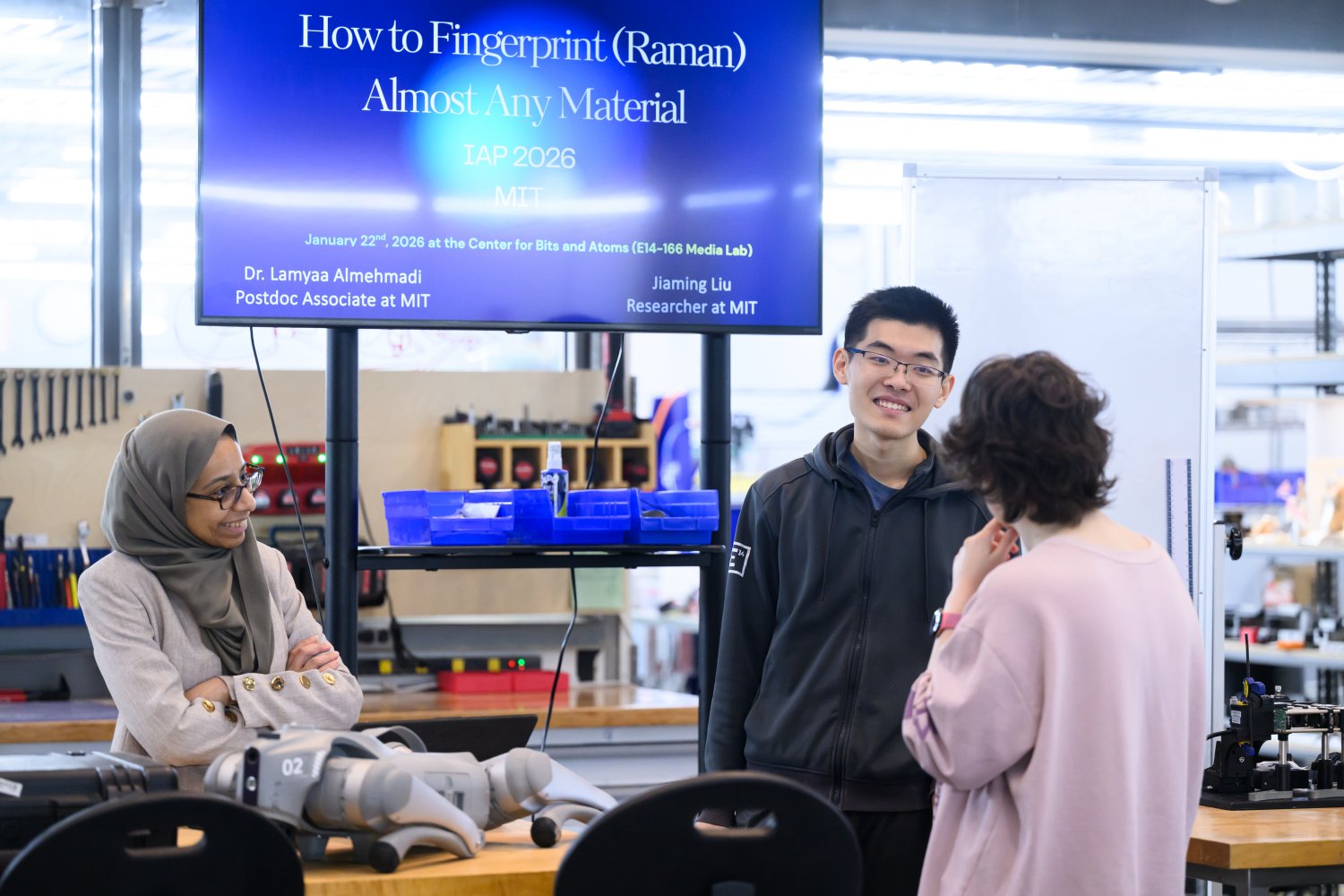
Could a three-hour workshop on an advanced materials analysis technique turn someone into a detective — or perhaps an art restorer?
At MIT’s Center for Bits and Atoms (CBA) in late January, about a dozen students explored that possibility during an Independent Activities Period (IAP) workshop on Raman spectroscopy, a technique that uses laser light to “fingerprint” materials. The session even featured a robotic dog equipped with sensing equipment, demonstrating how chemical analysis can be done remotely.
The workshop, led by MIT postdoc Lamyaa Almehmadi in collaboration with the CBA, introduced participants to a powerful technique now used by law enforcement and first responders to identify narcotics and explosives, by gemologists to authenticate precious stones, and pharmaceutical companies to verify raw materials and ensure product quality. CBA graduate researcher Jiaming Liu co-hosted, delivering lectures, demonstrating Raman equipment, and contributing to the curriculum and hands-on demonstrations.
“It can open up new possibilities for innovation across many fields,” said Almehmadi, an analytical chemist in the Department of Materials Science and Engineering (DMSE). After attendees learned the fundamentals, she encouraged them to think creatively about new applications: “My hope is to inspire all of you to think about doing something with Raman spectroscopy that no one has done before.”
Fingerprinting materials
Participants brought items to class to analyze using handheld devices, which fire laser light and measure how it bounces back. The resulting pattern behaves like a molecular fingerprint, identifying the materials in the item — whether it’s a paper clip, a piece of tree bark, or a mixing bowl.
Workshop attendee Sarah Ciriello, an administrative assistant at DMSE who brought a stone she found at the beach, was taken aback by the results. The Raman device suggested a 39 percent probability that the sample contained concrete-like material, with the remaining readings matching synthetic compounds — blurring the line between natural and manufactured materials.
“It’s man-made — I was surprised,” Ciriello said.
Developed in 1928 by Indian scientist C.V. Raman, who later won the Nobel Prize in Physics, Raman spectroscopy was groundbreaking because it used visible light to probe materials without destroying them, a major advantage over other techniques at the time, such as chromatography or mass spectrometry. But for decades, the Raman signal — the light scattered back from a sample — was weak, and the instruments were big and bulky, limiting its practical use.
Advances in lasers, computing power, and miniaturized optics have transformed Raman spectroscopy into a portable tool. Today’s handheld devices can instantly compare a sample’s molecular fingerprint against vast digital libraries, allowing users to identify thousands of materials in seconds. Because it doesn’t destroy the sample, Raman is especially useful in fields that require preserving materials — such as law enforcement, where evidence must remain intact, and art restoration.
Almehmadi’s own research focuses on advancing Raman spectroscopy by developing highly sensitive, semiconductor-based sensors that make portable chemical analysis possible, with applications ranging from medical diagnostics to forensic and environmental monitoring.
“Raman can be used to analyze any material,” Almehmadi says. “That’s why I decided to introduce it to students from diverse backgrounds.”
IAP classes are open to students and staff across MIT, and the Raman workshop reflected that range — from administrative staff to graduate and undergraduate students and postdocs in departments and labs including DMSE, the Department of Mechanical Engineering, the Media Lab, and the Broad Institute.
Walking the robot dog
A crowd-pleasing element in the workshop was the integration of a robot dog that belongs to the MIT Computer Science and Artificial Intelligence Laboratory (CSAIL). The demonstration highlighted how Raman technology can be used in dangerous environments, such as crime scenes or toxic industrial sites.
The handheld device was secured to the robot using tape, and Almehmadi showed how she could navigate the dog to a plastic bag filled with a white powder — baking soda.
But in a real-world scenario, “How can we know if it is baking soda or not?” she says. “So we just shined the light, and then the instrument told us what it was.”
Participants used a Wi-Fi app on their phones to view the results and a small remote controller to operate the robotic dog themselves.
“I loved the robot dog,” Ciriello says. “I was able to control it a bit, but it was challenging because the gauge was really sensitive.”
Michael Kitcher, a postdoc in DMSE, also praises the robot demonstration.
“Given that we just duct taped the device onto the dog — it was cool to see it actually worked,” he says.
Looking ahead
Kitcher, who researches magnetic materials for electronic applications, joined the workshop to learn more about Raman spectroscopy, which he had read about but never used. He was impressed by its versatility — in addition to the beach stone and baking soda, the device identified materials in a contact lens, cosmetics, and even a diamond.
Although it struggled to analyze a piece of chocolate he brought — other signals from the chocolate interfered — Kitcher sees strong potential for his own research. One area he’s interested in is unconventional magnetic materials, such as altermagnets, with unusual magnetic behavior that researchers hope to better understand and control for more energy-efficient electronics.
“Over the last couple of years, people have been trying to get a better sense of why these materials behave the way they do — how we can control this unconventional magnetic order,” he says. Raman spectroscopy can probe the vibrations of atoms in a material, helping researchers detect patterns in the crystal structure that underlie unusual magnetic behaviors. By understanding these vibrations, scientists could unlock material design rules that enable ultra-fast, low-energy computing.
Hands-on workshops like this — that inspire innovative future applications — Almehmadi says, are at the heart of an MIT education.
“I’ve always learned best by doing,” she says. “Lectures and reading are important, but real understanding comes from hands-on experience.”
