



As the price of solar panels has plummeted in recent decades, installation costs have taken up a greater share of the technology’s overall price tag. The long installation process for solar farms is also emerging as a key bottleneck in the deployment of solar energy.
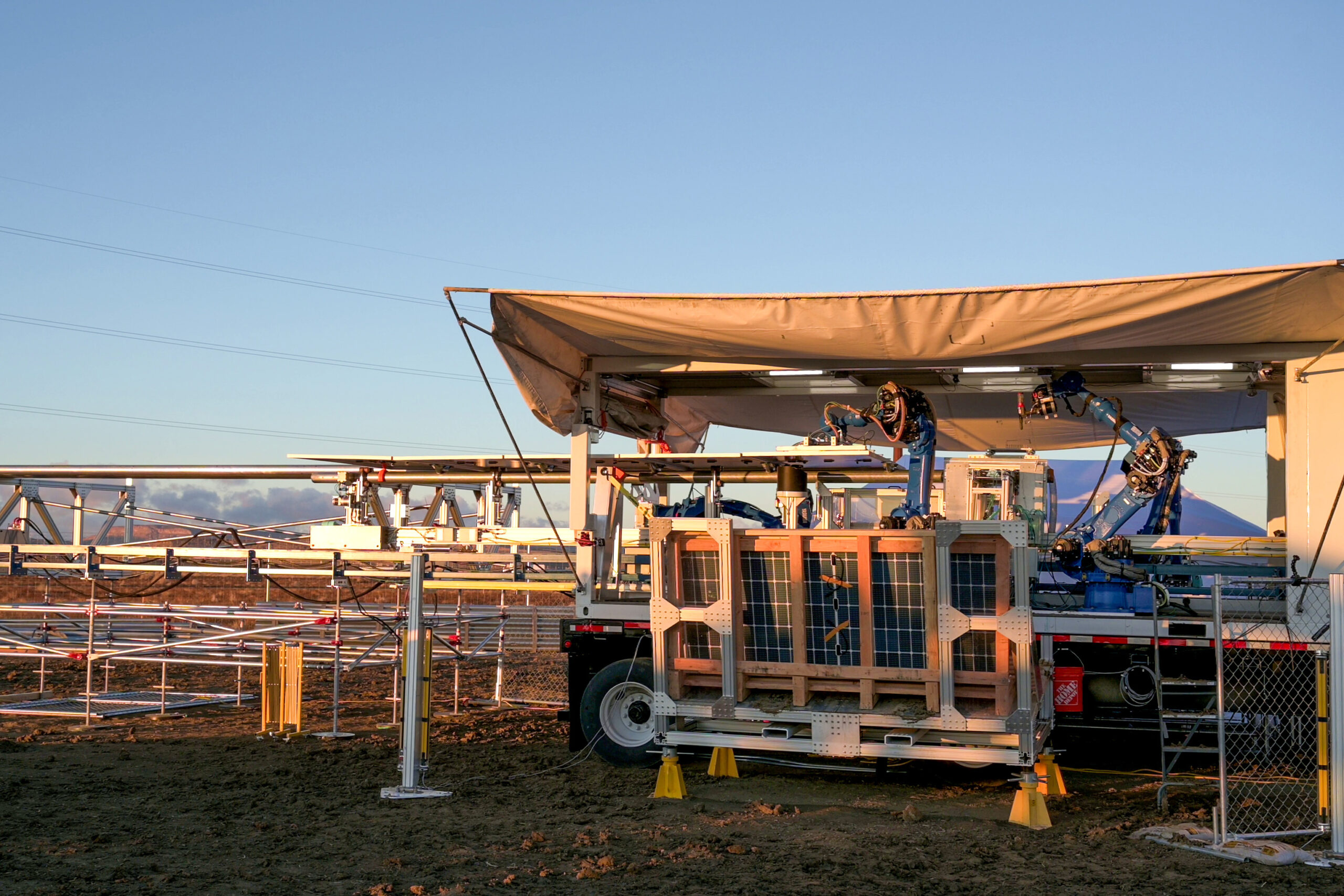
Now the startup Charge Robotics is developing solar installation factories to speed up the process of building large-scale solar farms. The company’s factories are shipped to the site of utility solar projects, where equipment including tracks, mounting brackets, and panels are fed into the system and automatically assembled. A robotic vehicle autonomously puts the finished product — which amounts to a completed section of solar farm — in its final place.
“We think of this as the Henry Ford moment for solar,” says CEO Banks Hunter ’15, who founded Charge Robotics with fellow MIT alumnus Max Justicz ’17. “We’re going from a very bespoke, hands on, manual installation process to something much more streamlined and set up for mass manufacturing. There are all kinds of benefits that come along with that, including consistency, quality, speed, cost, and safety.”
Last year, solar energy accounted for 81 percent of new electric capacity in the U.S., and Hunter and Justicz see their factories as necessary for continued acceleration in the industry.
The founders say they were met with skepticism when they first unveiled their plans. But in the beginning of last year, they deployed a prototype system that successfully built a solar farm with SOLV Energy, one of the largest solar installers in the U.S. Now, Charge has raised $22 million for its first commercial deployments later this year.
From surgical robots to solar robots
While majoring in mechanical engineering at MIT, Hunter found plenty of excuses to build things. One such excuse was Course 2.009 (Product Engineering Processes), where he and his classmates built a smart watch for communication in remote areas.
After graduation, Hunter worked for the MIT alumni-founded startups Shaper Tools and Vicarious Surgical. Vicarious Surgical is a medical robotics company that has raised more than $450 million to date. Hunter was the second employee and worked there for five years.
“A lot of really hands on, project-based classes at MIT translated directly into my first roles coming out of school and set me up to be very independent and run large engineering projects,” Hunter says, “Course 2.009, in particular, was a big launch point for me. The founders of Vicarious Surgical got in touch with me through the 2.009 network.”
As early as 2017, Hunter and Justicz, who majored in mechanical engineering and computer science, had discussed starting a company together. But they had to decide where to apply their broad engineering and product skillsets.
“Both of us care a lot about climate change. We see climate change as the biggest problem impacting the greatest number of people on the planet,” Hunter says. “Our mentality was if we can build anything, we might as well build something that really matters.”
In the process of cold calling hundreds of people in the energy industry, the founders decided solar was the future of energy production because its price was decreasing so quickly.
“It’s becoming cheaper faster than any other form of energy production in human history,” Hunter says.
When the founders began visiting construction sites for the large, utility-scale solar farms that make up the bulk of energy generation, it wasn’t hard to find the bottlenecks. The first site they traveled to was in the Mojave Desert in California. Hunter describes it as a massive dust bowl where thousands of workers spent months repeating tasks like moving material and assembling the same parts, over and over again.
“The site had something like 2 million panels on it, and every single one was assembled and fastened the same way by hand,” Hunter says. “Max and I thought it was insane. There’s no way that can scale to transform the energy grid in a short window of time.”
Hunter says he heard from each of the largest solar companies in the U.S. that their biggest limitation for scaling was labor shortages. The problem was slowing growth and killing projects.
Hunter and Justicz founded Charge Robotics in 2021 to break through that bottleneck. Their first step was to order utility solar parts and assemble them by hand in their backyards.
“From there, we came up with this portable assembly line that we could ship out to construction sites and then feed in the entire solar system, including the steel tracks, mounting brackets, fasteners, and the solar panels,” Hunter explains. “The assembly line robotically assembles all those pieces to produce completed solar bays, which are chunks of a solar farm.”
Each bay represents a 40-foot piece of the solar farm and weighs about 800 pounds. A robotic vehicle brings it to its final location in the field. Hunter says Charge’s system automates all mechanical installation except for the process of pile driving the first metal stakes into the ground.
Charge’s assembly lines also have machine-vision systems that scan each part to ensure quality, and the systems work with the most common solar parts and panel sizes.
From pilot to product
When the founders started pitching their plans to investors and construction companies, people didn’t believe it was possible.
“The initial feedback was basically, ‘This will never work,’” Hunter says. “But as soon as we took our first system out into the field and people saw it operating, they got much more excited and started believing it was real.”
Since that first deployment, Charge’s team has been making its system faster and easier to operate. The company plans to set up its factories at project sites and run them in partnership with solar construction companies. The factories could even run alongside human workers.
“With our system, people are operating robotic equipment remotely rather than putting in the screws themselves,” Hunter explains. “We can essentially deliver the assembled solar to customers. Their only responsibility is to deliver the materials and parts on big pallets that we feed into our system.”
Hunter says multiple factories could be deployed at the same site and could also operate 24/7 to dramatically speed up projects.
“We are hitting the limits of solar growth because these companies don’t have enough people,” Hunter says. “We can build much bigger sites much faster with the same number of people by just shipping out more of our factories. It’s a fundamentally new way of scaling solar energy.”
