



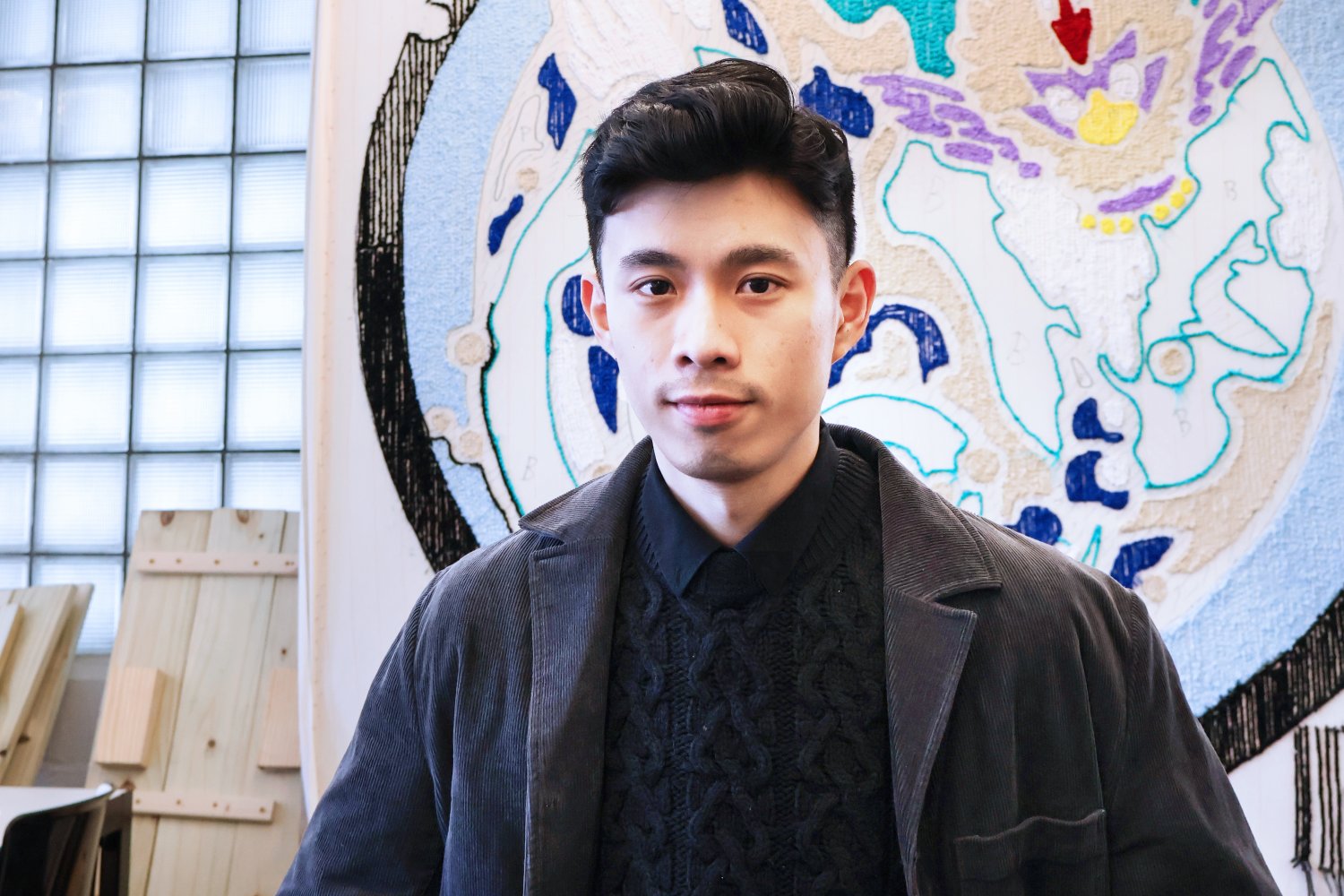
The speed with which new technologies hit the market is nothing compared to the speed with which talented researchers find creative ways to use them, train them, even turn them into things we can’t live without. One such researcher is MIT MAD Fellow Alexander Htet Kyaw, a graduate student pursuing dual master’s degrees in architectural studies in computation and in electrical engineering and computer science.
Kyaw takes technologies like artificial intelligence, augmented reality, and robotics, and combines them with gesture, speech, and object recognition to create human-AI workflows that have the potential to interact with our built environment, change how we shop, design complex structures, and make physical things.
One of his latest innovations is Curator AI, for which he and his MIT graduate student partners took first prize — $26,000 in OpenAI products and cash — at the MIT AI Conference’s AI Build: Generative Voice AI Solutions, a weeklong hackathon at MIT with final presentations held last fall in New York City. Working with Kyaw were Richa Gupta (architecture) and Bradley Bunch, Nidhish Sagar, and Michael Won — all from the MIT Department of Electrical Engineering and Computer Science (EECS).
Curator AI is designed to streamline online furniture shopping by providing context-aware product recommendations using AI and AR. The platform uses AR to take the dimensions of a room with locations of windows, doors, and existing furniture. Users can then speak to the software to describe what new furnishings they want, and the system will use a vision-language AI model to search for and display various options that match both the user’s prompts and the room’s visual characteristics.
“Shoppers can choose from the suggested options, visualize products in AR, and use natural language to ask for modifications to the search, making the furniture selection process more intuitive, efficient, and personalized,” Kyaw says. “The problem we’re trying to solve is that most people don’t know where to start when furnishing a room, so we developed Curator AI to provide smart, contextual recommendations based on what your room looks like.” Although Curator AI was developed for furniture shopping, it could be expanded for use in other markets.
Another example of Kyaw’s work is Estimate, a product that he and three other graduate students created during the MIT Sloan Product Tech Conference’s hackathon in March 2024. The focus of that competition was to help small businesses; Kyaw and team decided to base their work on a painting company in Cambridge that employs 10 people. Estimate uses AR and an object-recognition AI technology to take the exact measurements of a room and generate a detailed cost estimate for a renovation and/or paint job. It also leverages generative AI to display images of the room or rooms as they might look like after painting or renovating, and generates an invoice once the project is complete.
The team won that hackathon and $5,000 in cash. Kyaw’s teammates were Guillaume Allegre, May Khine, and Anna Mathy, all of whom graduated from MIT in 2024 with master’s degrees in business analytics.
In April, Kyaw will give a TedX talk at his alma mater, Cornell University, in which he’ll describe Curator AI, Estimate, and other projects that use AI, AR, and robotics to design and build things.
One of these projects is Unlog, for which Kyaw connected AR with gesture recognition to build a software that takes input from the touch of a fingertip on the surface of a material, or even in the air, to map the dimensions of building components. That’s how Unlog — a towering art sculpture made from ash logs that stands on the Cornell campus — came about.

Play video
Gesture Recognition for Feedback-Based Mixed Reality and Robotic Fabrication of the Unlog Tower
Video: Alexander Htet Kyaw
Unlog represents the possibility that structures can be built directly from a whole log, rather than having the log travel to a lumber mill to be turned into planks or two-by-fours, then shipped to a wholesaler or retailer. It’s a good representation of Kyaw’s desire to use building materials in a more sustainable way. A paper on this work, “Gestural Recognition for Feedback-Based Mixed Reality Fabrication a Case Study of the UnLog Tower,” was published by Kyaw, Leslie Lok, Lawson Spencer, and Sasa Zivkovic in the Proceedings of the 5th International Conference on Computational Design and Robotic Fabrication, January 2024.
Another system Kyaw developed integrates physics simulation, gesture recognition, and AR to design active bending structures built with bamboo poles. Gesture recognition allows users to manipulate digital bamboo modules in AR, and the physics simulation is integrated to visualize how the bamboo bends and where to attach the bamboo poles in ways that create a stable structure. This work appeared in the Proceedings of the 41st Education and Research in Computer Aided Architectural Design in Europe, August 2023, as “Active Bending in Physics-Based Mixed Reality: The Design and Fabrication of a Reconfigurable Modular Bamboo System.”
Kyaw pitched a similar idea using bamboo modules to create deployable structures last year to MITdesignX, an MIT MAD program that selects promising startups and provides coaching and funding to launch them. Kyaw has since founded BendShelters to build the prefabricated, modular bamboo shelters and community spaces for refugees and displaced persons in Myanmar, his home country.
“Where I grew up, in Myanmar, I’ve seen a lot of day-to-day effects of climate change and extreme poverty,” Kyaw says. “There’s a huge refugee crisis in the country, and I want to think about how I can contribute back to my community.”
His work with BendShelters has been recognized by MIT Sandbox, PKG Social Innovation Challenge, and the Amazon Robotics’ Prize for Social Good.
At MIT, Kyaw is collaborating with Professor Neil Gershenfeld, director of the Center for Bits and Atoms, and PhD student Miana Smith to use speech recognition, 3D generative AI, and robotic arms to create a workflow that can build objects in an accessible, on-demand, and sustainable way. Kyaw holds bachelor’s degrees in architecture and computer science from Cornell. Last year, he was awarded an SJA Fellowship from the Steve Jobs Archive, which provides funding for projects at the intersection of technology and the arts.
“I enjoy exploring different kinds of technologies to design and make things,” Kyaw says. “Being part of MAD has made me think about how all my work connects, and helped clarify my intentions. My research vision is to design and develop systems and products that enable natural interactions between humans, machines, and the world around us.”
