



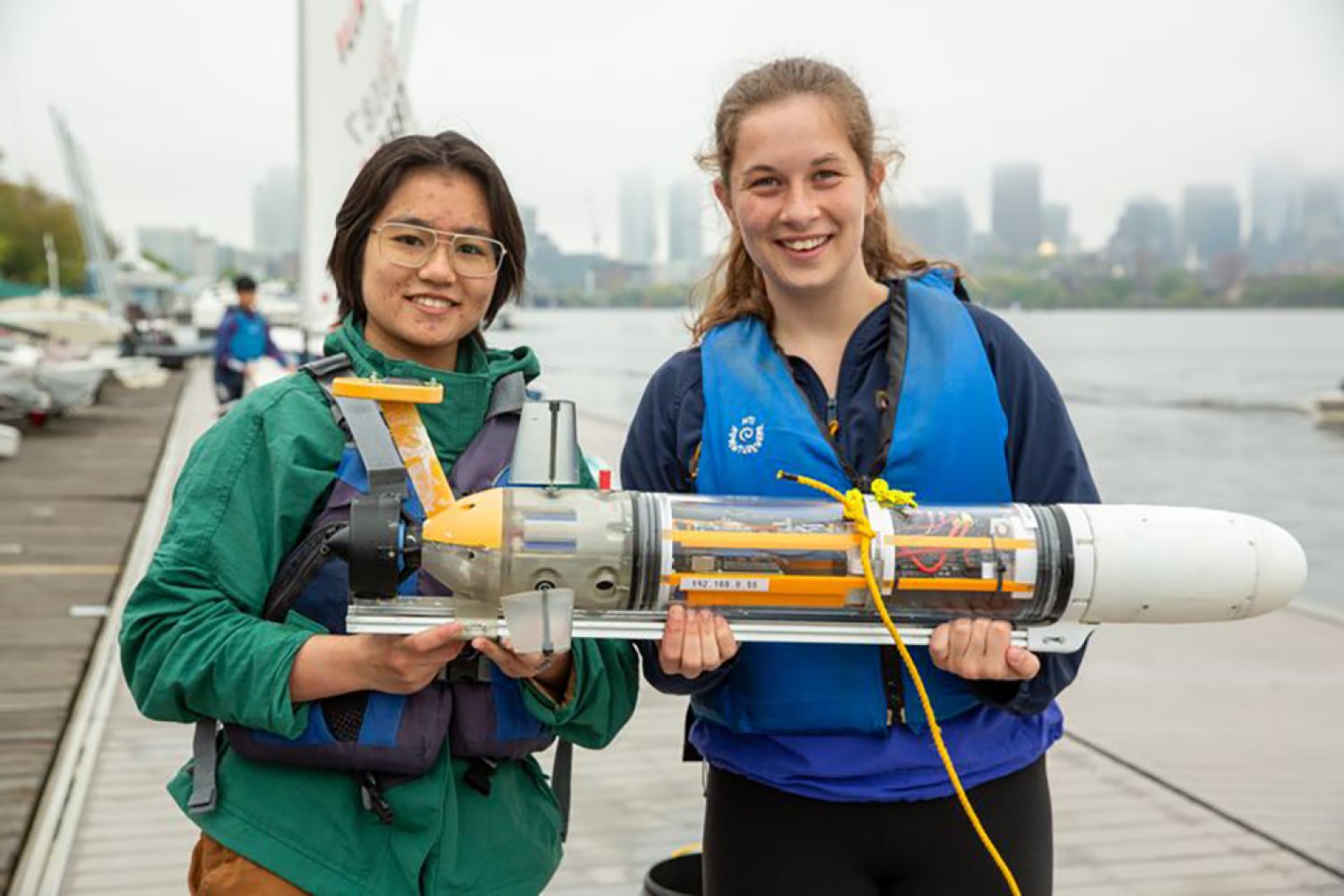
When Michael Benjamin, principal research scientist in the MIT Center for Ocean Engineering, arrived at MIT 25 years ago, only professors and postdocs were allowed to touch the department’s underwater vehicles. The vehicles were expensive, he explains, and required extensive training to operate.
“People were scared to death about losing or damaging them, [and] there was no education pipeline to teach students,” he says, adding that the introduction of class 2.680 (Marine Autonomy, Sensing, and Communication) changed this a lot, by creating a class where undergraduate and graduate students could learn to write autonomy code, and run their software on robots on the Charles River. The addition of class 2.S01 (Introduction to Autonomous Underwater Vehicles) last year took the hands-on learning opportunities even further.
“2.S01 is a return to our roots: underwater vehicles. We wanted to create a learning environment where every student handles a robot, and no one is afraid about losing one,” he says. Each student is sent home with an electronics kit, which Benjamin calls the heart of the robot. “They can experiment all they want in their dorm room, and we’ll give them another kit if they break it.”
The AUVs and student test kits in 2.S01 were designed and built by Supun Randeni, a research scientist in mechanical engineering and the primary lecturer and content creator of 2.S01, and Captain Michael Sacarny from MIT Sea Grant. “Dr. Randeni and Captain Sacarny are the geniuses behind the class,” says Benjamin. Together, Randeni and Sacarny run the hands-on lab instruction.
The goal is to expand education and research opportunities to include a larger and younger group of students. “It’s the exact opposite of 25 years ago, when only a privileged few people were allowed to get inside the robot,” says Benjamin. “Student growth and interest is directly related to the degree they have ‘ownership’ of their robot. Physical possession, but also responsibility for its safe operation and return.”
2.S01 provides students with an in-depth insight into autonomous underwater vehicles (AUVs), by introducing theoretical and practical aspects of the AUV design process. This includes fundamentals of naval architecture, electrical systems design, mechanical design, and software design. Students assemble their own AUVs by using a kit of parts and guidance from instructors, beginning with core electronics and building out a full vehicle for deployment in the Charles River on the MIT campus in the final weeks.
Among the activities, students engage in waterproofing vacuum tests, pre-launch sub-system tests, and dockside tests for ballasting, all followed by in-water low-level control tuning runs. Students also construct autonomy missions — first in simulation, followed by in-water autonomous missions to conduct an environmental survey in the Charles River. The course’s final labs include group competitions involving in-water challenges. For the second iteration of the course, which starts in late March, the instructors plan to add more labs that allow the students to explore the intricacies of the electronic, more simulations options, and more water time.
Adowyn Bryne, a second-year mechanical engineering (MechE) student, took the course last year as a member of the first cohort, but this wasn’t her first experience with underwater vehicles. She’d participated in a SeaPerch program in high school. “I chose 2.S01 because I wanted to learn about more complex underwater vehicles,” says Bryne. “I didn’t find out until later in the semester that SeaPerch was actually started at MIT Sea Grant!”
Benjamin says he hopes there are a few things that first-year students take away from participating in 2.S01: first, an understanding that marine robotics is a very cross-disciplinary effort, involving mechanical engineering, electrical engineering, control theory, computer science and ocean science; and, second, the opportunity to view the effort as a gateway to exploring and understanding the ocean. Students says it’s that, and so much more.
Isabella Yeung, a third-year Course 12 student, took the class during her sophomore year after participating in an MIT Undergraduate Research Opportunities Program (UROP) in the MIT Sea Grant Bio Lab with Carolina Bastidas. Bastidas is a research scientist in MIT Sea Grant’s Marine Advisory Services group.
“While UROP-ing, I’d seen many AUVs and other projects being developed at MIT Sea Grant,” Yeung says. “I was curious to learn more and have a deeper insight into what they were doing. This class was a prime opportunity to jump into the world of marine robotics without having any background in Course 2.”
She called the course “easily one of the most hands-on (and downright fun) classes” she’s ever taken, adding that she appreciated having the opportunity to assemble and deploy the AUV.
“As someone who enjoys tinkering, I appreciated the opportunity to get my hands dirty — quite literally, with grease and Charles [River] water,” says Yeung. “I looked forward to all of the classes, especially the deployment sessions. Nothing quite matched the sheer rush of launching our program, rushing to drop the AUV into the Charles, and engaging in a boat chase, hoping it hadn’t gone rogue.”
Bryne advises students considering the course to not worry too much if the class lines up with a particular career path they’re considering. “Your first year is about exploring. If you’re interested in the class, take it! You might find a new area of interest. Regardless of whether you want to keep learning about AUVs, you’ll get valuable transferable skills and have a lot of fun.”
Bryne, herself, says the experience is helping to set the stage for exploring future interests and opportunities. “Every time I’ve gotten to do something with robots, I’ve loved it,” she says, “but I’m also very passionate about women’s health. I want to design medical technology specifically for women, but I definitely think there’s room to incorporate robotics into that. It’s great that MechE is such a broad field, and that the curriculum at MIT allows me to explore so many potential areas of study.”
